Global Plants
Skip to Main Content
Global Plants
Browse
About
Access
Account
Saved Items
Profile
Log in
Browse
About
Access
Account
Saved Items
Profile
Filter search by
Names
Names with Synonyms
Places
People
Free Text
Search
Search
Advanced Search
Compilation
Marshallia grandiflora
3 Images
see all
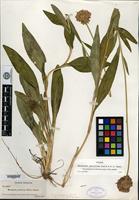
Isotype of Marshallia grandiflora Beadle & Boynton [family ASTERACEAE]
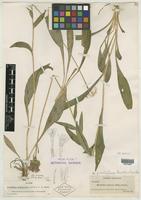
Isotype of Marshallia grandiflora Beadle & F. E. Boynton [family ASTERACEAE]
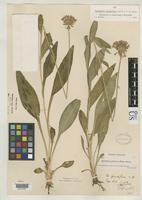
Isotype of Marshallia grandiflora Beadle, C.D. & Boynton, C.L. 1901 [family ASTERACEAE]
Previous
Next
Name
Identification
Isotype of Marshallia grandiflora
Beadle & Boynton
[family
ASTERACEAE
] (stored under name); Verified by Beadle & Boynton,
1901
Related name
Marshallia grandiflora
Flora
Entry for Marshallia grandiflora Beadle & F. E. Boynton [family COMPOSITAE]
Herbarium
Flora of North America (FNA)
Collection
Flora of North America
Resource Type
Reference Sources
Entry From
Flora of North America, Vol 21,
Names
Marshallia grandiflora
Beadle & F. E. Boynton
[family
COMPOSITAE
], Biltmore Bot. Stud., 1: 7, plate 1. 1901
Treatment Author(s)
Linda E. Watson
Information
Plants 20–90 cm. Leaves mostly basal; basal petiolate (distal sessile, reduced); blades 3-nerved, ± elliptic, broadly oblanceolate, or spatulate, 12–25 cm × 14–19 mm. Heads 1–2, 26–45 mm diam. Peduncles 10–20 cm. Phyllaries 8–11 × 2–4 mm, apices acute. Paleae ± linear, apices acute. Corollas pink, lobes 3–7 × 0.5–0.8 mm. Pappi: scale margins serrulate. 2n = 18.
Conservation Status
of conservation concern;
Phenology
may (spring), jun (summer)
Altitude range
500–1500 m;
Distribution
USA Ky.USA N.C.USA Pa.USA Tenn.USA W.Va.
Discussion
Marshallia grandiflora grows in the Appalachian Mountains. It is in the Center for Plant Conservation’s National Collection of Endangered Plants.
Related Materials
╳