

Compilation
Markhamia paucifoliolata
1 Images see all
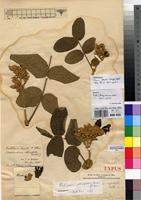
Name
Identification
Markhamia paucifoliolata De Wild. [family BIGNONIACEAE ] Verified by Not on sheet, Markhamia obtusifolia (Baker) Sprague [family BIGNONIACEAE ] (stored under name); Verified by Liben L., 1984
Related name
- Markhamia obtusifolia
- Markhamia paucifoliolata
Flora
Entry for Markhamia obtusifolia (Bak.) Sprague [family BIGNONIACEAE]
Herbarium
Royal Botanic Gardens, Kew (K)
Collection
Flora of Tropical East Africa
Resource Type
Reference Sources
Entry From
Flora of Tropical East Africa, page 1, (2006) Author: SALLY BIDGOOD, BERNARD VERDCOURT & KAJ VOLLESEN
Names
Markhamia obtusifolia (Bak.) Sprague [family BIGNONIACEAE], in K.B. 1919: 312 (1919); T.T.C.L.: 71 (1949); K.T.S.: 62 (1961); F.F.N.R.: 379 (1962); Liben. F.A.C., Bignon: 32, t.8, A–C (1977); Vollesen in Opera Bot. 59: 78 (1980); Palgrave, Trees S. Afr.: 831 (1981); Diniz in F.Z. 8(3): 76, t. 143 (1988) & C.F.A. 122 Bignon.: 23 (1993). Type: Mozambique, Shupanga, Kirk s.n. (K!, lecto.), chosen by Diniz
Dolichandrone obtusifolia Bak. [family BIGNONIACEAE], in K.B. 1894: 31 (1873)**
Markhamia lanata K.Schum. [family BIGNONIACEAE], in E. & P., Pf. 4 (3b): 242 (1895); Sprague in Hook. Ic. 28: t. 2800, fig. 8 (1905); Sprague in F.T.A. 4(2): 527 (1906). Type: Tanzania, unspecified syntypes (B†) (see note)
Markhamia paucifoliolata De Wild. [family BIGNONIACEAE], in Ann. Mus. Congo, Bot., sér. 4(1): 131 (1903). Type: Congo-Kinshasa, Lukafu, Verdick 54 (BR, holo.)
Markhamia verdickii De Wild. [family BIGNONIACEAE], in Ann. Mus. Congo, Bot., sér. 4(1): 132 (1903). Type: Congo-Kinshasa, Lofoi, Verdick s.n. (BR, holo.)
Markhamia tomentosa [family BIGNONIACEAE], sensu K.Schum. in Engl., Abhandl. K. Preuss. Akad. Wiss. Berlin, Phys. Math. K 1894: 34, 39 (1894) pro parte & in E.J. 28: 480 (1900), non (Benth.) K.Schum.
Information
Shrub 1.5–3.5 m tall or small tree 5–15(?–20) m tall*, freely regenerating; bark pale brown or grey, smooth or somewhat striated or ridged in larger trees; young branches golden brown velvety tomentose, soon glabrescent. Leaves 18–56 cm long; leaflets (1–)3–5(–6)-jugate, oblong, elliptic, ovate or obovate, (4.5–)6.5–18(–23)≈2.5–9.5(–13.5) cm, cuneate, rounded or subcordate at the base, entire or very slightly serrate, rounded or obtuse to very shortly acuminate at the apex, puberulous or pubescent above, densely woolly velvety beneath; petiole 2–9.5 cm long; petiolules 0–2 mm long; pseudostipules subulate, 0.5–1.3 cm long, tomentose. Flowers in dense tomentose terminal panicles, at first tight clusters ± 8 cm long, later 10–30(–40) cm long; pedicels 1–2.8 cm long, bracts 0.5–1(–1.5) cm long; buds ± uncinate; calyx 1.9–3.3(–4) cm long, 1.5–2.5 cm wide, obtusely cuspidate or uncinate, split to about 4–8 mm from the base, densely golden tomentose. Corolla bright yellow or orange-yellow with maroon guide lines in throat and maroon stripes or spots on 3 lower lobes; tube 3.5–4.5 cm long with lobes 1.5–3 cm long and wide and upper part of tube with conspicuous glands. Capsule nearly straight or curved, (20–)39–87 cm long, 1.4–2.8 cm wide, with prominent longitudinal median ridge on valves and marginal ones near sutures, densely golden velvety tomentose; seeds narrowly oblong, 3–4 cm long, 0.7–1.2 cm wide including the wing. Fig. 8, p. 36.
Range
DISTR. T 1–8
Altitude range
(0–)250–2050 m
Distribution
TANZANIA Lushoto District Korogwe, 19 Dec. 1962, Archbold 85!TANZANIA Morogoro District ± 29 km N of Morogoro along Dodoma road, 14 Mar. 1988, Bidgood et al 428!TANZANIA Lindi District Nachingwea, 17 Nov. 1949, Anderson 546!
Distribution (external)
Congo-Kinshasa
Rwanda
Burundi
Angola
Zambia
Malawi
Mozambique
Zimbabwe
Botswana
Namibia
South Africa
cultivated in Nairobi
Notes
K. Schumann merely gives ‘aus den Steppen Ostafrikas’ for his M. lanata but it is almost certain that Fischer 461 (Kagehi), Buchwald 697 (Usambaras), Holst 2228 (E Usambaras, Magila) and Busse 50 (probably T 3) are all syntypes; duplicates of the last three at Kew are isosyntypes. M. obtusifolia has been cultivated as an ornamental in Kenya (Nairobi, 1942, Bally 6168).