

Compilation
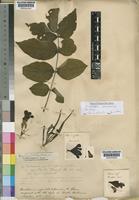
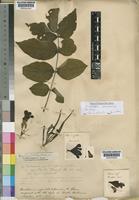
Markhamia infundibuliformis
2 Images see all
Name
Identification
Markhamia infundibuliformis K.Schum. [family BIGNONIACEAE ] Markhamia acuminata (Klotzsch) K.Schum. [family BIGNONIACEAE ] (stored under name); Markhamia zanzibarica (DC.) Engl. [family BIGNONIACEAE ] Verified by Verdcourt, B., Dolichandrone unrecorded unrecorded [family BIGNONIACEAE ]
Related name
- Markhamia infundibuliformis
- Markhamia zanzibarica
- Dolichandrone unrecorded
- Markhamia acuminata
Flora
Entry for Markhamia zanzibarica (DC.) Engl. [family BIGNONIACEAE]
Herbarium
Royal Botanic Gardens, Kew (K)
Collection
Flora of Tropical East Africa
Resource Type
Reference Sources
Entry From
Flora of Tropical East Africa, page 1, (2006) Author: SALLY BIDGOOD, BERNARD VERDCOURT & KAJ VOLLESEN
Names
Markhamia zanzibarica (DC.) Engl. [family BIGNONIACEAE], Abh. Königl. Preuss. Akad. Wiss. Berl. 1894: 16 (1894); K. Schum. in E. & P., Pf. 4 (3b): 242 (1895) & in P.O.A. C: 363 (1895); Sprague in F.T.A. 4 (2): 523 (1906) & in K.B. 1919: 313 (1919); T.T.C.L.: 72 (1949); K.T.S.: 64 (1961); Haerdi in Acta Trop., suppl. 8: 149 (1964); Liben, F.A.C. Bignon.: 26 (1977); Vollesen in Opera Bot. 59: 78 (1980); Diniz in F.Z. 8(3): 74, t. 14A (1988) & C.F.A. 122, Bignon.: 21 (1993); K.T.S.L.: 592, map (1994); Tardelli & Settesoldi in Fl. Som. 3: 304, fig. 210 (2006). Type: Zanzibar, Bojer s.n.(G, holo.)
Spathodea zanzibarica DC. [family BIGNONIACEAE], Prodr. 9: 208 (1845); Klotzsch in Peters, Reise Mossamb., Bot. 1: 191 (1861)
Spathodea acuminata Klotzsch [family BIGNONIACEAE], in Peters, Reise Mosamb., Bot. 1: 191 (1861). Type: Mozambique, Tete, Rios de Sena, Peters s.n. (B†, holo.)
Spathodea puberula Klotzsch [family BIGNONIACEAE], in Peters, Reise Mossamb., Bot. 1: 192 (1861). Type: Mozambique, Tete, Rios de Sena, Peters s.n. (B†, holo.)
Muenteria stenocarpa Seem. [family BIGNONIACEAE], in J.B. 8: 329, t.36 (1865). Types: Angola, Pungo Andongo, Mata de Cabondo, Welwitsch 483 (LISU, syn; BM!, COI, K!, isosyn.) & Golungo Alto, Luinha R. and near Cambondo, Welwitsch 482 (LISU, syn.; BM!, K!, isosyn.)
Dolichandrone hirsuta Bak. [family BIGNONIACEAE], in K.B. 1894: 31 (1894). Type: Mozambique, Tete, banks of the lower Zambesi, Kirk s.n. (K!, holo.)
Dolichandrone latifolia Bak. [family BIGNONIACEAE], in K.B. 1894: 31 (1894). Type: Kenya, Nyika Country, Wakefield s.n. (K!, holo & iso.)
Dolichandrone stenocarpa (Seem.) Bak. [family BIGNONIACEAE], in K.B. 1894: 31 (1894)
Markhamia acuminata (Klotzsch) K.Schum. [family BIGNONIACEAE], in P.O.A. C: 363 (1895); Sprague in F.T.A. 4(2): 524 (1906) & in K.B. 1919: 313 (1919); T.T.C.L.: 71 (1949); Pardy in Rhod. Agric. J. 53: 58, illustr. (1956); F.F.N.R.: 379 (1962); Palmer & Pitman, Trees S. Afr. 3: 2009, figs. (1967); Vollesen in Opera Bot. 59: 77 (1980); Palgrave, Trees S. Afr.: 831 (1981)
Markhamia puberula (Klotzsch) K.Schum. [family BIGNONIACEAE], in E. & P., Pf. 4(3b): 242 (1895); Sprague in F.T.A. 4(2): 523 (1906) & in K.B. 1919: 312 (1919)
Markhamia stenocarpa (Seem.) K.Schum. [family BIGNONIACEAE], in E. & P., Pf. 4(3b): 242 (1895); Sprague in F.T.A. 4 (2): 524 (1906) & in K.B. 1919: 313 (1919)
Markhamia infundibuliformis K.Schum. [family BIGNONIACEAE], in E. & P., Pf. 4(3b): 242 (1895) & in P.O.A. C: 363 (1895); Sprague in F.T.A. 4(2): 524 adnot. (1906). Type: Tanzania, Singida District, Ussure, Fischer 460 (B†, holo.)
Information
Shrub or much branched small tree, 2.4–9(?–15) m tall, readily regenerating after cutting; bark pale grey, smooth or rough, peeling; young branches usually lenticellate, minutely scaly. Leaves up to 35 cm long; leaflets 1–4-jugate or rarely reduced to the terminal leaflet, elliptic, elliptic-lanceolate, obovate, ovate or almost round, 2–25(–33)≈2–13 cm, acute to long-acuminate or obtuse to rounded at the apex, cuneate to rounded at the base, almost entire to toothed or rarely almost lobed, glabrous in typical coastal specimens save for pubescent axillary domatia usually present beneath, pubescent to densely velvety in (mostly) inland material, densely to sparsely lepidote; petiole 2–7(–9) cm long, sometimes together with rhachis faintly winged; petiolules 0–5 mm long; pseudostipules if present rounded to reniform, 0.5–2.5 cm long and wide. Flowers in terminal or axillary rather narrow lepidote panicles 2–11(–30) cm long; secondary peduncles up to 1 cm long, pedicels 0.5–1.5(–2) cm long with bracts 2–5(–7) mm long. Calyx 1–1.5 cm long, rounded, cuspidate or uncinate at the apex, split to about 8 mm from base, usually glabrous but densely hairy in some variants. Corolla yellow-green to yellow, the tube ± densely speckled with liver red or reddish purple spots and blotches and the lobes dull brown to reddish purple inside and speckled outside (often mostly purplish or brown with reduced yellow markings); tube campanulate to funnel-shaped, (1.8–)2–3(–4) cm long, limb ± 2–lipped, 5-lobed, the lobes rounded, 1–1.5 cm long and wide; discoid glands present at top of tube and on the lobes, probably greenish in life but dark when dry. Capsule straight or curved, 14–72≈0.9–1.8 cm, glabrous, usually with very conspicuous whitish lenticels; seeds 2–4 cm long, 4–6 mm wide including wing.
Range
DISTR. K 7; T 1–8; Z, P
Altitude range
0–1350 m
Distribution
KENYA Kwale District Mrima Hill, 5 Mar. 1977, R.B. & A.J. Faden 77/673!KENYA Kilifi District 6.5 km N of Malindi, Sabaki, 3 Nov. 1961, Polhill & Paulo 712!KENYA Lamu District 4 km S of Shakani ruins, NE of Kiunga, 5 Apr. 1980, Gilbert & Kuchar 5876!TANZANIA Pangani District Bushiri, 18 Sept. 1950, Faulkner 704!TANZANIA Morogoro District Morogoro, 14 Dec. 1933, B.D. Burtt 4998!TANZANIA Masasi District just W of Bangala R., 16 Dec. 1955, Milne-Redhead & Taylor 7677!TANZANIA Zanzibar Kokotoni, Oct. 1873, Hildebrandt 977!
Distribution (external)
Somalia
Angola
Zambia
Malawi
Mozambique
Zimbabwe
Botswana
northern South Africa
cultivated in northern Australia
Notes
As treated here, following Diniz in F.Z., this species is extremely variable particularly in the shape, toothing and indumentum of the leaves. However, it has not been possible to divide it satisfactorily into infraspecific entities. Despite Diniz’s comment about the leaves (“or even glabrous”) the species is typically glabrous, material from the type locality and lowland coastal areas of Kenya and Tanzania having almost uniformly glabrous somewhat thick more evergreen leaves, with rare exceptions (e.g. Tanner 9, Pangani District, Msubugwe Forest and Harris 1544, Uzaramo District, 20 km NW of Dar es Salaam, Wazo Hill). Away from the coast material has puberulous to velvety leaves, glabrous to velvety calyces and much variation in leaf-size but no geographical correlation can be found. Very velvety variants could be given a varietal name based on Dolichandrone hirsuta Bak. A distinctive variant is Greenway & Kanuri 14441 (Iringa District, Ruaha National Park, Kinyantupa track) with rounded or oblanceolate leaflets 10–12 cm wide and distinctly lobed-crenate; other material from the same area is similar. A detailed field study of the species throughout its range may reveal characters not evident from herbarium material. Richards 24747 (T2) reports flowers pale cream. Jex-Blake, Gard. E. Afr.: 350 (1957) mentions this, but we have not been able to trace any cultivated material.