JSTOR Global Plants Home
  • Home
  • Browse
  • About
  • Access
  • Account
    • Saved Items
    • Profile
  • Log in

Global Plants

Skip to Main Content
  • JSTOR Global Plants Home
  • Global Plants

    • Browse
    • About
    • Access
    • Account
      • Saved Items
      • Profile
Log in
  • Browse
  • About
  • Access
  • Account
    • Saved Items
    • Profile
Advanced Search

Compilation
Markhamia acuminata

5 Images see all

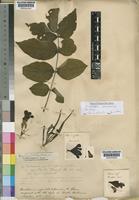
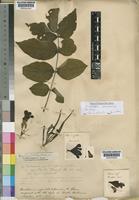
Type of Markhamia zanzibarica Klotzsch [family BIGNONIACEAE]
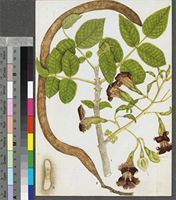
Markhamia acuminata (Klotzsch) K.Schum. original illustration from the 'Trees of Central Africa'
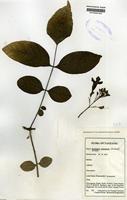
Markhamia acuminata (Klotzsch) K.Schum. [family BIGNONIACEAE]
[family ]
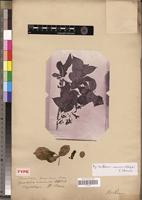
Type of Markhamia infundibuliformis K.Schum. [family BIGNONIACEAE]
Previous
Next

Name

Identification
Markhamia acuminata (Klotzsch) K.Schum. [family BIGNONIACEAE ]
Related name
  • Markhamia acuminata

Flora

Entry for MARKHAMIA acuminata K. Schum. [family BIGNONIACEAE]
Herbarium
Royal Botanic Gardens, Kew (K)
Collection
Flora of Tropical Africa
Resource Type
Reference Sources
Entry From
Flora of Tropical Africa, Vol IV, Part 2, page 516, (1905) Author: (By T. A. Sprague).
Names
MARKHAMIA acuminata K. Schum. [family BIGNONIACEAE], in Engl. Pfl. Ost-Afr. C. 363.
Spathodea acuminata Klotzsch [family BIGNONIACEAE], in Peters, Reise Mossamb. Bot. 191.
Muenteria stenocarpa Seem. [family BIGNONIACEAE], in Journ. Bot. 1865, 329, partly (as to Kirk's specimen).
Information
A shrub (Peters) or a tree, 10–20 ft. high (Lugard); branchlets minutely lepidote. Leaves 5–9 in. long; leaflets 5–7, elliptic, shortly and obtusely or, more rarely, acutely acuminate, 1–4 in. long, 3/4–2 1/2 in. broad, entire or serrulate, minutely and sparsely puberulous and lepidote above, lepidote below. Racemes axillary, borne on the old wood, lepidote, sometimes leafy at the base. Pedicels 4–7 lin. long, slender, minutely bibracteolate below the middle. Calyx 7–9 lin. long, cuspidate or uncinate, split down to within 1 1/2–3 lin. from the base, lepidote, sometimes puberulous. Corolla-tube funnel-shaped, 14–15 lin. long, yellowish with purple spots; basal cylindric portion 2 1/2–3 lin. long, 1 1/3 lin. in diam.; lobes brownish-purple, 6–8 lin. long. Stamens inserted 3–3 1/2 lin. above the base of the corolla-tube; anther-lobes 1 lin. long, obtuse at the base. Disc annular, nearly 1 lin. high. Ovary 1 1/2–2 lin. long, lepidote. Capsule 1–1 1/4 ft. long, 5 lin. broad, lenticellate; nucleus of seed 4–4 1/2 lin. long, 2 lin. broad.
Distribution
Portuguese East Africa Mozamb. Dist. opposite Sena, Kirk! between Tete and Kaurabassa, Kirk!Bechuanaland Mozamb. Dist. Ngamiland; Kwebe Hills, Lugard, 55! 58!South Tropical Africa Mozamb. Dist. Baines!
Notes
M. infundibuliformis, K. Schum. in Engl. & Prantl, Pflanzenfam. iv. 3 B. 242, and in Engl. Pfl. Ost-Afr. C. 363, from Msalala (Hannington!) and Ussure (Fischer, 460!) in German East Africa, scarcely differs from M. acuminata (as far as the material goes) except in having the veins of the leaflets distinctly pilose on the under surface, even in the adult state. Fischer's specimen has serrate leaflets, Hannington's entire leaflets. It is possible that the capsule and seeds, when known, may furnish further characters by which to separate M. infundibuliformis from M. acuminata .

Related Materials

  • Terms and Conditions
  • Privacy Policy
  • Cookie Policy
  • Cookie Settings
  • Accessibility
  • Help
  • Contact Us
  • Facebook
  • Twitter
ITHAKA

JSTOR is part of ITHAKA, a not-for-profit organization helping the academic community use digital technologies to preserve the scholarly record and to advance research and teaching in sustainable ways.

©2000-2026 ITHAKA. All Rights Reserved. JSTOR®, the JSTOR logo, JPASS®, Aluka®, and ITHAKA® are registered trademarks of ITHAKA.

╳