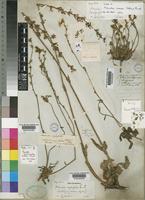
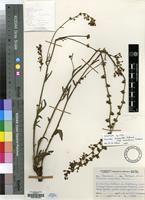
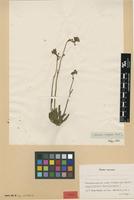
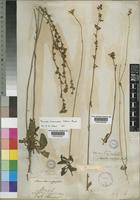
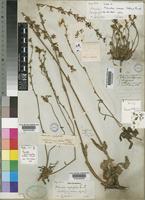
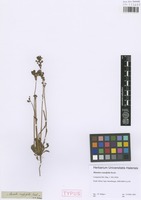
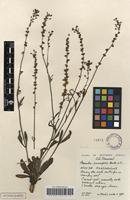
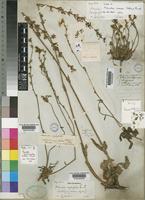
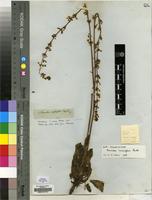
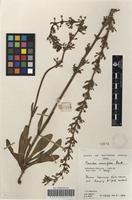
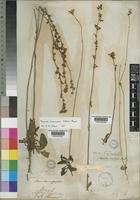
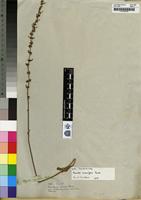
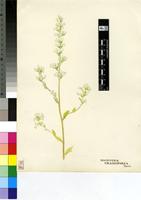
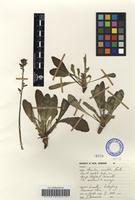
an annual herb, erect, puberulous, branched at or near the base or simple, 3–16 in. high, not or scarcely glossy; stem or basal branches scape-like or sparingly leafy, erect or ascending, leafy at the base; lower leaves subradical, rosulate, oblanceolate or elliptical, rounded or at least very obtuse, wedge-shaped at the base, rather thick, crenulate, dentate-pinnatifid or subentire, glabrous or minutely pulverulent, 1/2–3 1/2 in. long, 1/6– 2/3 in. broad; petioles 1/8–1 in. long; upper leaves few, subsessile; flowers 1/3– 2/5 in. long, yellow, pale-buff or milk-white, several or numerous, racemose, at first capitate, at length elongating and subspicate; racemes short or in fruit up to 6 in. long; pedicels up to 1/8 in. long, bracteate at or above the base; bracts subulate, puberulous, usually not exceeding the pedicels; calyx minutely puberulous or subglabrous, deeply 5-lobed, 1/8– 1/5 in. long; segments linear or lanceolate, obtuse; corolla-tube minutely papillose, rather slender, about twice as long as the calyx, somewhat curved or nearly straight; throat naked; lobes obovate or oblong, entire or nearly so, 1/12– 1/6 in. long; one pair of stamens included, the other projecting or appearing at the mouth of the corolla and barren; capsules oval, glabrous, about 1/6– 1/5 in. long, mostly distant. null