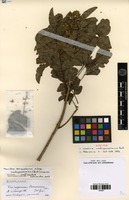
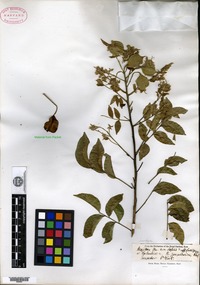
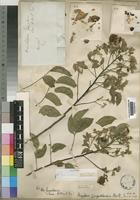
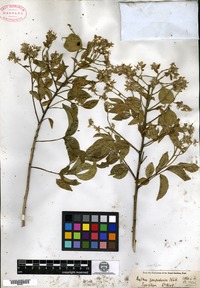
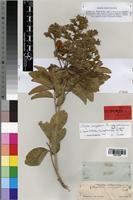
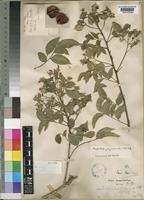
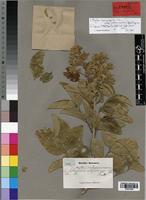
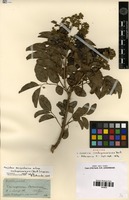
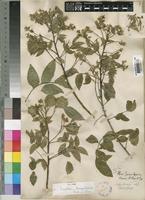
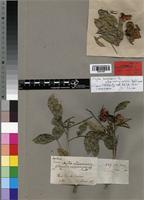
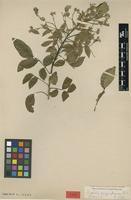
Shrub or tree 2–22 m. tall; bark rough or ± smooth, whitish buff; slash cream to pale orange; twigs with raised whitish lenticels. Leaf-rhachis 10–30 cm. long, 4-angled in cross-section; petiolules 1 mm. long; leaflets drying bright green, drooping when young, in 5–7 pairs, arranged regularly or tending to be alternate, ovate-lanceolate, 5–7 cm. long, 2–3 cm. wide, shortly bluntly acuminate or acute, asymmetrically cuneate at the base, glabrous and shining; lateral veins in 7–15 faint pairs. Inflorescence with main axes 8–15(–30) cm. long, all parts densely velvety pubescent; flowers pleasantly scented; bracts elliptic to lanceolate-elliptic, 1.3–1.7 cm. long, 6–8 mm. wide, pedicels 3–6 mm. long. Sepals ovate, 5–7 mm. long, the outermost largerthan the other 4; petals 4, yellow-green to red with white hairs, elliptic, 6 mm. long, 2 mm. wide, soon falling; disk hardly visible in the female flowers, pink-tinged and conspicuous in the male. Stamens exserted; filaments yellow-green to orange-red, 6 mm. long; staminodes very short. Male flowers without an ovary rudiment. Fruit a thinly woody trigonous apiculate capsule, externally brownish yellow, internally bright pink, 3–3.5 cm. long, 3.5–4.5 cm. wide. Seeds bluish black, ovoid, 1.2 cm. long, finely silky pubescent, ± persistent. Mature fruits and male flowers commonly occur together in the inflorescence. Fig. 4.