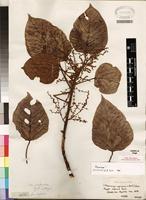
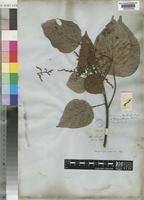
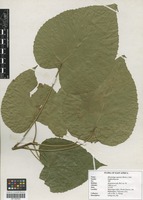
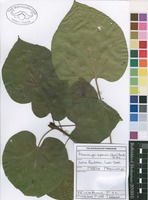
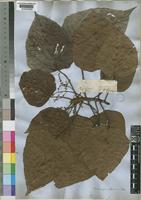
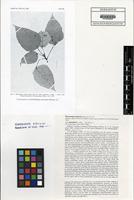
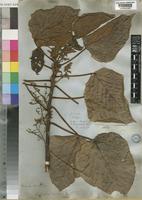
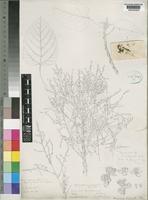
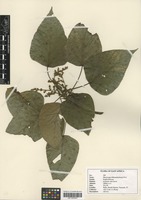
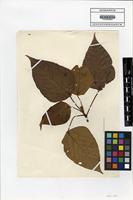
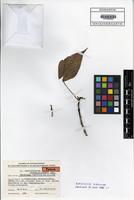
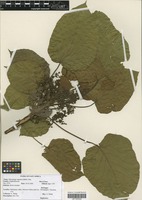
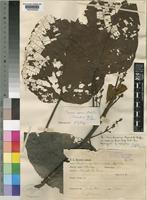
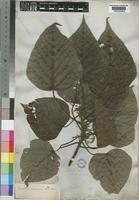
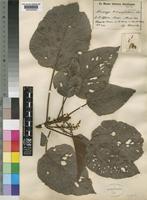
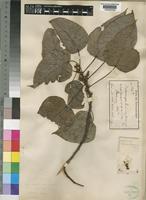
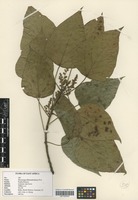
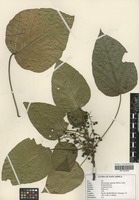
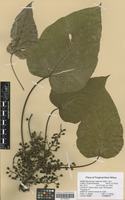
a diœcious tree 20–30 ft. high; trunk 1–2 ft. thick; twigs rusty-tomentose; leaves long-petioled, coriaceous, orbicular-ovate, rather abruptly acuminate, base rounded with a minute notch at the point of junction with the petiole, or sometimes there narrowly peltate, margin entire or very shortly denticulate, 3–6 (rarely in young plants up to 12) in. long, 3–4 (rarely in young plants up to 8) in. wide, 3–5-nerved from the base, pinnately nerved with 7–9 secondary nerves on each side of the median nerve beyond the base, the nerves all raised beneath, dark green, glabrous above or when young rusty-puberulous on the nerves only, beneath rusty-puberulous, but soon glabrescent and copiously gland-dotted throughout, with the lower two-thirds of the median nerves and the lower portion of the secondary nerves rather copiously pubescent with spreading long hairs; petiole glabrous, 2–5 in. long; stipules oblong-lanceolate, copiously rusty-puberulous, 3/4 in. long, soon deciduous; flowers in lax axillary panicles, male up to 3 in. long, 2 in. across, female up to 2 in. long, 1 1/2 in. across; bracts in both sexes lanceolate, reflexed, entire or sparingly toothed, densely rusty-pubescent; male flowers sessile, several to each bract; calyx 2–3-lobed, rusty-pubescent; stamens 2–3, at first 4-celled, when fully developed 2-celled; female flowers very shortly pedicelled, solitary to their bracts; calyx distinctly 2–3-fid; lobes ovate, acute, rusty-pubescent; ovary glabrous, with a resinous or waxy covering, 2-celled with 2 short free styles or as frequently by abortion 1-celled with a slightly excentric apical style and sometimes a minute rudimentary lateral style lower down; capsule small, viscous, globose, 1/5 in. across; valves coriaceous, very tardily dehiscent; seed globose. null