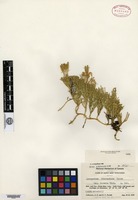
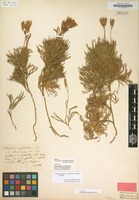
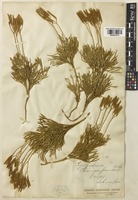
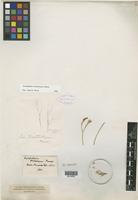
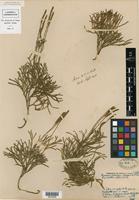
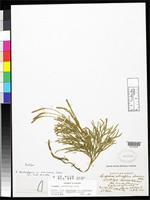
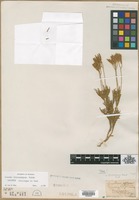
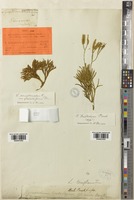
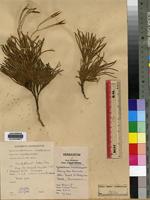
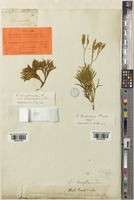
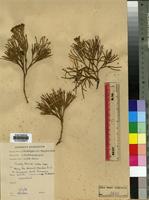
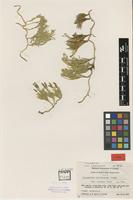
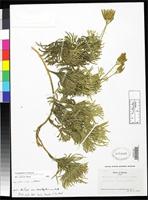
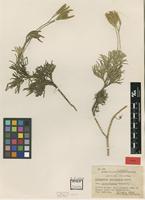
The distinctive Diphasiastrum tristachyum has narrow, rounded branches and dull, bluish white color. It is a parent in more hybrid combinations than any other North American Diphasiastrum .
The reticulogram shows the known pattern of interspecific hybridization in Diphasiastrum . The hybrids are discussed in detail by J. H. Wilce (1965), and their cytology is summarized by F. S. Wagner (1992). The best known North American hybrids are the four involving D . tristachyum . All of the hybrids have apparently normal meiosis and spores.
Diphasiastrum × zeilleri (Rouy) Holub (= D . complanatum X tristachyum ) is a frequent plant in areas of distributional overlap between the parents, especially in north central and western Minnesota jackpine forests.
Diphasiastrum × habereri (House) Holub (= D . digitatum X tristachyum ) has been overlooked and confused with both parents in zones of overlap. It is found occasionally to frequently in habitats like those of the parents, not necessarily growing close to them.
Diphasiastrum × issleri (Rouy) Holub (= D . alpinum X tristachyum ) is a rare hybrid in North America, reported only from Maine, but much more widespread in Europe.
Diphasiastrum × sabinifolium (Willdenow) Holub (= D . sitchense X tristachyum ) is widespread and frequent in eastern Canada. This hybrid is commonly confused with D . sitchense . It is highly variable, and some individuals approach one or the other parent in morphology (W. J. Cody and D. M. Britton 1989). In the flora, the populations are mainly disjunct from the main range of D . sitchense , including those in Ontario, Quebec, Maine, Michigan, New Hampshire, New York, Pennsylvania, and Vermont.
Two other North American nothospecies are Diphasiastrum complanatum X digitatum and D . alpinum X sitchense .