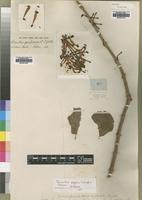
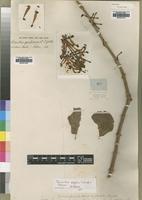
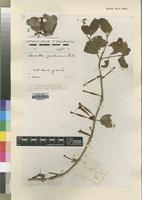
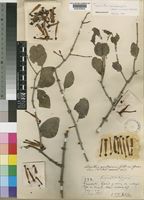
Loranthus zambesicusGibbs [family LORANTHACEAE ] Tapinanthus oleifolius(J.C.Wendl.) Danser [family LORANTHACEAE ] (stored under name); Verified by Polhill,R.M.,
Related name
Tapinanthus oleifolius
Tapinanthus quinquangulus
Loranthus zambesicus
Flora
Entry for LORANTHUS quinquangulus Sprague Var. pedicellatus [family LORANTHACEAE]
Herbarium
Royal Botanic Gardens, Kew (K)
Collection
Flora of Tropical Africa
Resource Type
Reference Sources
Entry From
Flora of Tropical Africa, Vol 6, Part 1, page 255, (1913) Author: (By J. G. Baker, with additions by C. H. Wright.)
Names
LORANTHUS quinquangulusSprague Var. pedicellatus [family LORANTHACEAE]
LORANTHUS zambesicusL. S. Gibbs [family LORANTHACEAE], in Journ. Linn. Soc. Bot. xxxvii. 467.
Information
Leaves broadly ovate, obovate, elliptic or suborbicular, subcuneate, obtuse or rounded at the base; petiole 1–4 lin. long. Umbels 4-flowered; peduncle about 1 lin. long; pedicels 1/2 lin. long, shortly pilose; bract shallowly ovate-cupular, shortly pilose outside, dorsal margin 7/8 lin. long, ventral margin 3/8 lin. long. Basal swelling of the corolla ellipsoid, 2 1/4–2 1/2 lin. long. Anthers 1 3/4 lin. long.
Distribution
Rhodesia Mozamb. Dist. Victoria Falls, Miss Gibbs, 140! Allen, 138!
Notes
Var. pedicellatus differs from the type in little but the presence of a distinct pedicel and the shape of the bract, and it may be found impossible to maintain it when further material comes to hand.