JSTOR Global Plants Home
  • Home
  • Browse
  • About
  • Access
  • Account
    • Saved Items
    • Profile
  • Log in

Global Plants

Skip to Main Content
  • JSTOR Global Plants Home
  • Global Plants

    • Browse
    • About
    • Access
    • Account
      • Saved Items
      • Profile
Log in
  • Browse
  • About
  • Access
  • Account
    • Saved Items
    • Profile
Advanced Search

Compilation
Loranthus rondensis

6 Images see all

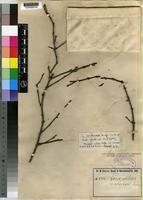
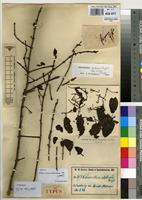
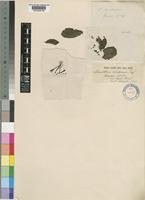
Type of Loranthus rondensis Engl. [family LORANTHACEAE]
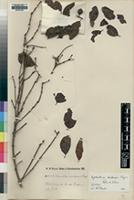
Isotype of Loranthus rondensis Engl. [family LORANTHACEAE]
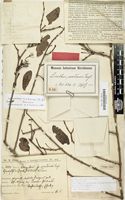
Holotype of Loranthus rondensis Engl. [family LORANTHACEAE]
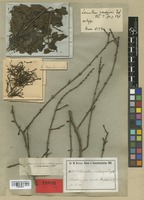
Isotype of Loranthus rondensis Engl. [family LORANTHACEAE]
Agelanthus rondensis (Engl.) Polhill & Wiens [family LORANTHACEAE]
Previous
Next

Name

Identification
Loranthus rondensis Engl. [family LORANTHACEAE ] Verified by Gebauer, Agelanthus rondensis (Engl.) Polhill&Wiens [family LORANTHACEAE ] (stored under name); Verified by Not on sheet.,
Related name
  • Loranthus rondensis
  • Agalanthus rondensii
  • Agelanthus rondensis

Flora

Entry for LORANTHUS rondensis Engl. [family LORANTHACEAE]
Herbarium
Royal Botanic Gardens, Kew (K)
Collection
Flora of Tropical Africa
Resource Type
Reference Sources
Entry From
Flora of Tropical Africa, Vol 6, Part 1, page 255, (1913) Author: (By J. G. Baker, with additions by C. H. Wright.)
Names
LORANTHUS rondensis Engl. [family LORANTHACEAE], in Engl. Jahrb. xl. 524.
Information
Branches slightly flexuous, terete, nodose, about 1 1/2 lin. in diam. 1 ft. below the apex, densely lenticellate, glabrous; branchlets spreading or ascending, angular; internodes 3/4–1 1/2 in. long. Leaves opposite or subopposite, oblong, oblong-lanceolate or ovate-oblong, acute or obtuse at the apex, obtuse or more rarely rounded at the base, 1 1/4–2 3/4 in. long, 7–16 lin. broad, rigidly coriaceous, glabrous, penninerved, upper surface slightly glossy; lateral nerves patulous, 4–6 on each side, anastomosing well within the margin, slightly raised on the upper surface, very inconspicuous or not visible on the lower; petiole 2 1/2–4 lin. long, channelled. Umbels axillary, fascicled, 2–4-flowered; peduncle 1/2– 3/4 lin. long; pedicels 1/4 lin. long; bract cupular, produced dorsally into a shortly ovate truncate lobe, umbonate, dorsal margin 1/2– 5/8 lin. long, ventral margin 1/4– 1/3 lin. long. Receptacle and calyx together suburceolate, 7/8 lin. long. Calyx subtruncate, sparingly ciliolate, 1/2 lin. long. Corolla 1 in. long or rather more, suprabasal swelling yellow, ellipsoid, 1–1 1/4 lin. long, remainder of the corolla purplish-red; tube altogether 6 1/2–7 lin. long, very slightly split unilaterally, glandular inside; lobes erect, linear-spathulate, 5–5 1/2 lin. long. Filaments inserted 5/8 lin. above the base of the corolla-lobes, tapering upwards, 2 1/2 lin. long, grooved transversely on the outer surface, involute; anthers linear, 1 7/8 lin. long; connective produced beyond the cells into a transversely elliptic appendage, 1/12 lin. long. Disc pentagonal, 1/8 lin. high. Style broadened above into the stigma.
Distribution
German East Africa Mozamb. Dist. eastern slopes of Rondo Plateau, Busse, 2554!
Notes
Differs from the other species of sect. Rigidiflori in having the corolla-lobes shorter than the tube.

Related Materials

  • Terms and Conditions
  • Privacy Policy
  • Cookie Policy
  • Cookie Settings
  • Accessibility
  • Help
  • Contact Us
  • Facebook
  • Twitter
ITHAKA

JSTOR is part of ITHAKA, a not-for-profit organization helping the academic community use digital technologies to preserve the scholarly record and to advance research and teaching in sustainable ways.

©2000-2026 ITHAKA. All Rights Reserved. JSTOR®, the JSTOR logo, JPASS®, Aluka®, and ITHAKA® are registered trademarks of ITHAKA.

╳