

Compilation
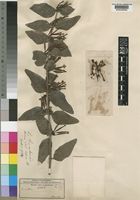
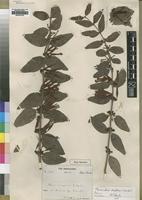
Loranthus bumbensis
2 Images see all
Name
Identification
Loranthus bumbensis Hiern [family LORANTHACEAE ] Tapinanthus oleifolius (J.C.Wendl.) Danser [family LORANTHACEAE ] (stored under name); Verified by Polhill,R.M.,
Related name
- Tapinanthus oleifolius
- Loranthus bumbensis
- Loranthus namaquensis
Flora
Entry for LORANTHUS oleæfolius Cham. & Schlecht. [family LORANTHACEAE]
Herbarium
Royal Botanic Gardens, Kew (K)
Collection
Flora Capensis
Resource Type
Reference Sources
Entry From
Flora Capensis, Vol 5, Part 2, page 100, (1925) Author: (By T. A. SPRAGUE.)
Names
LORANTHUS oleæfolius Cham. & Schlecht. [family LORANTHACEAE], in Linnæa, iii. 209;—DC. Prodr. iv. 304; Schultes, Syst. Veg. vii. 1634; E. Meyer in Drège, Zwei Pfl. Documente, 93, 96; Sprague in Kew Bulletin, 1914, 362.
LORANTHUS speciosus F. G. Dietr. [family LORANTHACEAE], Lexik. Gaertn. Nachtr. iv. 473.
LORANTHUS Lichtensteinii Herb. Willd. ex Cham. & Schlecht. [family LORANTHACEAE], in Linnæa, iii. 209, in synonymy.
LORANTHUS Meyeri Presl [family LORANTHACEAE], Bot. Bemerk. 76, name only; Engl. & Gilg in Warb. Kunene-Samb. Exped. 228
LORANTHUS Meyeri Hiern var. ligustrifolius [family LORANTHACEAE], in Cat. Afr. Pl. Welw. i. 932
LORANTHUS Meyeri Engl. var. inachabensis [family LORANTHACEAE], in Engl. Jahrb. xl. 535.
LORANTHUS namaquensis Harv. [family LORANTHACEAE], in Harv. & Sond. Fl. Cap. ii. 577; Schinz in Bull. Herb. Boiss. iv. App. iii. 54; N. E. Brown in Kew Bulletin, 1909, 135; De Wild. Pl. Nov. Herb. Hort. Then. t. 78; Sprague in Dyer, Fl. Trop. Afr. vi. i. 361
LORANTHUS namaquensis Engl. var. ligustrifolius [family LORANTHACEAE], in Engl. Jahrb. xx. 120.
LORANTHUS bumbensis Hiern [family LORANTHACEAE], in Cat. Afr. Pl. Welw. i. 933.
Lichtensteinia oleæfolia Wendl. [family ], Coll. Pl. ii. 4, t. 39.
Tapinanthus namaquensis Van Tiegh. [family LORANTHACEAE], in Bull. Soc. Bot. France, xlii. 267.
Information
branches terete, nodose, 2 1/2–3 1/2 lin. in diam. 1 ft. below the apex, pale brown, buff-coloured or ashy-grey, glabrous; branchlets minutely and densely puberulous in a young state, soon becoming glabrous, rather slender, 1–1 1/2 lin. in diam. 6 in. below the apex; internodes 1/4–2 in. long; leaves opposite, subopposite or alternate, petioled, elliptic-oblong, ovate, lanceolate, obovate or oblanceolate, 3/4–3 1/2 in. long, 1/4–1 1/4 in. broad, obtuse or rounded at the apex, obtuse or cuneate at the base, rather thickly coriaceous, minutely puberulous in a young state, quickly becoming glabrous, dull, penninerved, lateral nerves rather oblique, 4–5 on each side, anastomosing far from the margin, more or less raised on both surfaces in a dried state; petiole 1–3 lin. long; umbels axillary, solitary or fascicled, 3–4-flowered, minutely puberulous; peduncle stout, 3/4–2 lin. long; pedicels 5/8–1 lin. long; bract ovate-cupular, dorsal margin 7/8–1 1/4 lin. long, ventral margin 3/8– 5/8 lin. long; flowers pentamerous, expanding in two stages: in the first the corolla-lobes separate from one another and become reflexed, the filaments remaining closely pressed together round the style, in the second the corolla-tube splits unilaterally to about the middle, and the filaments become deflexed; receptacle and calyx together campanulate, wide-mouthed, 1 1/2–2 lin. long; calyx subtruncate or repand, 5/8– 7/8 lin. long; corolla red, tipped with green (Pearson), 1 1/2–1 3/4 in. long in bud, minutely puberulous outside, basal swelling ellipsoid, 1 3/4–2 3/4 lin. long, apical swelling oblong-ellipsoid, obtusely pentagonal with flat or slightly convex faces, subtruncate or apiculate from a rounded apex, 2–2 1/4 lin. long, 1 1/8–1 1/4 lin. in diam.; tube constricted above the basal swelling, then broadened to the middle and again narrowed to the base of the apical swelling; lobes reflexed below the middle, spathulate, 3 1/2–4 1/2 lin. long, upper part 2 lin. long, 7/8 lin. broad; filaments inserted 1/2– 3/4 lin. below the base of the corolla-lobes, deflexed or inflexed, 2 1/4–2 3/4 lin. long, produced in front of the anther into a tooth 1/4– 3/8 lin. long; anthers narrowly oblong, truncate or very slightly emarginate, 1 1/4–1 1/2 lin. long; disc 1/5– 1/4 lin. high, not lobed; style skittle-shaped above, thickened part 2 3/4–3 1/4 lin. long; stigma depressed-globose or obovoid, 1/3– 3/8 lin. long, 3/8– 1/2 lin. in diam.; berry orange (Pearson), ellipsoid, 5 lin. long. null
Distribution
CENTRAL REGION Prieska Div.; Prieska, by the Orange River, Lichtenstein; near the Orange River between Gariep Station and Shallow Ford, Burchell, 1648!EASTERN REGION Var. β: Delagoa Bay, Forbes! Morakwen, Junod, 457!KALAHARI REGION Bechuanaland; near Kuruman, on Acacia detinens, Burch., Marloth, 1075! Var. γ: Transvaal; Pietpotgieters Rust, on Acacia sp., Miss Leendertz, 1142! in thickets near Badsloop, Schlechter, 4291! Crocodile River, Burke! Doorn River, on a quince bush, Nelson, 538!WESTERN REGION Great Namaqualand; Naiams, Schinz, 284; Gauas, Schinz, 288! Kuibes, Schinz, 289; Schenck, 377; Bethany, Schenck, 394, 395; north of Keetmanshoop, Fenchel, 154; Karas Mountains, Fenchel, 153; Sandverhaar, on Parkinsonia africana, Sond., Pearson, 4440! Little Bushmanland; Ramonds Drift, Orange River, Schlechter! Bushmanland; banks of the Orange River near Abbasis, Pearson, 3005! sandy plains between Ougrabies and Kweekfontein, on Parkinsonia africana, Sond., Pearson, 3796! Little Namaqualand; by the Groen River, Drège! Orange River, near Verleptpram, Drège! near Modderfontein, Whitehead! Bolus, 9450! and without precise locality, Wyley, 73!
Notes
Harvey, following Ecklon & Zeyher, wrongly identified Lichtensteinia oleæfolia, Wendl., with Loranthus elegans, Cham. & Schlecht., and described the latter under the name Loranthus oleæfolius (Fl. Cap. ii. 576). He described the true Loranthus oleæfolius, Cham. & Schlecht., as a new species, L. namaquensis, Harv. An historical account of L. elegans and L. oleæfolius is given in Kew Bulletin, 1914, 359. L. oleæfolius, Cham. & Schlecht., as defined above, is polymorphic in regard to the shape and size of the leaves, and the indumentum of the corolla. Var. β Forbesii appears to differ from the type in nothing but the glabrous corolla; but Miss Leendertz's specimen, which is the type of var. γ Leendertziæ, has densely villous inflorescences and sessile flowers, and has a very distinct facies. It is, however, connected with typical L. oleæfolius by the specimens collected by Burke and Nelson, which have much less hairy inflorescences and distinctly pedicelled flowers.