

Compilation
Lonchitis natalensis
2 Images see all
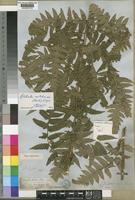
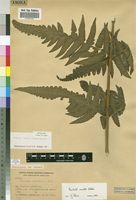
Name
Identification
Lonchitis natalensis Hook. [family DENNSTAEDTIACEAE ] (stored under name); Verified by Not on sheet, Lonchitis crenata Alston [family DENNSTAEDTIACEAE ] Verified by Paiva, J., 1966 Blotiella crenata (Alston) Schelpe [family DENNSTAEDTIACEAE ] Verified by Schelpe, E.A.C.L.E., 1972
Related name
- Lonchitis glabra
- Blotiella natalensis
- Blotiella crenata
- Lonchitis natalensis
- Lonchitis crenata
Flora
Entry for BLOTIELLA natalensis (Hook.) A. F.Tryon [family DENNSTAEDTIACEAE]
Herbarium
Royal Botanic Gardens, Kew (K)
Collection
Flora of Tropical East Africa
Resource Type
Reference Sources
Entry From
Flora of Tropical East Africa, page 1, (1999) Author: B. Verdcourt, B.Sc., Ph.D.
Names
BLOTIELLA natalensis (Hook.) A. F.Tryon [family DENNSTAEDTIACEAE], in Contr. Gray Herb. 191: 99 (1962); Schelpe, F.Z., Pterid.: 82 (1970) & in Expl. Hydrobiol. Bassin L. Bangweolo & Luapula, 8(3), Ptérid.: 43 (1973) & in C.F.A., Pterid.: 68 (1977); Schelpe & Diniz, Fl. Moçamb., Pterid.: 87 (1979); Kornaś, Distr. Ecol. Pterid. Zambia: 86 (1979); W. Jacobsen, Ferns S. Afr.: 205, fig. 144, map 42 (1983); Schelpe & N.C. Anthony, F.S.A., Pterid.: 81, fig. 21/1, map 64 (1986); J.E. Burrows, S. Afr. Ferns: 100, t. 15.3, fig. 21/102, map (1990). Type: South Africa, Natal, Pappe (K!, holo.)
Lonchitis natalensis Hook. [family ], Sp. Fil. 2: 57, t. 89B (1858); Tardieu in Mém. I.F.A.N. 28: 82 (1953) pro parte (excl. West African citations) & Fl. Madag. 5 (1): 72 (1958)
Lonchitis pubescens [family ], [sensu Sim, Ferns S. Afr., ed. 2: 261, pro parte quoad t. 131 (1915), non Kaulf.]
Information
Rhizome erect or creeping, often massive and woody, 1.5–2.5 cm diameter, covered with pale or reddish brown hairs 5–10 mm long. Fronds tufted or closely spaced, 0.6–2.6 m tall; stipe straw-coloured, up to 0.7(–1) m long with dense pale hairs when young but becoming glabrous; lamina lanceolate, narrowly oblong or triangular in outline, up to ± 1.5 m long, either 1-pinnate, 1-pinnate with a few lower pinnae having several free pinnules, or distinctly 2-pinnate; rachis pubescent, eventually slightly roughened by hair-bases, becoming glabrous below; terminal pinna ± hastate, pinnatifid and terminal segments of lateral pinnae similar with ± 7 pairs of lobes; pinnae narrowly oblong to narrowly triangular, (7.5–)18–31 cm long, (1.5–)3–12 cm wide, stalked, deeply pinnatifid with lobes lanceolate-triangular up to ± 4 cm long and 1 cm wide, narrowly joined at bases; in 2-pinnate fronds the pinnae have a deeply crenate terminal segment gradually passing into distinct pinnules which are narrowly triangular or lanceolate, 4.5–7.5 cm long, 1.5–2.2 cm wide, sessile, entire to wavy crenulate or pinnatifid; surfaces sparsely to densely pubescent with adpressed hairs, the costa with short pubescence even if surface glabrescent. Sori ± rounded, in sinuses between lobes of pinnules or pinnae but in more dissected fronds also in shallow sinuses of lobed margins of pinnules or pinna-lobes, up to ± 10 per pinnule and in places sometimes appearing almost continuous; paraphyses 0.2–0.4 mm long, thin, the apical cells brown, ellipsoidal, rounded or pointed.
Range
DISTR. U 2, 4; T 4, 7
Altitude range
1100–1900 m
Distribution
UGANDA Kigezi District Ishasha Gorge, 6 km SW of Kirima, 21 Sept. 1969, Faden et al. 69/1210;TANZANIA Buha/Kigoma District Mkenke Valley, 26 Jan. 1964, Pirozynski 301!;UGANDA Mengo District 14 km from Kampala on Masaka road, May 1937, Chandler 1624! (see note on p. 22)TANZANIA Iringa District Sao Hill, June 1958, Watermeyer 25!;TANZANIA Rungwe District 15 km S of Tukuyu, Makete, 7 May 1975, Hepper et al. 5359!
Distribution (external)
Congo (Kinshasa)
Burundi
Angola
Zambia
Malawi
Mozambique
Zimbabwe
eastern South Africa
Madagascar
Comoro Is
Seychelles
Mauritius ( fide Tardieu-Blot)
Notes
I at first considered B. crenata Alston (Schelpe) to be a synonym of B. natalensis but Fadenpersuaded me this was wrong. Kornaś was convinced that B. crenata is a distinct species and pointed out that Loveridge 935 cited by Schelpe as B. natalensis was undoubtedly B. crenata. Specimens with 1-pinnate fronds, the pinnae oblong with about 20 rounded lobes on each side and ± densely hairy are admittedly distinctive and represent B. crenata. Distinctions such as rhizome erect natalensis and creeping crenata appear to be of little use. I do not know on what specimens Schelpe’s record of natalensis from Kenya (in C.F.A.) is based but it must be admitted some Kenya material of B. stipitata can scarcely be distinguished.