

Compilation
Lobelia dobrowskyoides
1 Images see all
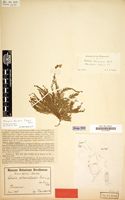
Name
Identification
Lobelia dobrowskyoides Diels [family CAMPANULACEAE ] Verified by Not on sheet., Monopsis decipiens (Sond.) Thulin [family CAMPANULACEAE ] (stored under name); Verified by Not on sheet.,
Related name
- Lobelia dobrowskyoides
- Monopsis decipiens
Flora
Entry for Monopsis decipiens Sonder Thulin [family LOBELIACEAE]
Herbarium
Royal Botanic Gardens, Kew (K)
Collection
Flora Zambesiaca
Resource Type
Reference Sources
Entry From
FZ, Vol 7, Part 1, page 116, (1983) Author: M. Thulin
Names
Monopsis decipiens Sonder Thulin [family LOBELIACEAE], in Bot. Notiser 132: 134, fig, 1B, E, 2 (1979). Type from Transvaal
Lobelia decipiens Sonder [family LOBELIACEAE], in Harv. & Sond., F.C. 3: 540 (1865). — Rolfe in Oates, Matabeleland and the Victoria Falls, ed. 2, app. 5: 402 (1889). — Gibbs in Journ. Linn. Soc., Bot. 37: 451 (1906). — E. Wimmer in Engl., Pflanzenr. IV. 276 b; 588 (1953). — Plowes & Drummond, Wild Flowers of Rhodesia: 137, t. 178 (1976). Type as above.
Lobelia breynii var. bragae Engl. [family LOBELIACEAE], Pflanzenw. Ost–Afr.C: 402 (1895). Type: Mozambique, Beira (locality probably erroneous), Braga 135 (B, holotype).
Lobelia dobrowskyoides Diels [family LOBELIACEAE], in Engl.,Bot. Jahrb. 26: 117 (1898). Type from Transvaal.
Monopsis scabra [family LOBELIACEAE], sensu E. Wimmer, op. cit. 276 c: 891 (1968) quoad specim. ex Zimbabwe.
Information
Annual or perennial erect or ascending herb. Stems 5–45 cm. long, usually sparsely branched, ribbed, ± pubescent with upturned hairs. Leaves alternate, fairly numerous and densely set, ± erecto–patent, linear, up to 8–15(25) x 0·8–1·5(2·5) mm., acute at the apex, harshly strigulose mainly along margins and on midrib beneath; margin incrassate, entire or rarely with one pair of denticles; midvein prominent beneath. Flowers resupinate, solitary, axillary or apparently terminal, confined to the upper part of the plant; pedicels 15–55 mm. long, pubescent with forwardly directed hairs; bracteoles resembling small leaves, sometimes opposite. Hypanthium hemispherical or broadly obconical, ± 10–nerved, appressed pubescent. Calyx–lobes 2–5 mm. long, acute, entire, strigulose on the outside, spreading. Corolla 10–18 mm. long, blue or blue and purple with yellow markings on lower lip, sometimes white or almost so, split on the upper side to ± 1 mm. from the base, 2–lipped with the lower lip broadly 3–lobed and the upper lip consisting of two reflexed lobes united with the tube for most of their length; appressed pubescent outside, sparsely pubescent near the base inside. Filaments almost free from corolla, linear, connate above, all pubescent on the inside above. Anther–tube 1·5–2·5 mm. long, all anthers densely penicillate at the tip, otherwise glabrous. Capsule ± 10–nerved, subglobose to ovoid, up to 6·5 mm. long, dehiscing by valves up to 2·5 mm. long. Seeds broadly elliptic in outline, compressed, 0·5–0·6 mm. long, reticulate, brown.
Habitat
In grassland, often in seasonally wet places.
Range
Wimmer (1953) also cited a specimen from Botswana without precise locality, Holub s.n. (PR not seen).
Distribution
Mozambique M Namaacha, Mt. M’Ponduine, 780 m., 25.vii.1980, Pettersson 2019 (UPS).Zimbabwe S Victoria, Monro 583 (BM; MO; SRGH).Zimbabwe E Melsetter Distr., Charter Forest Estates, 11.iii.1966, Plowes 2766 (COI; K; LISC; MO; SRGH).Zimbabwe C Salisbury Distr., between Wellesley and Darwendale, 25.ix.1955, Drummond 4876 (K; SRGH; W).Zimbabwe W Matobo Distr., Farm Besna Kobila, 1460 m., xii.1960, Miller 7552 (LISC; SRGH).Mozambique MS Manica, Rotanda, Tandara, 1700 m.,19.xi. 1965, Torre & Correia 13175 (LISC).Zimbabwe N 8 km. on the Mtoko–Tete road, 910 m., viii.1956, Davies 2095 (SRGH).
Distribution (external)
S. Africa (Transvaal, Natal, Orange Free State and E. Cape Province)
Swaziland
Lesotho