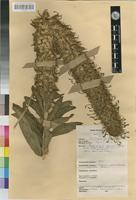
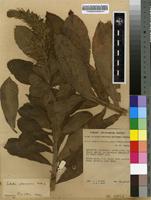
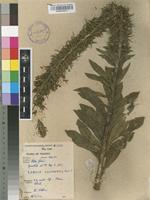
Entry for LOBELIA columnaris Hook. fil. [family CAMPANULACEAE]
Herbarium
Royal Botanic Gardens, Kew (K)
Collection
Flora of Tropical Africa
Resource Type
Reference Sources
Entry From
Flora of Tropical Africa, Vol 1, page 463, (1877) Author: (By W. B. Hemsley.)
Names
LOBELIA columnarisHook. fil. [family CAMPANULACEAE], in Journ. Linn. Soc. vi. p. 14.
Information
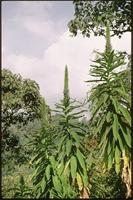
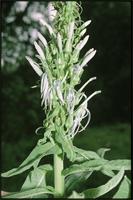
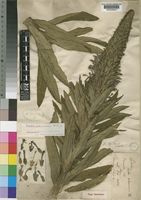
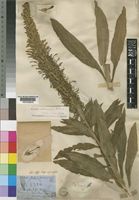
A monocarpic (?) herbaceous plant with the habit of a Digitalis. Stems about 6 ft. high, unbranched, tomentose, clothed with alternate somewhat crowded sessile narrow lanceolate acute irregularly denticulate more or less pubescent leaves, 4 to 6 in. long, and terminating in a dense bracteate many-flowered raceme of yellow or blue flowers. Bracts pubescent, not exceeding the shortly pedicellate pubescent flowers. Calyx-lobes narrow, lanceolate, acute, entire, about a third of the length of the corolla, which is about 1 1/2 in. long and divided into narrow lobes about half way down. Stamens equalling the corolla; filaments united to the base; anthers sparingly pilose, not bearded as in the foregoing. Style elongating after the flowers have expanded, and the stigma eventually projecting considerably beyond the staminal tube.
Distribution
Fernando Po Upper Guinea Clarence Peak, Mann!Upper Guinea Cameroons Mountains, Mann!
Notes
Perhaps the mainland specimen should be regarded as specifically different, but the material is insufficient to determine this question. In the typical specimen the leaves have a very prominently reticulated venation on the under surface, the bracts and pedicels are relatively longer, and the blue flowers are much more pubescent than those of the yellow-flowered specimen from the Cameroons.