

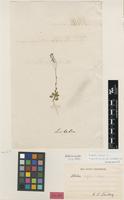
Name
Identification
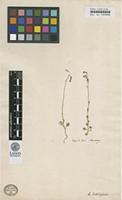
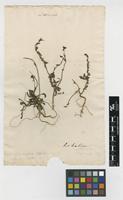
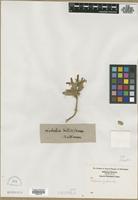
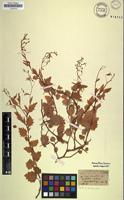
Lobelia bellidiflora L.f. [family CAMPANULACEAE ] (stored under name); Verified by Not on sheet, Lobelia erinus L. [family CAMPANULACEAE ] Verified by Not on sheet, Lobelia bellidifolia Thunb. [family CAMPANULACEAE ] Verified by Not on sheet,
Related name
- Lobelia bifida
- Lobelia erinus
- Lobelia bellidiflora
- Lobelia aethiopica
- Lobelia bellidifolia
- Lobelia puberula
- Rapuntium bellidifolium
- Lobelia not on sheet
Flora
Entry for Lobelia erinus L. [family LOBELIACEAE]
Herbarium
Royal Botanic Gardens, Kew (K)
Collection
Flora Zambesiaca
Resource Type
Reference Sources
Entry From
FZ, Vol 7, Part 1, page 116, (1983) Author: M. Thulin
Names
Lobelia erinus L. [family LOBELIACEAE], Sp. Pl.: 932 (1753) pro parte. — Sonder in Harv. & Sond., F.C. 3: 544 (1865) pro parte. — E. Wimmer in Annal. Naturhist. Mus. Wien 56: 349(1948); in Engl., Pflanzenr. IV. 276 b: 519, fig. 87 e–g (1953). Type from S. Africa (Cape Prov.).
Lobelia filiformis forma muzandazora E. Wimmer [family LOBELIACEAE], in Annal. Naturhist. Mus. Wien 56: 355 (1948); in Engl., Pflanzenr. IV. 276 b: 542 (1953). Syntypes from Zimbabwe: St. Trias Hill Mission, Mundy 3176 (K), and without precise locality, Hislop 59 (K).
Lobelia nuda var. rosulata S. Moore E. Wimmer [family LOBELIACEAE], in Kew Bull. 7: 138 (1952); in Engl, Pflanzenr. IV. 276 b: 775 (1953) & 276 c: 857 (1968). Type as for Lobelia rosulata.
Lobelia altimontis E. Wimmer [family LOBELIACEAE], in loc. cit. (1952); in Engl, Pflanzenr. IV. 276 b: 780 (1953) & 276 c: 866 (1968). Syntypes from Zimbabwe: Marandellas, Walters 2364 (K, syntype; SRGH), Pork Pie, Chase 1424 (BM; K; SRGH; W) and Pungwe, Hopkins in GHS 9396 (SRGH; W, syntype).
Lobelia polyodon E. Wimmer [family LOBELIACEAE], in tom. cit.: 140 (1952); in Engl, Pflanzenr. IV. 276 b: 778 (1953) & 276 c: 864 (1968). Syntypes from Zimbabwe: Inyanga Distr., Chipungu stream, Chase 1850 (SRGH; W, syntype) and Mozambique: Chimanimani Mts., Wild 2902 (K; SRGH; W) and Munch 69 (SRGH; W, syntype).
Lobelia wildii E. Wimmer [family LOBELIACEAE], in tom. cit.: 141 (1952); in Engl, Pflanzenr. IV. 276 b: 781 (1953) & 276 c: 866 (1968). Type: Zimbabwe, Chimanimani Mts., Mt. Peza, Wild 3619 (K; SRGH; W).
Lobelia wildii var. arcana E. Wimmer [family LOBELIACEAE], in tom. cit.: 141 (1952); in Engl, Pflanzenr. IV. 276 b: 781 (1953). Type: Zimbabwe, Marandellas Cave, Wild 3289 (SRGH; W, holotype).
Lobelia raridentata E. Wimmer [family LOBELIACEAE], in Engl, Pflanzenr. IV. 276 b: 538 (1953). Type: Zimbabwe, Vumba Mts., Peter 30616 (B, holotype; W).
Lobelia keilhackii E. Wimmer [family LOBELIACEAE], in Engl, Pflanzenr. IV. 276 b: 543 (1953). Type: Zimbabwe, Belingwe, Keilhack s.n. (B, holotype).
Lobelia nuzana E. Wimmer [family LOBELIACEAE], in Engl, Pflanzenr. IV. 276 b: 780 (1953). Type: Zimbabwe, Mt. Nuza, Gilliland 313 (BM; J, holotype; SRGH).
Lobelia senegalensis var. turgida E. Wimmer E. Wimmer [family LOBELIACEAE], in Engl, Pflanzenr. IV. 276 b: 552 (1953) & 276 c: 869 (1968). Type as for Lobelia turgida.
Lobelia filiformis var. filiformis [family LOBELIACEAE], sensu E. Wimmer in Engl, Pflanzenr. IV. 276 b: 541 (1953) pro parte. — Binns, H.C.L.M.: 25 (1969) pro parte.
Lobelia melsetteria E. Wimmer [family LOBELIACEAE], in Engl, Pflanzenr. IV. 276 c: 866 (1968) nom. invalid. Orig. colls.: Zimbabwe, Melsetter Distr., Crook M15 (PRE); Zambia, Kansuaja, Stohr 83 (PRE).
Lobelia lydenburgensis [family LOBELIACEAE], sensu E. Wimmer in Engl, Pflanzenr. IV. 276 c: 856 (1968) pro parte.
Lobelia bellidiflora L. f. [family LOBELIACEAE], Suppl. Pl.: 396 (1781), as “bellidifolia” by Thunb. and later authors. Type from S. Africa (Cape Prov.).
Rapuntium flexuosum Presl [family LOBELIACEAE], Prodr. Monogr. Lobel.: 16 (1836) nom. illegit. Type from S, Africa (Natal), not seen.
Lobelia natalensis A.DC. [family LOBELIACEAE], in DC., Prodr. 7: 369 (1839). — Sonder, tom. cit.: 545 (1865) pro parte. Type as for Rapuntium flexuosum.
Lobelia senegalensis A.DC. [family LOBELIACEAE], tom. cit.: 372 (1839). — Hemsl. in F.T.A. 3: 469 (1877). — E. Wimmer, tom. cit.: 551, fig. 90 d (1953) pro parte; in F.W.T.A., ed .2, 2: 313 (1963); in Engl., Pflanzenr. IV. 276 c: 869 (1968) pro parte. — Binns, H.C.L.M.: 25 (1969). Type from Senegal.
Lobelia pubescens var. simplex O. Ktze. [family LOBELIACEAE], in Jahrb. Bot. Gart– Berlin ± 267 (1886). Type from Namibia.
Lobelia benguellensis Hiern [family LOBELIACEAE], tom. cit.: 626 (1898). — E. Wimmer, op. cit. IV. 276 b: 545 (1953) & 276 c: 868 (1968). Type from Angola.
Lobelia lavendulacea Klotzsch [family LOBELIACEAE], in Peters, Reise Mossamb., Bot. 1: 302 (1862). — E. Wimmer, tom. cit.: 551 (1953). Type from Zanzibar.
Lobelia kohautiana Vatke [family LOBELIACEAE], in Linnaea 38: 719 (1874) nom. illegit. Type as for Lobelia senegalensis.
Lobelia nuda Hemsl. [family LOBELIACEAE], loc. cit. — Hiern, Cat. Afr.Pl. Welw. 1: 628 (1898). — R.E. Fr., Wiss. Ergebn. Schwed. Rhod.–Kongo–Exped. 1: 317 (1916). — E. Wimmer, tom. cit.: 464,fig .78 b (1953). — Roessler in Prodr.Fl.SW.Afr, 137: 3 (1966). — E. Wimmer, op. cit. IV. 276 c: 857 (1968). — Binns, H.C.L.M.: 25 (1969). Type: Zambia, Batoka Country, Kirk s.n. (K, holotype).
Lobelia chilawana Schinz [family LOBELIACEAE], in Mem. Herb. Boiss. 10: 70 (1900). Type: Mozambique, Delagoa Bay,Junod 398 (G, holotype).
Lobelia rosulata S. Moore [family LOBELIACEAE], in Journ. Bot. 41: 402 (1903). — Markgraf in Engl., Bot. Jahrb. 75: 217 (1950). Type from S. Africa (Transvaal).
Lobelia jugosa S. Moore [family LOBELIACEAE], in Journ. Linn. Soc., Bot. 40: 125 (1911). Type: Zimbabwe, between Lusitu R. and Nyahodi R., Swynnerton 2037 (BM, holotype).
Lobelia transvaalensis Schltr. [family LOBELIACEAE], in Engl., Bot. Jahrb. 57: 622 (1922). Type from S. Africa (Transvaal).
Lobelia trierarchi R. Good [family LOBELIACEAE], in Journ. Bot., Lond. 62: 139 (1924). Type from Sudan.
Lobelia turgida E. Wimmer [family LOBELIACEAE], in Feddes Repert. Spec. Nov. 38: 82 (1935). — Markgraf in Engl., Bot. Jahrb. 75: 218 (1950). Type: Mozambique, Dawe 349 (BR, holotype; K).
Lobelia nuda forma hirtella E. Wimmer [family LOBELIACEAE], in Annal. Naturhist. Mus. Wien 56: 343 (1948); in tom. cit.: 465 (1953). Type from Namibia.
Lobelia filiformis var. natalensis A.DC. E. Wimmer [family LOBELIACEAE], in Annal. Naturhist. Mus. Wien 56: 354 (1948); in Engl., Pflanzenr. IV. 276 b: 541, fig. 89 c (1953). — Roessler, loc. cit. Type as for Lobelia natalensis.
Lobelia filiformis forma albiflora E. Wimmer [family LOBELIACEAE], in Annal. Naturhist. Mus. Wien 56: 355 (1948); in Engl., Pflanzenr. IV. 276 b: 542 (1953). Syntypes from S. Africa (Natal) and Tanzania.
Lobelia filiformis forma multipilis E. Wimmer [family LOBELIACEAE], in Annal. Naturhist. Mus. Wien 56: 355 (1948); in Engl., Pflanzenr. IV. 276 b: 542 (1953). Syntypes from Angola, Zambia: Chirihutu, R.E. Fries 287 (B; UPS; W) and Mozambique: Beira, Braga 81 (B).
Information
Annual or sometimes perennial, decumbent to erect herb, 5–70 cm. long or tall. Stem terete to ± triangular or ribbed, glabrous to pubescent at least below with rather rigid to very fine and soft hairs. Leaves up to 15–75(100) x (1)4–20 mm., sparsely Sérrulate to dentate, crenate or almost pinnatifid, the upper linear to narrowly elliptic, the lower sometimes ± rosulate, oblanceolate to spathulate, acute to obtuse at the apex, narrowing below into a petiole–like base or an up to 15 mm. long petiole, glabrous to pubescent on both surfaces, or ciliate at the leaf–bases only. Flowers in lax racemes; pedicels up to 5–45 mm. long, glabrous or occasionally pubescent; bracts similar to upper stem leaves, much shorter to equalling the pedicels; bracteoles c. 0·4· 1·2 mm. long, linear, at or near the base of the pedicel, occasionally absent. Hypanthium narrowly obconical to obovoid, 8–10–nerved, glabrous or occasionally pubescent. Calyx–lobes narrowly triangular to subulate, erect or somewhat spreading, 1·2–5 mm. long, entire, glabrous or occasionally pubescent or ciliate. Corolla 7–13 mm. long, blue or rarely mauve or white, with two bumps in the mouth of the tube, split to 0·6–2·8(3·2) mm. from the base on the back, short pubescent or. papillose on the inside of the tube, glabrous or occasionally pubescent on the outside. Stamens 3–7 mm. long; filaments linear, puberulous and attached to the corolla–tube at the base; anther–tube 1·2–2·4 mm. long, ± pubescent on the back of the upper thecae, or occasionally glabrous, the two lower anthers each with a tuft of hairs and a hyaline appendage at the apex. Ovary subinferior. Capsule 8–10–nerved with 2 valves ± 1 mm. long, inferior part of capsule 3–8 mm. long. Seeds elliptic to broadly elliptic in outline, somewhat compressed, 0·3–0·4 mm. long, very finely striate, brown.
Habitat
In swamps, river banks, sandy ground, upland grassland, also on disturbed or cultivated ground.
Distribution
Mozambique M Marracuene, Incomati valley, 2.x.1957, Barbosa & Lemos 7918 (COI; K; LISC).Mozambique GI Bazaruto I., 5 m., 28.X.1958, Mogg 28686 (LISC).Mozambique T 2 km. N. of Mlangeni near Ntcheu–Dedza road, 1385 m.,25.v.1970, Brummitt 11104 (K; LISC).Mozambique MS Chimoio (Vila Pery), Choa Mts., 1300 m., 25.v.1971, Torre & Correia 18660 (LISC).Malawi C Dedza Distr., Chongoni Forest boundary, Kadzera dambo, 4.L1968, Salubeni 928 (K; SRGH).Zimbabwe S Chibi Distr., near Madzivire dip, 6 km. N. of Lundi R. bridge, 3.v. 1962, Drummond 7879 (K; SRGH).Zimbabwe E Inyanga Distr., Hill Fort, Rhodes Estate, 1830 m., 19.iv.1953, Chase 4912 (BM; COI; K; MO; SRGH).Zimbabwe C Hateliffe South, 14 km. NNE. of Salisbury, 1540 m., 26.ix.1955, Drummond 4879 (B; EA; K; SRGH; W).Zimbabwe W Zambesi R., near Victoria Falls, 910 m., vii.1908, F. A. Rogers 5134 (K).Zambia C Chakwenga Headwaters, 100–129 km. E. of Lusaka, 25.viii.1963, Robinson 5634 (K; SRGH).Zambia W Kitwe, 30.vii.1963, Mutimushi 346 (K; SRGH).Zambia N Mbala Distr., Kasesha Village, 1520 m., 15.v.1969, Sanane 709 (K).Botswana SE Gaberones, ix.1967, Lambrecht 297 (K; SRGH).Mozambique N Lichinga (Vila Cabral), 13.vi.1934, Torre 166 (LISC).Malawi N Viphya Plateau, 95 km. SW. of Mzuzu, 1890 m., 22.xi.1975, Pawek 10371 (K; MO; SRGH).Zimbabwe N Noro Mine, 13 km. N. of Mtoroshanga, 17.iv.1964, Wild 6531 (K; LISC).Zambia B Mongu Lealui, 10 km. E. of Mongu, 24.x.1965, Robinson 6689 (B; EA; K; MO; SRGH).Botswana N Shaile Camp on Linyanti R., 28.x.1972, Pope, Biegel & Russell 896 (COI; K; SRGH).Caprivi Strip Mpola, 24 km. on Katima Mulilo–Ngoma road, 910 m., 5.i.1959, Killick & Leistner 3297 (PRE; SRGH).
Distribution (external)
tropical and southern Africa
Notes
L. erinus in the broad sense taken here is an exceedingly variable species, particularly in eastern Zimbabwe, where two or three forms may occur in the same area as on the Chimanimani Mts. Some of the more characteristic forms are here briefly described. In many parts of the FZ–area there is an annual, erect, rather tall, subglabrous or sparsely pubescent form with narrow, non–rosulate leaves and an angular stem. This agrees with the type of L. senegalensis and is the predominant form in the northern part of the range of the species, but very similar plants also occur in the Cape area. It is usually found at lower altitudes in ± wet conditions. At the coast of Mozambique and Tanzania there is a similar form with ± erect pedicels less than 10 mm. long (L. lavandulacea, L. chilawana). Another form in Zambia, Zimbabwe as well as in Angola, Namibia, SE. Botswana and Transvaal is ± pubescent with ± rosulate leaves and a ±: terete stem (e.g. L. rosulata, L. transvaalensis, L.jugosa). Also in this case very similar forms occur at the Cape. In the uplands of eastern Zimbabwe and western Mozambique there are, for example, distinctly perennial, often densely pubescent and ± decumbent forms (L. altimontis), and annuals with ± petiolate, deeply dentate to pinnatifid leaves (L. polyodon). All these forms, however, ±: completely intergrade, and intermediates are legion. Under these circumstances I have not been able to make any satisfactory subdivision of the species. L. erinus has in tropical Africa very often been called L. filiformis or L. filiformis var. natalensis. L. filiformis, however, in my opinion is a closely related species endemic to the Mascarene Islands.