JSTOR Global Plants Home
  • Home
  • Browse
  • About
  • Access
  • Account
    • Saved Items
    • Profile
  • Log in

Global Plants

Skip to Main Content
  • JSTOR Global Plants Home
  • Global Plants

    • Browse
    • About
    • Access
    • Account
      • Saved Items
      • Profile
Log in
  • Browse
  • About
  • Access
  • Account
    • Saved Items
    • Profile
Advanced Search

Compilation
Linociera urophylla

4 Images see all

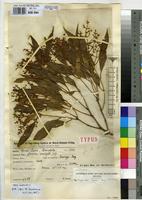
Isotype of Linociera urophylla Gilg [family OLEACEAE]
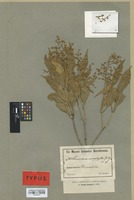
Type of Linociera urophylla Gilg [family OLEACEAE]
Previous
Next

Name

Identification
Olea urophylla (Gilg) Gilg&Schellenb. [family OLEACEAE ] (stored under name); Linociera urophylla Gilg [family OLEACEAE ]
Related name
  • Olea capensis
  • Linociera urophylla
  • Olea urophylla

Flora

Entry for LINOCIERA urophylla Gilg [family OLEACEAE]
Herbarium
Royal Botanic Gardens, Kew (K)
Collection
Flora of Tropical Africa
Resource Type
Reference Sources
Entry From
Flora of Tropical Africa, Vol 4, Part 1, page 1, (1904) Author: (By J. G. Baker.)
Names
LINOCIERA urophylla Gilg [family OLEACEAE], in Engl. Jahrb. xxx. 373.
Information
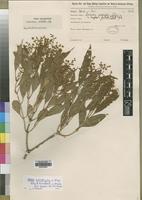
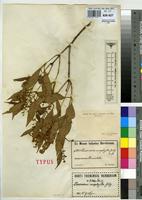
A tall tree, glabrous in all its parts, with smooth grey bark. Leaves distinctly petioled, lanceolate, 2–3 in. long, 1/2– 2/3 in. broad, conspicuously acuminate, narrowed gradually to the base, entire, subcoriaceous, shining on the upper surface, opaque beneath; veins few, conspicuous on the underside of the leaf. Panicles lax, terminal. Calyx subcampanulate, nearly entire, 1/2 lin. long. Petals ovate or oblong, twice as long as the calyx, spreading. Anthers sessile.
Distribution
German East Africa Mozamb. Dist. Upper Kondeland; Usenga mountains, at Umalila, 6500 ft., Goetze, 1364.
Notes
L. gilgiana, Volkens, from Mount Kilimanjaro, mentioned by Gilg in Engl. Jahrb. xxx. 374, has also a terminal inflorescence, but has not further been described.

Related Materials

  • Terms and Conditions
  • Privacy Policy
  • Cookie Policy
  • Cookie Settings
  • Accessibility
  • Help
  • Contact Us
  • Facebook
  • Twitter
ITHAKA

JSTOR is part of ITHAKA, a not-for-profit organization helping the academic community use digital technologies to preserve the scholarly record and to advance research and teaching in sustainable ways.

©2000-2026 ITHAKA. All Rights Reserved. JSTOR®, the JSTOR logo, JPASS®, Aluka®, and ITHAKA® are registered trademarks of ITHAKA.

╳