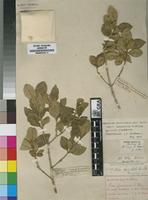
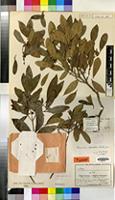
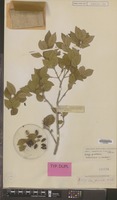
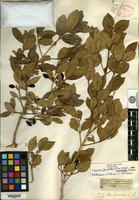
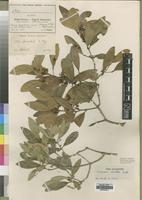
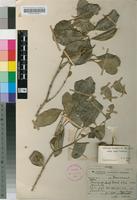
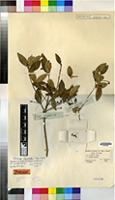
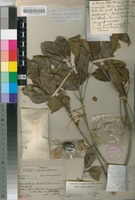
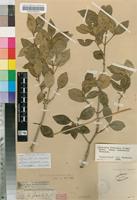
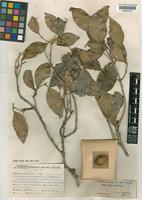
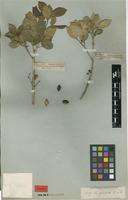
Small trees, sometimes up to 10 m high or forest trees up to 30 m high; ultimate twigs short, usually with 2 pairs of leaves, glabrous or tomentulose. Leaves varying in size and texture, glabrous or sparsely pubescent at base and on midrib, ovate-oblong, oblong-elliptic or oblong, rounded or shortly cuneate at base (in coppice shoots rounded to cordate at base), shortly or gradually narrowed to an obtuse apex, or with a broad, sometimes retuse, acumen at apex, 2-7 cm long (if longer then under 3 cm broad) and 1 • 3-3 ? 7 cm broad, very minutely and obscurely scaly, especially on lower surface, appearing as if minutely pitted, acarodomatia usually present in the axils of the leaves below; petiole 2-7 mm long. Inflorescence short, laxly flowered, cymose panicles, axillary and on the old wood, glabrous, or bracts and calyces setulose, glabrescent, 0-5-3 cm long, peduncles sometimes reduced, giving the appearance of fascicled inflorescences. Calyx 1 • 5-2 mm long, 4-lobed to beyond the middle; lobes rounded at the apex, usually ciliate. Corolla white, sometimes tinted pink, sweetly scented, about 5 mm long, 4-lobed almost to the base and between alternate lobes right to the base; lobes about 4 mm long with margins deeply infolded and apex cucullate (like a mocassin toe), appearing longer than broad. Stamens normally 2 (4 found in some flowers), inserted on the short tube between alternate lobes; filaments fused on corolla-tube and only slightly longer than it; anthers about 1 • 75 mm long and 1 • 5 mm broad. Ovary subglobose; stigma subcapitate, obscurely 2-lobed; ovules 2, attached ventrally, usually near the base. Fruit green, turning blackish or purplish-black when mature, subglobose to oblong, 1 • 5-2 • 8 cm long and 0 • 8-2 cm broad.