

Compilation
Leucosphaera bainesii
2 Images see all
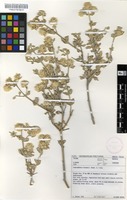
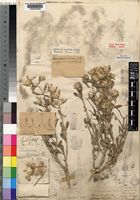
Name
Identification
Sericocomopsis bainesii (Hook.f.) Schinz [family AMARANTHACEAE ] Marcellia bainesii (Hook.f.) C.B.Clarke [family AMARANTHACEAE ] Leucosphaera bainesii (Hook.f.) Gilg [family AMARANTHACEAE ] (stored under name); Sericocoma bainesii Hook.f. [family AMARANTHACEAE ]
Related name
- Sericocoma bainesii
- Marcellia bainesii
- Leucosphaera bainesii
- Sericocomopsis bainesii
Flora
Entry for Leucosphaera bainesii Hook. f. Gilg [family AMARANTHACEAE]
Herbarium
Royal Botanic Gardens, Kew (K)
Collection
Flora Zambesiaca
Resource Type
Reference Sources
Entry From
FZ, Vol 9, Part 1, page 28, (1988) Author: C. C. Townsend
Names
Leucosphaera bainesii Hook. f. Gilg [family AMARANTHACEAE], in Engl. & Prantl Pflanzenfam. Nachtr. 3, 1a: 153 (1897).—Schinz in Viert. Nat. Ges. Zürich 56: 250 (1911); in Engl. & Prantl Pflanzenfam. ed. 2, 16 C: 45 (1934).—Cavaco in Mém. Mus. Hist. Nat. Paris Sér. B. 13: 83 (1962).—Podlech & Meeuse in Merxm. Prodr. Fl. SW. Afr. 33: 18 (1966). TAB. 17. Type: Botswana, Ngamiland, Kobi Pan to N. Shaw Valley, Baines s.n. 1863 (K, holotype).
Sericocoma bainesii Hook. f. [family AMARANTHACEAE], in Benth. & Hook. Gen. Pl. 3, 1: 31 (1880). Type as above.
Sericocomopsis bainesii Hook. f. Schinz [family AMARANTHACEAE], in Engl. Bot. Jahrb. 21: 185 (1895). Type as above.
Leucosphaera pfeilii Gilg [family AMARANTHACEAE], in Notizbl. Bot. Gart. Berl. 1: 328 (1897). Type from S. Africa.
Marcellia bainesii Hook. f. C.B. Clarke [family AMARANTHACEAE], in F.T.A. 6, 1: 51 (1909). Type as for L. bainesii.
Information
Dwarf shrub, 8–45 cm. tall, much-branched and frequently gnarled about the base; branches terete, striate, the older parts glabrescent with a greyish to brownish cortex, the young twigs densely canescent with appressed, whitish hairs. Leaves narrowly or broadly elliptic to lanceolate or ovate, 10–30 (40) × 3–12 (17) cm., subacute to acute (obtuse to retuse occasionally in the inferior leaves), equally densely furnished on both surfaces with appressed whitish hairs or somewnat less so above (glabrescent and darkening with age), cuneate or attenuate at the base with a short (2–5 mm. long) petiole. Inflorescence 1.5–2 cm. in diam., hemispherical in flower and more or less spherical in fruit, formed of densely set partial inflorescences of 1–2 fertile and 1–2 sterile flowers (very occasionally a triad may be found in the largest plants). Bracts deltoid lanceolate, hyaline, (3)4–5 mm. long, densely pilose centrally below and at the apex, shortly aristate with the excurrent darker midrib. Bracteoles of the partial inflorescences (5)7.7.5 mm. long, narrowly deltoid-ovate, hyaline, the darker midrib forming a plumose-hairy arista (1)2–3 mm. long; bracteoles of the sterile flowers c. (5)7 mm. long, densely hairy except at the extreme base, basal half narrowly elliptical or lanceolate, the upper half an arista formed by the excurrent plumose-pilose midrib. Sterile flowers of a few (2–4) narrow, plumose-hairy, linear, bracteoliform processes. Outer 2 tepals of fertile flowers c. (5.5)7–9 mm. long, lanceolate, obscurely 3-nerved, the excurrent midrib forming an arista (2)3–4 mm. long, margins hyaline below; inner 3 tepals similar, scarcely shorter but more expanded below with broader hyaline margins; aristae of all tepals plumose-hairy. Ovary pyriform, c. 1 mm. long, furnished with dense, erect, white hairs except at the extreme base; style slender, c. 3–4 mm. long. Stamens (2.5)3.5–4 mm. long; filaments slender, abruptly expanded in about the basal one-third and fused into a cup, with acute sinuses between; anthers narrowly oblong, c. 1 mm. long. Fruit shortly cylindrical, (1.5)2–2.25 mm. long, densely erect-pilose on the firm, flat apex, the delicate walls glabrous; seed brown, c. 2 mm. long, shining, feebly reticulate (not perfectly mature).
Habitat
Chiefly on sandy or loamy soil in or near pans in open places in Acacia bush, in overgrazed areas, on alluvial flood plains.
Distribution
Botswana SE Chukudu Pass, c 370 km. NW. of Molepolole, 22.vi.1955, Story 4955 (K; SRGH).Botswana SW Ghanzi, 20.ii.1960, Wild 5095 (K; SRGH).Zimbabwe S Beitbridge Distr., Shashe-Limpopo confluence, 22.iii.1959, Drummond 5951 (K; LISC; SRGH).Botswana N 113 km. W. of Nokaneng, 12.iii.1965, Wild & Drummond 6920 (K; LISC; SRGH).
Distribution (external)
Angola
Namibia
S. Africa (Cape Prov.)
Notes
The two specimens from Zimbabwe have among the smallest flowers seen, with short, squarrose awns; one has the basal cup of the androecium slightly separated, showing small lobules on each side of the filaments, but the other is quite normal in this respect. In size, specimens from Botswana grade into them, and there seems no need to regard them as a separate taxon.