JSTOR Global Plants Home
  • Home
  • Browse
  • About
  • Access
  • Account
    • Saved Items
    • Profile
  • Log in

Global Plants

Skip to Main Content
  • JSTOR Global Plants Home
  • Global Plants

    • Browse
    • About
    • Access
    • Account
      • Saved Items
      • Profile
Log in
  • Browse
  • About
  • Access
  • Account
    • Saved Items
    • Profile
Advanced Search

Compilation
Lepidium texanum

3 Images see all

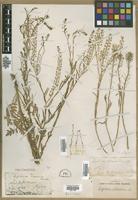
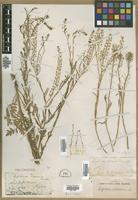
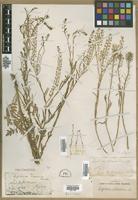
Type? of Lepidium texanum Buckley [family BRASSICACEAE]
Previous
Next

Name

Identification
Lepidium texanum Buckley [family BRASSICACEAE ] (stored under name); Verified by Not on Sheet,
Related name
  • Lepidium intermedium
  • Lepidium texanum

Flora

Entry for Lepidium ruderale Linnaeus [family CRUCIFERAE]
Herbarium
Flora of North America (FNA)
Collection
Flora of North America
Resource Type
Reference Sources
Entry From
Flora of North America, Vol 7,
Names
Lepidium ruderale Linnaeus [family CRUCIFERAE], Sp. Pl., 2: 645. 1753
Lepidium texanum Buckley [family CRUCIFERAE]
Lepidium virginicum Linnaeus subsp. texanum (Buckley) Thellung [family CRUCIFERAE]
Treatment Author(s)
Ihsan A. Al-Shehbaz
John F. Gaskin
Information
Annuals or biennials; (fetid); puberulent (trichomes cylind-rical). Stems simple from base, erect ascending, branched (several) distally, (0.5–)1–3.5(–5.5) dm. Basal leaves rosulate; petiole 1–3.2(–5.3) cm; blade (1- or) 2- or 3-pinnatisect (lobes oblong), (1.5–)3–5(–7.2) cm, margins (of lobes) usually entire, rarely dentate. Cauline leaves sessile; blade linear, (0.4–)1–2(–3) cm × 0.5–2.5(–3.5) mm, base cuneate, not auriculate, margins entire. Racemes considerably elongated in fruit; rachis puberulent, trichomes straight, cylindrical. Fruiting pedicels divaricate to horizontal, straight, (terete), (1.5–)2–4(–5) × 0.1–0.15 mm, puberulent. Flowers: sepals oblong, 0.5–0.9(–1) × 0.2–0.4 mm; petals (absent or rudimentary), white, linear, 0.2–0.5 × 0.1 mm, claw absent; stamens 2, median; filaments 0.7–0.8 mm; anthers 0.1–0.2 mm. Fruits elliptic, (1.5–)1.8–2.5(–3) × 1.5–2(–2.3) mm, apically winged, apical notch 0.1–0.2 mm deep; valves thin, smooth, not veined, glabrous; style obsolete or to 0.1 mm, included in apical notch. Seeds oblong to ovate-oblong, 1–1.5 × 0.6–0.8 mm. 2n = 16, 32.
Phenology
apr-may (spring), jun-jul (summer)
Altitude range
0–300 m;
Distribution
Eurasiaintroduced also in South AmericaAustralia.USA Ala.USA Ark.USA Calif.USA Del.USA Fla.USA Ind.USA La.USA MaineUSA Md.USA Mass.USA Mich.USA N.H.USA N.J.USA N.Mex.USA N.Y.USA N.C.USA OhioUSA Oreg.USA Pa.USA R.I.USA Tenn.USA Tex.Canada Alta.Canada B.C.Canada Man.Canada N.B.Canada Nfld. and Labr. (Nfld.)Canada N.S.Canada Ont.Canada P.E.I.Canada Que.Canada Sask.
Native/Introduced
introduced;

Related Materials

  • Terms and Conditions
  • Privacy Policy
  • Cookie Policy
  • Cookie Settings
  • Accessibility
  • Help
  • Contact Us
  • Facebook
  • Twitter
ITHAKA

JSTOR is part of ITHAKA, a not-for-profit organization helping the academic community use digital technologies to preserve the scholarly record and to advance research and teaching in sustainable ways.

©2000-2026 ITHAKA. All Rights Reserved. JSTOR®, the JSTOR logo, JPASS®, Aluka®, and ITHAKA® are registered trademarks of ITHAKA.

╳