JSTOR Global Plants Home
  • Home
  • Browse
  • About
  • Access
  • Account
    • Saved Items
    • Profile
  • Log in

Global Plants

Skip to Main Content
  • JSTOR Global Plants Home
  • Global Plants

    • Browse
    • About
    • Access
    • Account
      • Saved Items
      • Profile
Log in
  • Browse
  • About
  • Access
  • Account
    • Saved Items
    • Profile
Advanced Search

Compilation
Lepidium ramosissimum

11 Images see all

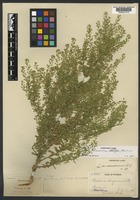
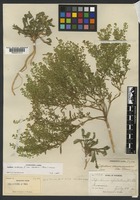
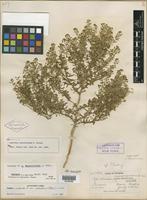
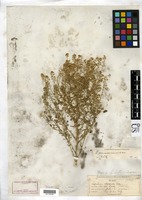
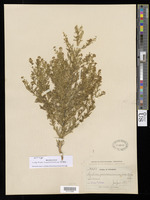
Syntype of Lepidium ramosissimum A. Nelson [family BRASSICACEAE]
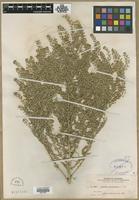
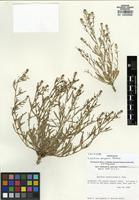
Type? of Lepidium ramosissimum A.Nelson [family BRASSICACEAE]
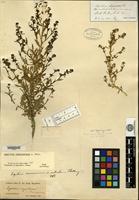
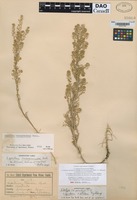
Type of Lepidium ramosissimum A. Nelson var. robustum Thellung [family BRASSICACEAE]
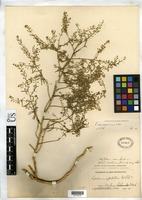
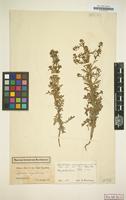
Lepidium ramosissimum A. Nelson [family BRASSICACEAE]
Syntype of Lepidium ramosissimum A. Nelson [family BRASSICACEAE]
Isotype of Lepidium paysonii Rollins [family BRASSICACEAE]
Isotype of Lepidium fletcheri Rydb. [family BRASSICACEAE]
Type? of Lepidium ramosissimum var. robustum Thell. [family CRUCIFERAE]
Isosyntype of Lepidium ramosissimum A. Nelson [family BRASSICACEAE]
Lepidium ramosissimum A. Nelson [family BRASSICACEAE]
Syntype of Lepidium ramosissimum A. Nelson [family BRASSICACEAE]
Previous
Next

Name

Identification
Lepidium ramosissimum [family CRUCIFERAE ] (stored under name); Verified by Not on sheet.,
Related name
  • Lepidium ramosissimum
  • Lepidium paysonii

Flora

Entry for Lepidium ramosissimum A. Nelson [family CRUCIFERAE]
Herbarium
Flora of North America (FNA)
Collection
Flora of North America
Resource Type
Reference Sources
Entry From
Flora of North America, Vol 7,
Names
Lepidium ramosissimum A. Nelson [family CRUCIFERAE], Bull. Torrey Bot. Club, 26: 124. 1899
Lepidium bourgeauanum Thellung [family CRUCIFERAE]
Lepidium densiflorum Schrader var. bourgeauanum (Thellung) C. L. Hitchcock [family CRUCIFERAE]
Lepidium divergens Osterhout [family CRUCIFERAE]
Lepidium fletcheri Rydberg [family CRUCIFERAE]
Lepidium ramosissimum var. bourgeauanum (Thellung) Rollins [family CRUCIFERAE]
Lepidium ramosissimum var. divergens (Osterhout) Rollins [family CRUCIFERAE]
Lepidium ramosissimum var. robustum Thellung [family CRUCIFERAE]
Treatment Author(s)
Ihsan A. Al-Shehbaz
John F. Gaskin
Information
Perennials; puberulent, (trichomes cylindrical). Stems simple from base, erect, branched (several) distally, (0.6–)1–5.3(–7.7) dm. Basal leaves (soon withered); not rosulate; petiole 1–4 cm; blade oblanceolate or pinnatifid, 2–5 cm × 8–15 mm, margins (of lobes) entire serrate or dentate. Cauline leaves shortly petiolate or sessile; blade oblanceolate or (distal) linear, (0.6–)1.2–4.8(–6) cm × 1–8(–10) mm, base attenuate to cuneate, not auriculate, margins dentate, (distal) entire, or, rarely, lobed. Racemes slightly elongated in fruit; rachis puberulent, trichomes curved, cylindrical to subclavate. Fruiting pedicels divaricate-ascending to horizontal, straight or recurved, (terete), (1.6–)2–3.8(–5) × 0.2–0.3 mm, usually puberulent adaxially, rarely throughout. Flowers: sepals oblong, 0.6–0.9(–1.1) × 0.3–0.4 mm; petals (absent or rudimentary), white, linear, 0.2–0.8(–1) × 0.05–0.1 mm, claw absent; stamens 2, median; filaments 0.6–0.9 mm; anthers 0.15–0.2 mm. Fruits elliptic, 2.2–3.2 × 1.7–2.1mm, apically winged, apical notch 0.1–0.3(–0.4) mm deep; valves thin, smooth, not veined, glabrous or puberulent at least along margin; style usually obsolete, rarely to 0.1 mm, included in apical notch. Seeds oblong, 1.2–1.6 × 0.8–0.9 mm. 2n = 32, 64.
Phenology
jun-aug (summer)
Altitude range
0–2900 m;
Distribution
Mexico (Chihuahua).USA AlaskaUSA Calif.USA Colo.USA IdahoUSA MaineUSA Minn.USA Mont.USA Nebr.USA Nev.USA N.Mex.USA N.Dak.USA S.Dak.USA Tex.USA UtahUSA Wyo.Canada Alta.Canada B.C.Canada Man.Canada N.B.Canada Nfld. and Labr. (Nfld.)Canada N.W.T.Canada Ont.Canada Que.Canada Sask.Canada Yukon
Discussion
As noted by R. C. Rollins (1993, p. 581), the varieties of Lepidium ramosissimum are “weak at best.” They are based largely on the branching habit and, most importantly, on the presence versus absence of trichomes on the fruit valve. In some collections (e.g., Scoggan 4233, GH; Boivin et al., 13221, GH), both puberulent- and glabrous-fruited forms occur. It is almost certain that the same situation exists not only in other populations of this species, but in other North American Lepidium. It is also clear that some populations might consist entirely of one of the two forms, but it is highly unlikely that this variation has any geographical basis. Therefore, we believe that the separation of varieties solely on the basis of presence or absence of the fruit trichomes is taxonomically meaningless.
We are reluctantly including Lepidium divergens in the synonymy of L. ramosissimum because we have not seen its type; the topotypes that we studied have broadly obovate to suborbicular fruits that appear more at home in the L. densiflorum or L. virginicum complexes.

Related Materials

  • Terms and Conditions
  • Privacy Policy
  • Cookie Policy
  • Cookie Settings
  • Accessibility
  • Help
  • Contact Us
  • Facebook
  • Twitter
ITHAKA

JSTOR is part of ITHAKA, a not-for-profit organization helping the academic community use digital technologies to preserve the scholarly record and to advance research and teaching in sustainable ways.

©2000-2026 ITHAKA. All Rights Reserved. JSTOR®, the JSTOR logo, JPASS®, Aluka®, and ITHAKA® are registered trademarks of ITHAKA.

╳