JSTOR Global Plants Home
  • Home
  • Browse
  • About
  • Access
  • Account
    • Saved Items
    • Profile
  • Log in

Global Plants

Skip to Main Content
  • JSTOR Global Plants Home
  • Global Plants

    • Browse
    • About
    • Access
    • Account
      • Saved Items
      • Profile
Log in
  • Browse
  • About
  • Access
  • Account
    • Saved Items
    • Profile
Advanced Search

Compilation
Lepidium austrinum

12 Images see all

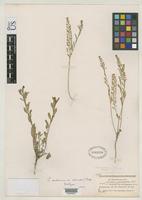
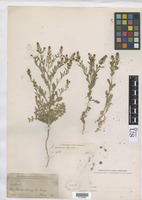
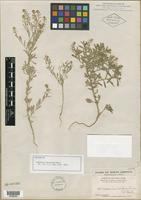
Isotype of Lepidium austrinum var. orbiculare Thellung, A. 1906 [family BRASSICACEAE]
Isotype of Lepidium austrinum var. orbiculare Thell. [family BRASSICACEAE]
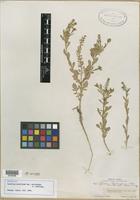
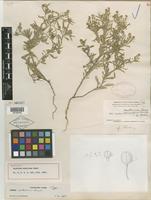
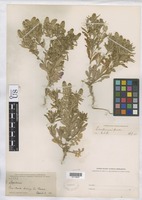
Lepidium austrinum Small [family BRASSICACEAE]
Isotype of Lepidium austrinum Small, J.K. 1903 [family BRASSICACEAE]
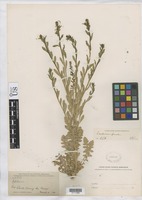
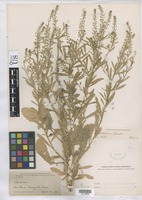
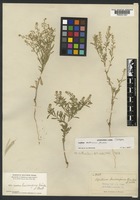
Lepidium austrinum Small [family BRASSICACEAE]
Holotype of Lepidium austrinum Small [family BRASSICACEAE]
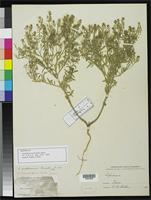
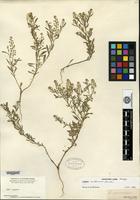
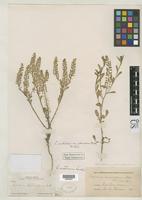
Lepidium austrinum Small [family BRASSICACEAE]
Isotype of Lepidium austrinum Small [family BRASSICACEAE]
Lepidium austrinum Small [family BRASSICACEAE]
Isotype of Lepidium austrinum Small [family BRASSICACEAE]
Isotype of Lepidium austrinum var. orbiculare Thellung, A. 1906 [family BRASSICACEAE]
Previous
Next

Name

Identification
Isotype of Lepidium austrinum Small [family BRASSICACEAE ] (stored under name); Verified by Small, 1903
Related name
  • Lepidium austrinum

Flora

Entry for Lepidium austrinum Small [family CRUCIFERAE]
Herbarium
Flora of North America (FNA)
Collection
Flora of North America
Resource Type
Reference Sources
Entry From
Flora of North America, Vol 7,
Names
Lepidium austrinum Small [family CRUCIFERAE], Fl. S.E. U.S., 468, 1331. 1903
Lepidium austrinum var. orbiculare Thellung [family CRUCIFERAE]
Lepidium lasiocarpum var. orbiculare (Thellung) C. L. Hitchcock [family CRUCIFERAE]
Treatment Author(s)
Ihsan A. Al-Shehbaz
John F. Gaskin
Information
Annuals or biennials; often densely hirsute, (trichomes cylindrical). Stems often simple from base, erect, branched distally, (1.5–)2–6.7(–9.4) dm. Basal leaves (later withered); rosulate; petiole (0.7–)1.5–4.5 cm; blade pinnatifid, 2–8.3 cm × 9–26 mm, margins (of lobes) entire or dentate. Cauline leaves shortly petiolate; blade oblanceolate to nearly linear, 1–4.5(–6.2) cm × 3–10(–17) mm, base attenuate to cuneate, not auriculate, margins entire or dentate. Racemes much-elongated in fruit; rachis pubescent, trichomes curved, with fewer and longer, straight ones. Fruiting pedicels usually divaricate, rarely horizontal, straight or slightly recurved, (terete), (2.5–)3–4.1(–4.7) × 0.2 mm, puberulent adaxially. Flowers: sepals oblong, 0.8–1 × 0.2–0.4 mm; petals (sometimes absent), white, oblanceolate, 0.4–1.6 × 0.1–0.8 mm, claw absent; stamens 2, median; filaments 0.8–1 mm; anthers 0.1–0.2 mm. Fruits elliptic-obovate to obovate-orbicular, 2.4–3.2 × 1.8–2.5 mm, apically winged, apical notch 0.2–0.5 mm deep; valves thin, smooth, not veined, sparsely puberulent, (trichomes often antrorsely appressed, sometimes restricted to margin); style 0.05–0.1 mm, included in apical notch. Seeds ovate, 1.4–1.6 × 0.7–0.9 mm.
Phenology
mar-may (spring), jun (summer)
Distribution
Mexico (Coahuila).Mexico (Nuevo León).Mexico (San Luis Potosí).USA Kans.USA La.USA Miss.USA N.Mex.USA Okla.USA Tex.

Related Materials

  • Terms and Conditions
  • Privacy Policy
  • Cookie Policy
  • Cookie Settings
  • Accessibility
  • Help
  • Contact Us
  • Facebook
  • Twitter
ITHAKA

JSTOR is part of ITHAKA, a not-for-profit organization helping the academic community use digital technologies to preserve the scholarly record and to advance research and teaching in sustainable ways.

©2000-2026 ITHAKA. All Rights Reserved. JSTOR®, the JSTOR logo, JPASS®, Aluka®, and ITHAKA® are registered trademarks of ITHAKA.

╳