JSTOR Global Plants Home
  • Home
  • Browse
  • About
  • Access
  • Account
    • Saved Items
    • Profile
  • Log in

Global Plants

Skip to Main Content
  • JSTOR Global Plants Home
  • Global Plants

    • Browse
    • About
    • Access
    • Account
      • Saved Items
      • Profile
Log in
  • Browse
  • About
  • Access
  • Account
    • Saved Items
    • Profile
Advanced Search

Compilation
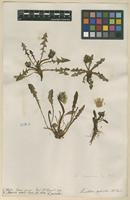
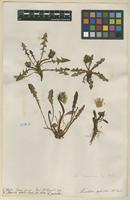
Leontodon palustris

2 Images see all

Filed as Leontodon palustris Lyons [family ASTERACEAE]
Previous
Next

Name

Identification
Leontodon palustris Lyons [family ASTERACEAE ] (stored under name); Verified by Not on sheet, Leontodon taraxacum L. [family ASTERACEAE ] Verified by Smith, Sir James Edward,
Related name
  • Leontodon palustre
  • Leontodon palustris
  • Leontodon taraxacum
Common name
  • pissenlit palustre, Flora of North America Vol. 19
  • Marsh dandelion, Flora of North America Vol. 19

Flora

Entry for Taraxacum palustre (Lyons) Symons [family COMPOSITAE]
Herbarium
Flora of North America (FNA)
Collection
Flora of North America
Resource Type
Reference Sources
Entry From
Flora of North America, Vol 19,
Names
Taraxacum palustre (Lyons) Symons [family COMPOSITAE], Syn. Pl. Ins. Brit., 172. 1798
Leontodon palustris Lyons [family COMPOSITAE], Fasc. Pl. Cantabr., 48. 1763 (as palustre)
Taraxacum turfosum (Schultz-Bipontinus) van Soest [family COMPOSITAE]
Treatment Author(s)
Luc Brouillet
Information
Plants 5–6.5(–10 in fruit) cm; taproots seldom branched. Stems 1–5+, decumbent to ascending, purple, (rarely exceeding foliage before fruiting), sparsely villous or glabrate to ± densely villous distally. Leaves 10+, horizontal to ± erect; petioles often purplish (midveins also), ± narrowly winged; blades oblanceolate to linear-oblanceolate, 2.5–9 × 0.2–1.1 cm, bases attenuate to long-cuneate, margins usually toothed, sometimes pinnately, shallowly lobed, lobes fewer than 10 per side, remote, (and teeth) straight to retrorse, narrow, deltate to narrowly triangular, often acuminate, apices obtuse to acute, faces glabrous or sparsely villous (particularly along midveins). Calyculi 10–15, appressed to spreading, pale to dark purplish green, ovate to elliptic bracklets in 2 series, 6–8.5 × 2–5 mm, margins ± purplish, widely scarious, apices acuminate to caudate, hornless. Involucres green to grayish green, campanulate, 12–16 mm. Phyllaries 14–16 in 2 series, lanceolate to lance-linear, 1.5–2.5 mm wide, margins scarious to narrowly scarious in proximal 1/2, apices long-acuminate, erose-scarious, hornless. Florets ca. 50; corollas yellow, outer abaxially gray-striped, 13–14 × 1.4–2.2 mm. Cypselae straw-colored to olivaceous, bodies narrowly obovoid, 2.8–4 mm, cones terete, 0.8–1 mm, beaks slender, 7–9 mm, ribs ca. 6, sharp, faces slightly muricate in distal 1/3; pappi white to cream, 4.5–6.5 mm. 2n = 24, 32, 40 (reported for complex in Europe).
Phenology
early spring
Altitude range
10–100 m;
Distribution
Europe.USA Mich.USA N.Y.Canada Ont.Canada Que.
Discussion
This small dandelion has only recently been reported from North America (D. F. Brunton 1989). It has now spread east into Quebec, where it is known beyond the Montreal area, west into Michigan, and south into northern New York state. It is mostly spreading in wet ditches along highways and flowers in early spring.
It clearly belongs to sect. Palustria. Until it is firmly associated with a European species, I am using the name Taraxacum palustre. The name T. cognatum Štepánek & Kirschner, which designates a microspecies from central Europe, has been applied to a North American specimen sent by D. F. Brunton to J. Kirschner.
Native/Introduced
introduced;

Related Materials

  • Terms and Conditions
  • Privacy Policy
  • Cookie Policy
  • Cookie Settings
  • Accessibility
  • Help
  • Contact Us
  • Facebook
  • Twitter
ITHAKA

JSTOR is part of ITHAKA, a not-for-profit organization helping the academic community use digital technologies to preserve the scholarly record and to advance research and teaching in sustainable ways.

©2000-2026 ITHAKA. All Rights Reserved. JSTOR®, the JSTOR logo, JPASS®, Aluka®, and ITHAKA® are registered trademarks of ITHAKA.

╳