JSTOR Global Plants Home
  • Home
  • Browse
  • About
  • Access
  • Account
    • Saved Items
    • Profile
  • Log in

Global Plants

Skip to Main Content
  • JSTOR Global Plants Home
  • Global Plants

    • Browse
    • About
    • Access
    • Account
      • Saved Items
      • Profile
Log in
  • Browse
  • About
  • Access
  • Account
    • Saved Items
    • Profile
Advanced Search

Compilation
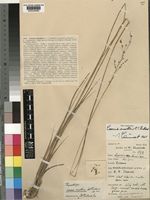
Leersia oncothrix

2 Images see all

Leersia oncothrix C.E.Hubb. [family POACEAE]
Type of Leersia oncothrix C.E.Hubb. [family POACEAE]
Previous
Next

Name

Identification
Leersia oncothrix C.E.Hubb. [family POACEAE ] (stored under name);
Related name
  • Leersia hexandra
  • Leersia oncothrix

Flora

Entry for Leersia oncothrix C. E. Hubb. [family GRAMINEAE]
Herbarium
Royal Botanic Gardens, Kew (K)
Collection
Flora Zambesiaca
Resource Type
Reference Sources
Entry From
FZ, Vol 10, Part 1, (1971) Author: E. Launert
Names
Leersia oncothrix C. E. Hubb. [family GRAMINEAE], in Kew Bull. 1934: 263 (1935). — Melderis in Svensk Bot. Tidskr. 40: 228 (1946). — Launert in Senckenb. Biol. 46: 140, fig. 1, 21 (1965). TAB. 7 fig. D. Type: Zambia, Kalomo, Trapnell 993 (K).
Information
A loosely caespitose perennial, often with short rhizomes. Culms 30-85 (-120) cm. high, 2-4-noded, erect or geniculately ascending, often rooting at the lower nodes, simple or branched, subterete, slender, smooth, glabrous but pubescent at the nodes. Leaf-sheaths striate, somewhat loose, smooth, glabrous, auriculated at the mouth; the lowermost usually longer than the internodes and often splitting into irregular fibres. Ligule 2·3-6(-9) mm. long, oblong-lanceolate to triangular-lanceolate, often lacerate at the apex. Leaf-laminae 5-25(-33) x 0·2-0·36 cm., narrowly linear, tapering to a setaceous point, expanded, conduplicate or with the margins involute, usually slightly curved, flexible, glabrous, smooth or scaberulous on both surfaces. Panicle 10-28 x 1·5-3 cm., narrowly elliptic to oblong in outline, erect or somewhat nodding, often purplish; rhachis slender, terete or obtusely angular, asperulous; branches 8-12 cm. long, solitary or rarely adnate, slender, erect or rarely somewhat spreading, branched in the upper half; racemes bearing 3-7(-9) spikelets. Pedicels less than 1mm. long. Spikelets 3·5-4(-4·25) x (1·5)1·7-2 mm., elliptic-oblong or oblong; callus short. Lemma as long as the spikelet, semi-elliptic-oblong in lateral view, cartilaginous, finely transversely ridged; keel and margins with a row of semi-circularly curved cilia; flanks more or less densely covered by inwardly curved hairs similar to the cilia along the margins; lateral nerves distinct. Palea slightly shorter and narrower than the lemma and of the same consistency; keels and flanks as in the lemma; margins glabrous. Anthers c. 2·5 mm. long, linear. Caryopsis unknown.
Habitat
In flooded grassland or small pools, around edges of termite mounds, on sour soil
Distribution
Zambia S Mapanza E., 21.iii.1954, Robinson 626 (K; SRGH).Zambia N Kasama, Chibutubutu flood plain, 1220 m., 19.ii.1962, Vesey-FitzGerald 3748 (BM; SRGH).

Related Materials

  • Terms and Conditions
  • Privacy Policy
  • Cookie Policy
  • Cookie Settings
  • Accessibility
  • Help
  • Contact Us
  • Facebook
  • Twitter
ITHAKA

JSTOR is part of ITHAKA, a not-for-profit organization helping the academic community use digital technologies to preserve the scholarly record and to advance research and teaching in sustainable ways.

©2000-2026 ITHAKA. All Rights Reserved. JSTOR®, the JSTOR logo, JPASS®, Aluka®, and ITHAKA® are registered trademarks of ITHAKA.

╳