JSTOR Global Plants Home
  • Home
  • Browse
  • About
  • Access
  • Account
    • Saved Items
    • Profile
  • Log in

Global Plants

Skip to Main Content
  • JSTOR Global Plants Home
  • Global Plants

    • Browse
    • About
    • Access
    • Account
      • Saved Items
      • Profile
Log in
  • Browse
  • About
  • Access
  • Account
    • Saved Items
    • Profile
Advanced Search

Compilation
Lasianthus macrocalyx

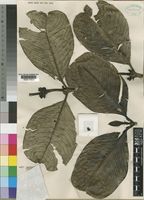
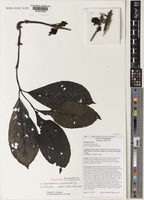
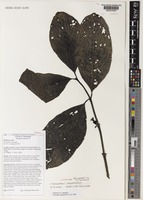
3 Images see all

Lasianthus macrocalyx K. Schum. [family RUBIACEAE]
Isoneotype of Lasianthus macrocalyx K.Schum. [family RUBIACEAE]
Previous
Next

Name

Identification
Lasianthus wallacei E.A.Bruce [family RUBIACEAE ] Lasianthus grandifolius Verdc. [family RUBIACEAE ] Lasianthus macrocalyx K. Schum. [family RUBIACEAE ] (stored under name); Verified by Jannerup, P.L.,
Related name
  • Lasianthus wallacei
  • Lasianthus grandifolius
  • Lasianthus macrocalyx

Flora

Entry for LASIANTHUS macrocalyx K. Schum. [family RUBIACEAE]
Herbarium
Royal Botanic Gardens, Kew (K)
Collection
Flora of Tropical East Africa
Resource Type
Reference Sources
Entry From
Flora of Tropical East Africa, page 1, (1976) Author: B. VERDCOURT
Names
LASIANTHUS macrocalyx K. Schum. [family RUBIACEAE], in E.J. 28: 499 (1900); T.T.C.L.: 503 (1949). Type: Tanzania, Uluguru Mts., Lukwangule, Stuhlmann 9123 (B, holo. †)
Information
Spreading shrub (1–)2–3 m. tall, occasionally epiphytic; stems glabrous and drying blackish when young, usually ± 2-ribbed. Leaf-blades oblong or elliptic, 6–23 cm. long, 3.5–13 cm. wide, [acute] shortly but distinctly acuminate at the apex, cuneate at the base, glabrous above, hairy on the nerves beneath; lateral nerves 8–14 pairs, sometimes appearing impressed on some young leaves but probably not genuinely so and mostly slightly raised; petiole 1–2.8 cm. long; stipules oblong-triangular, 5–8(–10) mm. long, [glabrous] shortly hairy inside and at margins. Flowers in subsessile or shortly pedunculate 2-several-flowered fascicles on older parts of stems; peduncles 0.3–1[1.5–2] cm. long; bracts and bracteoles ovate, hairy inside. Calyx violet; tube turbinate, 4 mm. long, glabrous; limb-tube 2.5 mm. long; lobes 3, ovate, 0.8–1 cm; long, 0.7–1 cm. wide, venose, glabrous save for a few scattered hairs on the midvein outside near apex [calyx elongate-tubulose, 7–8 mm. long, denticulate]. Corolla white, flushed violet, fleshy; tube 1.2–1.3 cm. long, 4.5–6 mm. wide, hairy inside; lobes 5–6, lanceolate, 6–8 mm. long, thickened at the apex, hairy inside. Stamens included in long-styled form. Ovary 6-locular; style 1.4 cm. long, finely ribbed, just exserted; stigma-lobes 6, linear-oblong, 2.2 mm. long. Fruit [pale steel blue] or cobalt blue, [0.8–1 cm. diameter], 6-locular, grooved between the pyrenes in dry state, crowned with the persistent calyx; pyrenes dark red-brown, segment-shaped, ± lunate, 7.5 mm. long, 4 mm. wide, 3 mm. thick, strongly pointed at the basal end, apically truncate, so that the general effect is that of a bird’s head, excavated around the hilar area, faintly rugose.
Range
DISTR. T6 not known elsewhere
Altitude range
1800–2430 m.
Distribution
TANZANIA Morogoro District Uluguru Mts., Lukwangule Plateau, above Chenzema Mission, 13 Mar. 1953, Drummond & Hemsley 1527! & same locality, Jan. 1975, Polhill & Wingfield 4646! & Bondwa Peak, 12 Oct. 1969, Gibson & Pócs 6051/V!
Notes
There are some discrepancies between the material I have ascribed to this species and the original description, the most serious being the description of the calyx as denticulate. I feel there is an error here, but only extensive surveys will prove this. Major discrepancies or dimensions given for the type which do not agree with the recent material are enclosed in square brackets. Unfortunately the mature fruits mentioned on the field- of the Drummond & Hemsley material are not present on the specimen nor in the spirit material.

Related Materials

  • Terms and Conditions
  • Privacy Policy
  • Cookie Policy
  • Cookie Settings
  • Accessibility
  • Help
  • Contact Us
  • Facebook
  • Twitter
ITHAKA

JSTOR is part of ITHAKA, a not-for-profit organization helping the academic community use digital technologies to preserve the scholarly record and to advance research and teaching in sustainable ways.

©2000-2026 ITHAKA. All Rights Reserved. JSTOR®, the JSTOR logo, JPASS®, Aluka®, and ITHAKA® are registered trademarks of ITHAKA.

╳