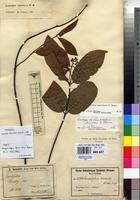
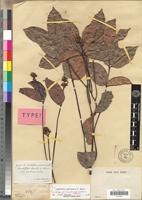
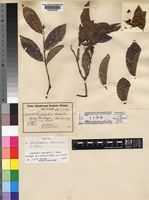
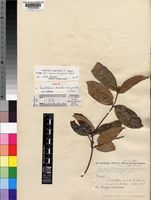
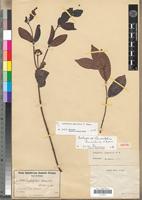
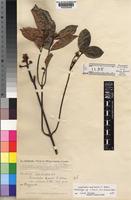
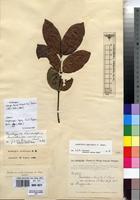
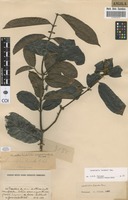
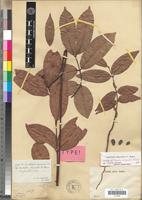
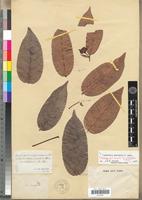
A small undershrub, scantily branched or producing only subherbaceous simple shoots, about 1 1/2 ft. high, with scanty short tendrils; young branches pubescent to tomentose, at length glabrescent, dark brown or blackish when dry, old bark dotted with numerous very minute lenticels. Leaves ovate-oblong or ovate-elliptic, rarely oblong, shortly and obtusely acuminate, rounded at the base, rarely obscurely cordate, 3–4 1/2 in. long, 1–1 3/4 in. broad, thinly coriaceous, glabrous above, softly pubescent beneath or finally glabrescent; midrib channelled above, prominent below; secondary nerves 6–7 on each side, more or less curved, connected by strongly curved arches approaching the margins within 1–2 lin., faintly raised like the loosely reticulating veins; petiole 1–3 lin. long. Panicles shortly peduncled, small, compact, fulvo-tomentose, rarely elongate with distant spreading or recurved branches; peduncle up to 1 in. long; bracts broad-ovate, subacute, the lower early deciduous; pedicels hardly any. Calyx 1 1/2 lin. long, fulvo-tomentose; sepals very broad, ovate, obtuse or subacute. Corolla-tube cylindric, wide, widest between the middle and the mouth, 3–3 1/4 lin. long, more or less tomentose without at least in the upper part, villous within in the upper third; lobes oblong, subacute, spreading or reflexed, fleshy, 2–3 lin. long, finely pubescent on both sides. Stamens inserted in the upper third of the tube; anthers oblong, subacute. Ovary turbinate, top convex, finely tomentose. Style and stigma 2 lin. long, the latter conical, shortly bifid. Fruit of the shape of an ordinary plum, about 1 1/4 in. long, 3/4 in. in diam. (or of the size of an apple according to Schlechter).