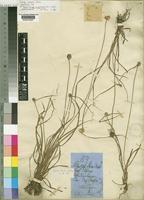
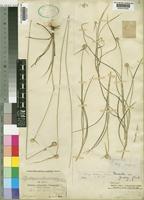
Kyllinga buchananiC.B.Clarke [family CYPERACEAE ] (stored under name); Verified by Mtotomwema, Kyllinga buchananiC.B.Clarke [family CYPERACEAE ] Verified by C.B.Clarke, Kyllinga crassipesBoeck. [family CYPERACEAE ] Verified by Mtotomwema, Cyperus sublaevicarinatusMattf. & Kük. [family CYPERACEAE ] Verified by Mtotomwema,
Related name
Cyperus sublaevicarinatus
Kyllinga alba
Kyllinga crassipes
Kyllinga buchanani
Flora
Entry for KYLLINGA Buchanani C. B. Clarke [family CYPERACEAE]
Herbarium
Royal Botanic Gardens, Kew (K)
Collection
Flora Capensis
Resource Type
Reference Sources
Entry From
Flora Capensis, Vol 7, page 149, (1900) Author: (By C. B. CLARKE.)
Names
KYLLINGA BuchananiC. B. Clarke [family CYPERACEAE]
Information
glabrous; rhizome hardly any; stems 6–15 in. long, tufted, hardly thickened at the base; leaves often 2/3 as long as the stem, 1/8– 1/6 in. broad; bracts 3, spreading, lowest 4 in. long, similar to the leaves; spike 1, globose or subovoid, 1/3 in. long, straw-coloured; spikelets 1/5 in. long, elliptic-oblong, often perfecting 2 nuts; glumes 1-coloured, hardly acute, with impressed glandular dots; keel wingless, not at all green, smooth; style 2-fid; nut 1/2 as long as the glume, yellow-brown. null
Range
Also in the Shire Highlands, British Central Africa.
Distribution
EASTERN REGION Natal; Umzula, Mudd!
Notes
The keel of the fertile glume is wingless; yet this species may prove only an extreme state of K. alba.