JSTOR Global Plants Home
  • Home
  • Browse
  • About
  • Access
  • Account
    • Saved Items
    • Profile
  • Log in

Global Plants

Skip to Main Content
  • JSTOR Global Plants Home
  • Global Plants

    • Browse
    • About
    • Access
    • Account
      • Saved Items
      • Profile
Log in
  • Browse
  • About
  • Access
  • Account
    • Saved Items
    • Profile
Advanced Search

Compilation
Kniphofia typhoides

5 Images see all

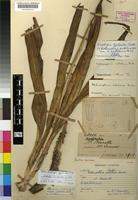
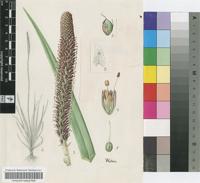
Isotype of Kniphofia typhoides Codd [family ASPHODELACEAE]
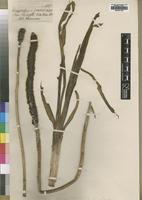
Type of Notosceptrum natalense Baker [family ASPHODELACEAE]
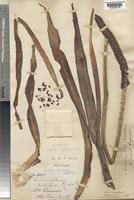
Holotype of Kniphofia typhoides Codd [family ASPHODELACEAE]
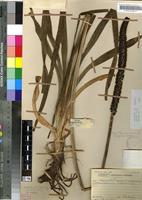
Filed as Kniphofia typhoides Codd [family ASPHODELACEAE]
Kniphofia typhoides Codd
Previous
Next

Name

Identification
Kniphofia typhoides Codd [family ASPHODELACEAE ]
Related name
  • Kniphofia typhoides

Flora

Entry for Kniphofia typhoides [family ALOACEAE]
Herbarium
South African National Biodiversity Institute, Compton Herbarium, Cape Town (SAM)
Collection
Flora of Southern Africa
Resource Type
Reference Sources
Entry From
Flora of South Africa, (2003) Author: Dr J.P. Roux
Names
Kniphofia typhoides [family ALOACEAE]
Common names
Notosceptrum natalense Baker: 285 (1896); Baker: t. 2523 (1897b); A.Berger: 71 (1908); non Kniphofia natalensis Baker.
Information
Plants with one to several stems from a short, thickened rhizome. Leaves more or less distic­hous, glaucous, ascending, 350-650 x 8-25 mm, shallowly channelled above, keeled, tend­ing to be spirally twisted, firm and semifleshy in texture; margin smooth. Scape overtopping leaves, 500-750 mm tall. Raceme cylindrical, very dense, 150-300 x 15-25 mm, rounded at apex; buds erect, dark brown; flowers ascend­ing to spreading, brown to purplish brown, faintly scented. Bracts obovate or subrotund to ovate, 4-6 mm long, rounded at apex; margin entire to minutely eroso-denticulate. Pedicels up to 0.5 mm long. Perianth subcampanulate or shortly cylindrical, 4.5-6.5 mm long; lobes ovate to rounded, 1.5 mm long, not spreading. Stamens exserted by 3-4 mm at anthesis. Fruit ovoid, more or less triquetrous, 5-6 mm long. Flowering time: February to March. Figure 5.
Habitat
Kniphofia typhoides is characterized by the ascending, glaucous, strap-shaped leaves ar­ranged in a more or less distichous manner, and the dense bullrush-like racemes of small brown flowers carried well above the leaves.
Use
5. Kniphofia typhoides Codd in The Flowering Plants of Africa 36: t. 1424 (1964d); Codd: 407 (1968); Retief & PPJ.Herman: 102 (1997). Type: Natal [KwaZulu-Natal], 'Klip River County', Mrs K. Saunders sub J.M. Wood 3895 (K,holo.!;BM!,NR!).
Range
Recorded from the northern districts of Kwa­Zulu-Natal, the eastern part of the North-West, Gauteng, Mpumalanga and northeastern Free State, at altitudes of 1 300-1 800 m. It is almost invariably found on black clay soil, and shows a preference for low-lying places. The type locality is given by Baker as Klip River County, but on the sheet in NH the locality is given as 'near Newcastle', which fits in better with the known distribution. Map 2.

Related Materials

  • Terms and Conditions
  • Privacy Policy
  • Cookie Policy
  • Cookie Settings
  • Accessibility
  • Help
  • Contact Us
  • Facebook
  • Twitter
ITHAKA

JSTOR is part of ITHAKA, a not-for-profit organization helping the academic community use digital technologies to preserve the scholarly record and to advance research and teaching in sustainable ways.

©2000-2026 ITHAKA. All Rights Reserved. JSTOR®, the JSTOR logo, JPASS®, Aluka®, and ITHAKA® are registered trademarks of ITHAKA.

╳