Entry From
Flora of South Africa, (2003) Author: Dr J.P. Roux
Common names
K. uvaria var. maxima Baker: t. 6533 (1881); A.Berger: 61 (1908). K. alooides var. maxima (Baker) Baker: 283 (1896). Type: Hortus kewensis, Oct 1879 ex Max Leichtlin (K, holo.!). K. alooides sensu Baker: 283 (1896), p.p., as to syn. K. praecox and probably K. alooides var. nobilis (Guillon) Baker and var. serotina Baker (see discussion). K. longicollis sensu Baker: t. 7623 (1898a), non Baker (1893c). K. uvaria var. praecox (Baker) A.Berger: 62 (1908), and probably var. nobilis (Guillon) A.Berger and var. serotina (Baker) A.Berger.
Habitat
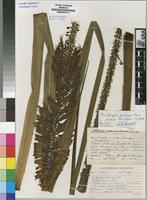
As indicated in Codd (1968: 448), a robust brid Kniphofia cropped up in European gar-ns in the early 1800s which, judging by the long, narrow bracts, was derived from K. bruceae (No. 22) crossed with one of the showy species such as K. uvaria (No. 44) or K. linearifolia (No. 46), both of which have shorter, ovate bracts. It is apparent that the hybrid produced several derivaÂtives which became widely accepted in cultivaÂtion under epithets such as uvaria and alooides, while the original K. uvaria was lost or was reÂgarded as inferior and less desirable from the horÂticultural viewpoint. The bract shape is virtually the only character which can be used to separate herbarium specimens of these hybrids from K. linearifolia, from which it follows that many illustrations which have been published over the years cannot be satisfactorily identified in the absence of a voucher specimen or a description or drawing of the bracts. From specimens preserved at Kew it may be concluded that the plant described as K. praeÂcox was one of these hybrid derivatives. It was grown in the garden of Mr W.W. Saunders of Reigate and said to have been introduced from the Cape by Thomas Cooper. However, it is considered that an error had crept into the garÂden records between Cooper's visit to South Africa in 1859-1862 and the subsequent prepaÂration of the Refugium botanicum t. 169 (Baker 1870). No specimen collected in the wild state by Cooper matching the type of K. praecox has been seen, though he did collect K. linearifolia (No. 3599 in K, Z). The name K. alooides var. serotina Hort. ex Baker: 283 (1896) may apply to the late-flowering form of K. praecox but no material has been traced and so its identity is uncertain.
Use
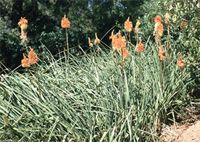
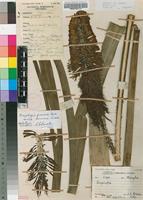
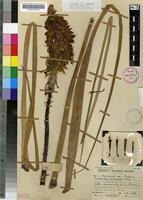
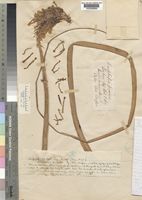
23. Kniphofia praecox Baker in SaunÂders, Refugium Botanicum: t. 169 (1870); Codd: 447 (1968), p.p., excl. Mogg s.n., Codd 9922, Marais 577, Van Breda & Admiraal 2174; Codd: 185 (1987); Goldblatt & J.C.Manning: 73 (2000). Type: ex Hort. Saunders (K, holo.!).