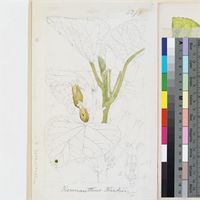
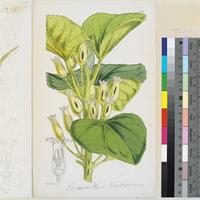
Sparingly branched herb or shrub with succulent stems to ± 1 m., arising from a tuberous rootstock; plant densely rusty-brown hairy; no tendrils. Leaf-blades some pale green, sometimes punctate near the margin beneath, not lobed, ovate to orbicular, base cordate to truncate, top subacute to rounded, 1.5–15 by 1–14 cm., 5-nerved from base to ± pinninerved; margin subentire or up to 5 mm. dentate; petiole 1–12 cm. Glands at blade-base 2, on the up to 10 mm. wide peltate blade-base; blade-glands 0; marginal glands minute, as blackish mucros on the teeth. Stipules linear, sometimes lacerate, 3–10 mm., pubescent. Inflorescences sessile, up to 10-flowered in ♂, 1–2-flowered in ♀; tendrils 0. Male flowers urceolate, including the 1–3.5 mm. long stipe 17–26 mm.; hypanthium broadly cup-shaped, 1.5–2 by 8–10 mm.; calyx-tube 8–17 mm., lobes ovate or ovate-oblong, obtusish, 3–5 mm., woolly-fimbriate; petals lanceolate to linear, 5–7 mm., 1 -nerved, fimbriate, inserted 2–9 mm. above the corona; filaments 3–5 mm., up to 1.5 mm. connate, inserted at the base of the hypanthium; anthers 6–7 mm., obtuse; septa 0; corona threads sparse, 1–2 mm., rarely absent; disk glands 1–2 mm. Female flowers urceolate, resembling ♂ flowers, including the ± 1.5 mm. long stipe 18–22 mm.; hypanthium 1–1.5 by 8–12 mm.; calyx-tube 12–14 mm., lobes 4–5 mm.; petals linear, ± 3 mm., 1 -nerved, fimbriate, inserted 6–7 mm. above the corona; staminodes ± 3.5 mm.; septa 0; corona consisting of a few hairs ± 1 mm.; disk glands ± 1 mm.; gynophore 1–1.5 mm.; ovary subglobose to ellipsoid, 5–6 mm.; styles connate for ± 3 mm., style-arms 1–1.5 mm.; stigmas ± reniform, laciniate-papillate, each 4–5 mm. in diameter. Fruits 1 per inflorescence, subglobose, excluding the 1–2 mm. long gynophore 3.5–5 by 3–4.5 cm.; pericarp coriaceous, sometimes spongy inside, crimson or purplish when fresh. Seeds 20–40 per capsule, broadly ovoid to ellipsoid, 7(–9) mm.