

Compilation
Kalanchoe pyramidalis
2 Images see all
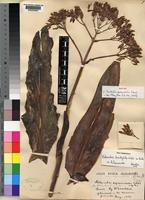
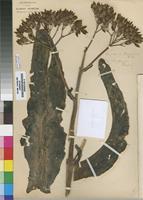
Name
Identification
Kalanchoe pyramidalis Sch”nland [family CRASSULACEAE ] Verified by Not on sheet, Kalanchoe brachyloba Welw. ex Britten [family CRASSULACEAE ] (stored under name); Verified by Not on sheet,
Related name
- Kalanchoe pyramidalis
- Kalanchoe brachyloba
Flora
Entry for Kalanchoe brachyloba Welw. ex Britten [family CRASSULACEAE]
Herbarium
Royal Botanic Gardens, Kew (K)
Collection
Flora Zambesiaca
Resource Type
Reference Sources
Entry From
FZ, Vol 7, Part 1, page 3, (1983) Author: R. Fernandes
Names
Kalanchoe multiflora Schinz [family CRASSULACEAE], in Verb. Bot. Ver. Brand. 30: 172 (1888); in Bull. Herb. Boiss. 5, App. 3: 100 (1897). — N.E. Br. in Kew Bull. 1909: 110 (1909). — Dinter in Fedde,Repert. 18: 434 (1922). — Hutch, Botanist in S. Afr. : 456 (1946). — R.-Hamet & Marnier-Lapostolle in Arch. Mus. Nation. Hist. Nat. Paris, Sér. 7, 8: 83, t. 30 fig. 100-101 (1964). Type: Botswana, Lake Ngami, Schim 177 (K, isotype).
Kalanchoe paniculata [family CRASSULACEAE], sensu Bak. f. in Journ. of Bot. 37: 434 (1899). — Engl. in Sitz.-Ber. Konigl. Preuss. Akad. Wiss. 52: 878 (1906). — Burtt Davy, F.P.F.T. 1: 144 (1926) pro parte. — R.-Hamet, Crass. Ic. Select. 5: t. 94-95 (1963) non Harv. (1862),
Kalanchoe baumii Engl. & Gilg [family CRASSULACEAE], in Warb., Kunene-Samb.-Exped. Baum: 242 (1903). — R.-Hamet in Bull. Herb. Boiss. 7: 895 (1907) pro parte; op. cit. 8: 255 (1908); in Bull. Soc. Bot. Fr. 57: 21 (1910). Type from Angola.
Kalanchoe pyramidalis Schönl. [family CRASSULACEAE], in Rec. Albany Mus. 2, 2: 154 (1907). — R.-Hamet in Bull. Soc. Bot. Fr. 57: 54 (1910). Type: a cultivated plant at Garden of Albany Museum from seeds collected by Schönland in Botswana, Serowe (AMG, holotype; K).
Kalanchoe pruinosa Dinter [family CRASSULACEAE], in Fedde, Repert. 18: 434 (1922); op. cit. 19: 147 (1923), descript. emend. Type from Namibia.
Kalanchoe praesindentis-vervoerdii R.-Hamet [family CRASSULACEAE], Crass. Ic. Select. 5: t. 80-83 (1963) nom. nud., pro parte quoad inflorest., fl. et fr. specim. Holub (Zimbabwe, Matabele Country, Shashi R.(K)).
Kalanchoe brachyloba Welw. ex Britten [family CRASSULACEAE], in F.T.A. 2: 392 (1871). — Engl., Hochgebirgsfl. Trop. Afr. : 232 (1892). — Hiern., Cat. Afr.Pl. Welw. 1: 326 (1896). — R.-Hamet in Bull. Herb. Boiss., Sér. 2, 7: 896 (1907); in Bol. Soc. Brot., Sér. 2, 37: 6-9 (1963). — Friedr. in Prodr. Fl. SW. Afr.52: 37 (1968). — Jacobs., Das Sukk. Lexikon: 250(1970). — R.Fernandes in Bol. Soc. Brot., Sér. 2, 53: 329(1980). Type from Angola.
Information
A completely glabrous, 0·60-2 m. tall perennial (or also biennial) succulent. Stern from a subspherical or napiform tuber or woody rootstock, stout, terete up to 2·5 cm. in diameter at the base, erect, simple or sometimes forked, green, leafless at flowering time (at least below); lowermost internodes short (only up to 2 cm. long), the following increasing successively up to 16 cm.; nodes somewhat thickened. Leaves decussate, the lower the largest, (5·5)12-26(28) x (2·5)3-7(8) cm., subrosulate, ovate-lanceolate or elliptic to oblong, spathulate or sometimes ovate, obtuse or rounded at the apex, usually serrate-lobed or crenate or entire and undulate at the margin, contracted or attenuate below into a subpetiolar base up to 12 mm. broad and shortly sheathing, the median ones relatively narrower, lanceolate to oblong or linear, also crenate or remotely dentate or entire, sessile, not connate, amplexicaul or not, each ± decurrent in 2 raised lines, the upper shortening successively to the uppermost bract-like ones, all fleshy and very succulent, glaucous or glaucous-green when young and fresh, ± rigid or sometimes chartaceous on drying, ± caducous. Flowers erect in ± dense cymes forming partial flattish corymbs, disposed in a repeatedly dichotomous terminal flat-topped corymb-like inflorescence (5)13-35(45) x (5)13-25 cm.; main branches of inflorescences in up to 8 pairs, the lowermost up to 35 cm. long, straight, at ± 45° angles with the axis; pedicels of dichotomies 6-11(15) mm. long. Calyx 1·5-4(5) mm. long, pale green; tube 0·75-1·5 mm. long; sepals 0·75-2·5(3·5) x 1·5-2·25 mm., lanceolate to shortly triangular, subacute to obtuse, fleshy, rigid when dry. Corolla 13·5-16(17) mm. long, subconical after anthesis, narrowing gradually from the roundish base to the apex of the approximate lobes; corolla-tube (10)11-13·5(15) mm. long, and ± 4 mm. in diameter near the base, obtusely 4-angled below, distinctly so above, not contracted below the lobes after anthesis, yellow-green, turning reddish-brown scarious when dry; corolla-lobes 2-5·25 x 2-4·25 mm., ovate or deltate-semiorbicular, acute, slightly apiculate, lemon-yellow to orange-yellow, sometimes whitish- or red-edged, erect and usually connivent, flat or twisted (together with the uppermost part of tube) even after anthesis, only spreading in the afternoon. Filaments 0·5 or 1·5 mm. long; anthers 0·5 or 0·75 mm., those of the lower stamens below or attaining the sinuses between the corolla-lobes, those of the upper ones slightly above the base of corolla-lobes. Follicles 8·5-12 mm. long; styles 0·5-1·5 mm. long. Scales 1·5-3·25 x 0·5 mm., linear-lanceolate, emarginate, hyaline or brownish-scarious.
Habitat
In woodland, in fissures of rocks, on sandy or stony ground.
Distribution
Mozambique M Magude, between Motase and Mohine, 16.vii.1953, Myre &? Carvalho 1696 (LMA).Zimbabwe S Gwanda, outcrop by Bubye River n. Bubye Ranch homestead, c. 576 m., 3.v.1958, Drummond 5539 (BR; K; LISC; SRGH).Zimbabwe C Chilimanzi, 30 mil. S. of Umvuma, 15.iii.1958, Leach 7360 (SRGH).Zambia S Masabuka, 20.v.1961, Fanshawe 6595 (K).Zimbabwe W Wankie, Kazuma Range, 1000 m., v.1972, Russell 1956 (COI; SRGH).Zambia C Between Rufunsa and Lusaka, 1180 m., 26.iii.1955, Exell, Mendonça & Wild 1207 (BM; LISC; SRGH).Zambia W Ndola, 10.vii.1954, Fanshawe 1370 (K; SRGH).Botswana SE 8 km. E. of Lothlekane, 24.iii.1965, Wild & Drummond 7258 (K; SRGH).Mozambique MS Mossurize, between Mossurize R. and Massangena, 11.vi.1942, Torre 4302 (C; LISC; LMU; MO).Malawi N Rumphi Distr., Njakwa Gorge, S. Rukuru R., c. 1120 m., 2.vii.1970, Pawek 3526 (K).Zimbabwe N Gokwe, Sasami River Test Herd, below Sasami River Gorge, 22.iv.1964, Bingham 1253 (LISC; SRGH).Zambia N Luapula Distr., Mbesuma Ranch, c. 1408 m., 24.iii.1961, Astle 873 (K; SRGH).Botswana N Kwebe Hills, 14.iv.1898, Lugard 224 (K).
Distribution (external)
Zaire
Angola
Namibia
Swaziland
S. Africa (Transvaal)
Notes
Similar to K. paniculata (no. 18) but distinguished by the leaves being relatively longer and narrower, usually crenate, dentate or crenate-dentate; by the inflorescence not so dense with less fastigiate ultimate branches; by the flowers slightly larger with a not so strongly marked 4-angled corolla-tube and relatively shorter corolla-lobes which are usually connivent or twisted.