

Compilation
Kalanchoe cuisinii
1 Images see all
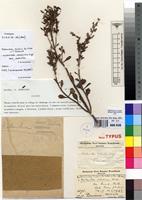
Name
Identification
Kalanchoe cuisinii De Wild. [family CRASSULACEAE ] Verified by Not on sheet, Kalanchoe lateritia Engl. [family CRASSULACEAE ] (stored under name); Verified by Not on sheet,
Related name
- Kalanchoe lateritia
- Kalanchoe cuisinii
Flora
Entry for Kalanchoe lateritia Engl. [family CRASSULACEAE]
Herbarium
Royal Botanic Gardens, Kew (K)
Collection
Flora Zambesiaca
Resource Type
Reference Sources
Entry From
FZ, Vol 7, Part 1, page 3, (1983) Author: R. Fernandes
Names
Kalanchoe zimbabwensis Rendle [family CRASSULACEAE], in Journ. of Bot. 70: 90 (1932). — Hutchs., Botanist in S. Afr. : 469 (1946). — J. Blake, Gard. E. Afr. : 181 (1950). — Jacobs., Das. Sukk. Lexikon: 257 (1970). Type: Zimbabwe, Chibopopo River, 11.viii.1928, Rendle 259 (BM, lectotype).
Kalanchoe lateritia var. zimbabwensis Rendle Brenan [family CRASSULACEAE], in Mem. N.Y. Bot. Gard. 8, 5: 435 (1954). Type as above.
Kalanchoe integra var. subsessilis Britten Cufod. [family CRASSULACEAE], in Osterr. Bot. Zeit. 116: 317 (1969). Type as for Kalanchoe coccinea var. subsessilis.
Kalanchoe velutina [family CRASSULACEAE], sensu R.-Hamet in Bull. Herb. Boiss., Sér. 2, 8: 36 (1908) pro parte quoad specim. Afr.Or. et Centr. — Berger in Engl. & Prantl, Nat. Pflanzenfam. ed. 2, 18a: 406 (1930) pro parte. — Robyns. Fl. Parc Nat. Alb. 1:228(1948). — Jacobsen, Das Sukk. Lexicon: 256 (1970) pro parte, non Welw. ex Britten (1871).
Kalanchoe lateritia Engl. [family CRASSULACEAE], [in Abh. Königl. Akad. Wiss. Berl. 189± 19 (1894) nom. nud.]; Pflanzenw. Ost-Afr.C: 189 (1895). — R.E. Fr., Wiss. Ergebn. Schwed. Rhod.-Kongo-Exped. 1: 59 (1916). — Bally in Journ. E. Afr.Uganda Nat. Hist. Soc. 15:13 (1940). — R.-Hamet in Bull. Jard. Bot. Brux. 19: 437 (1949); in Bol. Soc. Brot., Sér. 2, 2± 97-98 (1950). — Toussaint in F.C.B. 2: 564 (1951). — R.-Hamet & Marnier-Lapostolle in Arch. Mus. Nat. Hist. Nat. Paris, Sér. 7, 8: 78, t. 2 fig. I et K, t. 27 fig. 89-90, t. 28 fig. 91 (1964). — Binns, H.C.L.M.: 41 (1968). — Raadts in Willdenowia, 8: 131 (1977). Syntypes from E. Africa (Lectotype Holst 2986 (B)).
Kalanchoe coccinea var. subsessilis Britten [family CRASSULACEAE], in F.T.A. 2: 395 (1871). Type: Malawi, Manganja Hills, Meller s.n. (K, lectotype).
Kalanchoe caccinea [family CRASSULACEAE], sensu Engl., loc. cit. (1895) pro parte quoad specim. region. Mossamb. non Welw. ex Britten (1871).
Kalanchoe crenata var. collina Engl. [family CRASSULACEAE], loc. cit. (1895) pro parte quoad specim. mossamb. Braga s.n. (COI).
Kalanchoe cuisinii De Wild. & Th. Dur. [family CRASSULACEAE], in Bull. Soc. Roy. Bot. Belg. 38, 2: 122 (1899); in Ann. Mus. Congo, Bot., Sér. 3, 1: 82 (1901). — Th. & H. Dur., Syll. Fl. Cong.: 193 (1909). — R.-Hamet, loc. cit. (1949). Type from Zaire.
Kalanchoe kirkii N. E. Br. [family CRASSULACEAE], in Gard. Chron., Ser. 3, 32: 110(1902). — Hook. f. in Curtis, Bot. Mag. 58: t. 7871 (1902). — R.-Hamet & Marnier-Lapostolle, tom. cit.: t. 1 fig. F (1964). Type a cultivated plant at Kew Garden (K).
Information
A succulent perennial, pubescent-glandular throughout, 19-150 cm. high (incl. the inflorescence); hairs of the indumentum up to 1(1·5) mm. long, spreading, thin, capitate-glandular, ± dense, tawny to dark-brown or rusty-red on drying. Stem erect, usually simple, sometimes forked into two ± long floriferous axes, 0·5-1·8 cm. in diameter at the base, terete, leafless at fruiting time; lower internodes (from below upwards) 0·3-7 cm. long, the median ones 6-15 cm. long, the two terminal ones usually very elongate, (12)18-29 cm. long. Leaves condensed towards the lower part of stem, there petiolate and spreading-decurved, the median and the upper ones usually rather scattered, distinctly smaller than the lower, sub-bract-like, shortly petiolate to subsessile, ascending; lamina of the lower leaves 3·5-16(21) x 3-10(12·5) cm., subcircular or broadly obovate, less than twice as long as broad, rounded or obtusely acuminate at the top, crenate or doubly crenate at margin, rounded or cuneate at the base, the others obovate-spathulate to linear-cuneate, nearly or quite entire, flat in all leaves and rather fleshy, not very thin and somewhat rigid, dark brown or dark green when dry; petiole 0·5-5 cm. long, channelled, rather broad. Flowers in ± dense cymes grouped either in a single ± dense small terminal corymb or in a larger looser one (up to 20 cm. in diameter) or sometimes in several corymbs disposed in thyrsoid or panicle-like inflorescences, very densely rusty-pubescent-glandular; pedicels 1-3·5(5) mm. long. Calyx (4)5-7(8) mm. long; tube (0·3)0·5-1(2) mm. long; sepals (1)1·5-2·5(3) mm. broad at the base, ovate-oblong to oblong-lanceolate, rarely ovate, ± attenuate, acute or subacute, green, lineolate with red. Corolla 13·5-17 mm. long; tube 8·5-14 mm. long, dilated at base, yellow-orange turning white-hyaline below and pale-pink upwards at fruiting; corolla-lobes 4·5-7(8·5) x 2-4·2 mm., ovate or elliptic, attenuate or abruptly contracted at the apex, long apiculate, usually orange-red or brilliant scarlet-orange to brick-red, rarely yellow. Filaments ± 2·5 mm. long, insertedd above the middle of corolla-tube; anthers ± 0·75 mm. long, oblong, included. Follicles (4)-6-8(9) mm. long, attenuate into the 0·75-2 mm. long styles. Seeds c. 1 x 0·33 mm., oblong-linear, longitudinally slightly ribbed, curved at the top. Scales 1·75-4 mm. long, linear.This description applies to var. lateritia. var. prostrata Raadts, with prostrate stem and glabrous leaves and stern, and var. pseudolateritia Raadts, with a slightly longer corolla-tube, were described from Kenya and Tanzania.
Habitat
In Brachystegia woodland, in grass, hollow of rocks etc.
Distribution
Mozambique GI 9 miles S. of Cheline on Maxixe-Mambone road, 5.x.1936, Leach & Bayliss 11841 (K; LISC; SRGH).Mozambique MS Cheringoma, Inhaminga, 29.vii.1967, Moura 212 (COI; LMU).Mozambique Z Alto Molucué, at km. 21 on the road to Alto Ligonha, c. 600 m., 29.x.1967, Torre & Correia 16276 (C; COI; LISC; MO).Zimbabwe S Zimbabwe, c. 1120 m., viii.1929, Dame Alice & Misses Godman 162 (BM).Zimbabwe C Salisbury, Physic. Lab. Gard., 25.v.1943, Sturgeon (K; SRGH).Zimbabwe E Melsetter, Lavinas Rust Farm Hillside, 30.vii.1950, Crook M. 38 (K; LISC; SRGH).Mozambique N between Muêda and Chomba, 25.ix.1948, Pedro & Pedrógão 5351 (LMA).Malawi S 2 miles W. of Chiradzulu Mts. (cult. and flower. at Greendale) 21.vii.1958, Leach 7194 (K; PRE; SRGH); Likabula, Mulanje Mt., c. 800 m., vii.1958, Chapman H/734 (SRGH).Zimbabwe W Victoria, Kyle National Park Game Reserve, Chembira Hill, 22.v 1971, Grosvenor 528 (SRGH).
Distribution (external)
Kenya
Tanzania
Rwanda
Zaire
Notes
All specimens seen except Banda 1061 (SRGH), from Blantyre, Ndiranda Forestry Plant. area, Malawi, and Banda 1158 (K; SRGH), cultivated in Chancellor College Biol. Bot. Gard. Malawi, have corollas more or less tinged with red which, according to collectors, with age or on drying turn to ± brick-red. However, the two above mentioned specimens have completely yellow corollas, brighter so on the lobes, not darkening on drying. This species was originally considered as a variety of K. crenata (= K. coccinea). In fact, it is very similar to the latter mainly to the forms with an indumentum of glandular hairs on the stem and inflorescence, and corollas with identical variation in colour. Nevertheless, K. lateritia has some characters which permit one to distinguish it from all forms of K. crenata: hairs of the indumentum longer (up to 1-(1·5) mm., not only up to 0·5 mm. long as in K. crenata), denser and darker; leaves more condensed towards the base of the stem, the lower and median contrasting distinctly in form and shape with the 2-3 upper pairs which are not only more scattered but also smaller, nearly bract-like; in K. lateritia the leaves are hairy on both surfaces, while they are glabrous in nearly all forms of K. crenata; their lamina is relatively shorter (the breadth usually more than half of the length), thicker, turning darker in colour and more rigid on drying whereas in K. crenata the lamina is membranous or nearly so in the dry state; the inflorescence is usually denser, the pedicels shorter, the sepals relatively shorter and broader, more close (sinus narrower in K. lateritia), less attenuate, a little more connate at the base than in K. crenata. Thus we prefer to consider this taxon at specific level, following Engler, De Wildeman, N. E. Brown and many other authorities. The specimen from Mozambique (Niassa, Cabo Delgado, Quissanga, between Mahate and Metuge, 1.x.1946, Barbosa 2344 (LISC; LMA)) has flowers like K. fernandesii (no. 5), but its leaves are petiolate.