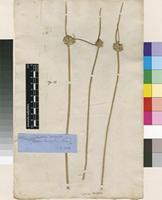
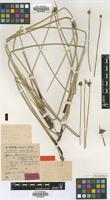
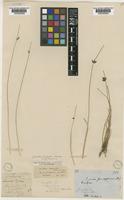
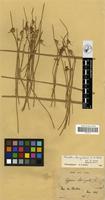
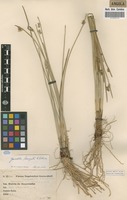
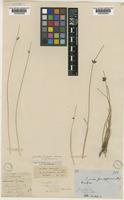
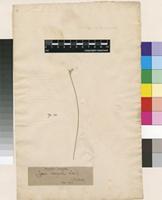
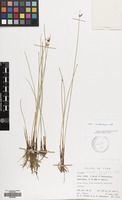
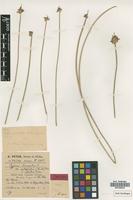
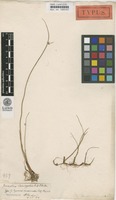
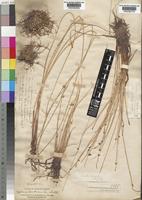
Tufted perennial with crowded stems or stems solitary on a long creeping rhizome; rhizome 1–5 mm thick, light brown to purplish black; stems usually 3–60(–150) cm long and 0.5–2(–6) mm thick, rounded to triangular or angular, glabrous, the basal part covered with short scales and rather loose leaf-sheaths and the stem therefore wider across the sheaths. Leaves to 4 cm long and 0.5–2 mm wide, usually inrolled and almost stem-like, scabrid on margin, blade sometimes absent; sheaths light to dark purple brown, all or the lowest only without leaf-blades. Inflorescence a solitary spikelet or more commonly a lax to crowded head of 2–30 spikelets (rarely to 80 spikelets), 0.5–3.5 cm in diam.; major involucral bract 1–3 cm long, scabrid on margin, slightly flattened but stem-like and continuing in the direction of the stem, the inflorescence therefore apparently lateral. Spikelets 5–20 x 1.5–3 mm, straight or curved, linear to lanceolate, somewhat flattened, pale yellowish grey, rarely variegated dark brown, 15–30-flowered. Glumes 2–3.5 mm long, very closely overlapping, broadly elliptic, rounded on the back that is without keel except near the tip, pale yellowish with reddish brown dots; apex acute, shortly mucronate or frayed. Stamens 3. Style with 2 long branches. Nutlet 1.5–1.7 x 0.8–1 mm, obovate with short apiculus, flat on 1 side, rounded on the other, grey to brown; surface smooth but with distinct rather large isodiametric surface-cells.