JSTOR Global Plants Home
  • Home
  • Browse
  • About
  • Access
  • Account
    • Saved Items
    • Profile
  • Log in

Global Plants

Skip to Main Content
  • JSTOR Global Plants Home
  • Global Plants

    • Browse
    • About
    • Access
    • Account
      • Saved Items
      • Profile
Log in
  • Browse
  • About
  • Access
  • Account
    • Saved Items
    • Profile
Advanced Search

Compilation
Jasminum swynnertonii

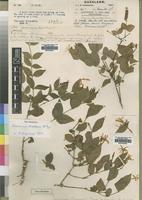
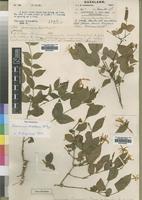
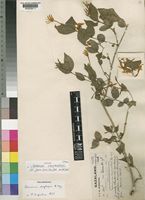
3 Images see all

Type of Jasminum swynnertonii S.Moore [family OLEACEAE]
Isotype of Jasminum swynnertonii S.Moore [family OLEACEAE]
Previous
Next

Name

Identification
Jasminum streptopus E.Mey. [family OLEACEAE ] (stored under name); Verified by Kupicha,F., Jasminum swynnertonii S.Moore [family OLEACEAE ]
Related name
  • Jasminum swynnertonii
  • Jasminum streptopus

Flora

Entry for JASMINUM swynnertonii S. Moore [family OLEACEAE]
Herbarium
Royal Botanic Gardens, Kew (K)
Collection
Flora of Tropical East Africa
Resource Type
Reference Sources
Entry From
Flora of Tropical East Africa, page 1, (1952) Author: W. B. TURRILL
Names
JASMINUM swynnertonii S. Moore [family OLEACEAE], in J.L.S. 40: 135 (1911). Type: Portuguese East Africa, Kurumadzi, R. Jihu, Nov. 1906, Swynnerton 180a (BM, lecto.! K, iso-lecto.!)
Information
A twining shrub up to 1.2 m. tall, the youngest branches very densely but shortly pubescent, later becoming glabrous. Leaves simple, opposite or sub-opposite; blades ovate, ovate-lanceolate, to elliptic, attenuated and sometimes shortly acuminate at the apex, finally shortly apiculate, cuneate to rounded at the base, very variable in size, well-formed ones 2.5–5.6 cm. long and 1–2.7 cm. broad, more or less pubescent on the upper surface, with less pubescence on the midrib and main veins on the lower surface, midrib slightly impressed on upper and with the main veins fairly conspicuous on the lower surface; petioles about 2 mm. long, jointed near the apex but not conspicuously, densely and shortly pubescent. Flowers solitary and terminal to short branches; pedicels 15–20 mm. long (in E. African material), with scattered pubescence to glabrous. Calyx glabrous or with scattered pubescence especially on the lobes, which are very narrowly subulate-linear, acutely tapering, 4–5 mm. long. Corolla white, scented; tube 1.5–2.1 cm. long.
Range
DISTR. T5
Altitude range
c. 1100 m.
Distribution
TANGANYIKA Mpwapwa District Mpwapwa, Jan. 1930, H. E. Hornby 169!
Distribution (external)
Portuguese East Africa
Northern
Southern Rhodesia
Notes
The East African material is, like that from farther south, not entirely uniform in leaf size and details of indumentum. It differs from the type in having longer pedicels, but more specimens are required before it can be decided whether it should be given an intraspecific name or considered only an ecad. The species, if it be accepted as such, probably occurs elsewhere in southern Tanganyika. The variation suggests that there may have been some hybridization and it is possible that J. parvifolium has contributed to the characters, if, indeed, J. swynnertonii is not best considered a variety of J. parvifolium. Certainly the various specimens of Hornby 169, at Kew, the British Museum, and Nairobi, are not all alike in several details, and link up J. swynnertonii and J. parvifolium.

Related Materials

  • Terms and Conditions
  • Privacy Policy
  • Cookie Policy
  • Cookie Settings
  • Accessibility
  • Help
  • Contact Us
  • Facebook
  • Twitter
ITHAKA

JSTOR is part of ITHAKA, a not-for-profit organization helping the academic community use digital technologies to preserve the scholarly record and to advance research and teaching in sustainable ways.

©2000-2026 ITHAKA. All Rights Reserved. JSTOR®, the JSTOR logo, JPASS®, Aluka®, and ITHAKA® are registered trademarks of ITHAKA.

╳