JSTOR Global Plants Home
  • Home
  • Browse
  • About
  • Access
  • Account
    • Saved Items
    • Profile
  • Log in

Global Plants

Skip to Main Content
  • JSTOR Global Plants Home
  • Global Plants

    • Browse
    • About
    • Access
    • Account
      • Saved Items
      • Profile
Log in
  • Browse
  • About
  • Access
  • Account
    • Saved Items
    • Profile
Advanced Search

Compilation
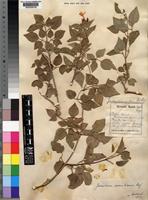
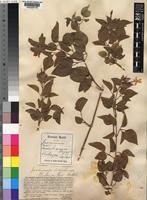
Jasminum somaliense

2 Images see all

Type of Jasminum somaliense Baker [family OLEACEAE]
Previous
Next

Name

Identification
Jasminum somaliense Baker [family OLEACEAE ] Jasminum mauritianum Bojer ex DC. [family OLEACEAE ] Jasminum fluminense Vell. [family OLEACEAE ] (stored under name);
Related name
  • Jasminum mauritianum
  • Jasminum fluminense
  • Jasminum somaliense

Flora

Entry for JASMINUM fluminense Vell. [family OLEACEAE]
Herbarium
Royal Botanic Gardens, Kew (K)
Collection
Flora Somalia
Resource Type
Reference Sources
Entry From
Flora Somalia, Vol 3, (2006) Author: by M. Thulin [updated by M. Thulin 2008]
Names
JASMINUM fluminense Vell. [family OLEACEAE], (1825).
JASMINUM somaliense Bak. [family OLEACEAE], (1895);. types: N1, “Golis” range at “Dara-as”, Cole s.n. and Lort Phillips s.n. (K syn.).
JASMINUM mauritianum Bojer ex DC. [family OLEACEAE], (1844);
JASMINUM fluminense (Bojer ex DC.) Turrill subsp. mauritianum [family OLEACEAE], in Kew Bull. 7: 134 (1952). [type as above]
Information
Climbing or scrambling shrub, up to several m long; young stems pubescent to tomentose or glabrous. Leaves opposite, 3-foliolate, pubescent on both surfaces or glabrous; petiole 5–25 mm long; petiolules of lateral leaflets 4–18 mm long, of terminal leaflet 8–22 mm long; leaflets ovate, elliptic or suborbicular, rounded to cuneate at the base, acute, acuminate or rounded at the apex, the lateral ones 1.2–6 x 0.8–3.8 cm, the terminal one 2.7–9 x 1.3–5 cm; acarodomatia present, usually only in axils of lower lateral nerves. Flowers in terminal and lateral corymb-like cymes; pedicels up to 3 mm long. Calyx glabrous or pubescent, 1.5–3 mm long, with 5–6±triangular teeth less than 0.5 mm long. Corolla white, often tinged with red outside; tube 11–28 mm long; lobes (5–)6–9, 7.5–11 mm long, elliptic, rounded and minutely apiculate at the apex. Stamens inserted near top of corolla-tube; anthers 3–4 mm long. Fruit with lobes 6–7 mm long when dry, subglobose.
Range
N1, 2, and cultivated in N3; S3 widespread in tropical Africa, also cultivated in South America and tropical Asia.
Altitude range
1170–1500 m in N1 and N2, c. 40 m in S3. N1, 2,
Distribution
SOMALIA Bally & Melville 16061; Newbould 953; Gillett & al. 25169.
Distribution (external)
Eritrea
Ethiopia
Notes
Da-ali, mutkarr (Som.). J. fluminense was subdivided by Turrill in Fl. Trop. E. Afr. (1952) into several subspecies and varieties, but these were not upheld by Kupicha in Fl. Zamb. (1983). Green in Kew Bull. 41: 416–417 (1986) treated the material of J. fluminense from the Arabian peninsula as subsp. gratissimum (Deflers) P.S. Green. This taxon is characterized by its long-acuminate leaflets and is also known from cultivation in Arabia and eastwards to India. A plant cultivated in N3 (Bosaso, near sea level), Thulin, Abdi Dahir & Ahmed Osman 10227, appears to be referable to subsp. gratissimum as well.

Related Materials

  • Terms and Conditions
  • Privacy Policy
  • Cookie Policy
  • Cookie Settings
  • Accessibility
  • Help
  • Contact Us
  • Facebook
  • Twitter
ITHAKA

JSTOR is part of ITHAKA, a not-for-profit organization helping the academic community use digital technologies to preserve the scholarly record and to advance research and teaching in sustainable ways.

©2000-2026 ITHAKA. All Rights Reserved. JSTOR®, the JSTOR logo, JPASS®, Aluka®, and ITHAKA® are registered trademarks of ITHAKA.

╳