JSTOR Global Plants Home
  • Home
  • Browse
  • About
  • Access
  • Account
    • Saved Items
    • Profile
  • Log in

Global Plants

Skip to Main Content
  • JSTOR Global Plants Home
  • Global Plants

    • Browse
    • About
    • Access
    • Account
      • Saved Items
      • Profile
Log in
  • Browse
  • About
  • Access
  • Account
    • Saved Items
    • Profile
Advanced Search

Compilation
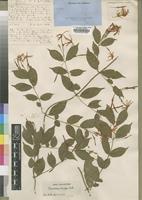
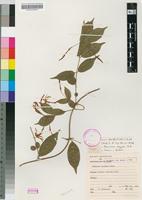
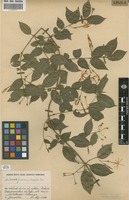
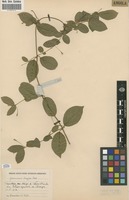
Jasminum longipes

6 Images see all

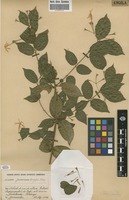
Type of Jasminum longipes Baker [family OLEACEAE]
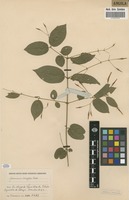
Isotype of Jasminum longipes Baker [family OLEACEAE]
Filed as Jasminum longipes Baker [family OLEACEAE]
Previous
Next

Name

Identification
Jasminum longipes Baker [family OLEACEAE ] Jasminum pauciflorum Benth. [family OLEACEAE ] (stored under name);
Related name
  • Jasminum pauciflorum
  • Jasminum longipes

Flora

Entry for JASMINUM longipes Baker [family OLEACEAE]
Herbarium
Royal Botanic Gardens, Kew (K)
Collection
Flora of Tropical Africa
Resource Type
Reference Sources
Entry From
Flora of Tropical Africa, Vol 4, Part 1, page 1, (1904) Author: (By J. G. Baker.)
Names
JASMINUM longipes Baker [family OLEACEAE], in Kew Bulletin, 1895, 94. —Hiern in Cat. Afr. Pl. Welw. i. 655.
Information
A wide climbing shrub. Branchlets very slender, pubescent. Leaves opposite or lower alternate, oblong, very acute, moderately firm, 1 1/2–3 in. long, slightly pubescent beneath; petiole very hairy, 1/6– 1/3 in. long. Cymes few-flowered, terminal and axillary; pedicels very slender, sometimes 1 in. long. Calyx 1/3 in. long; teeth linear, shorter than the subcylindrical tube. Corolla-tube 3/4 in. long; lobes 9–10, lanceolate, 1/2 in. long.
Distribution
Angola Lower Guinea Golungo Alto; in bushy places on the outskirts of the forests of Alto Queta, about Sange, and at the River Cate in Sobato de Bumba, Welwitsch, 925!

Related Materials

  • Terms and Conditions
  • Privacy Policy
  • Cookie Policy
  • Cookie Settings
  • Accessibility
  • Help
  • Contact Us
  • Facebook
  • Twitter
ITHAKA

JSTOR is part of ITHAKA, a not-for-profit organization helping the academic community use digital technologies to preserve the scholarly record and to advance research and teaching in sustainable ways.

©2000-2026 ITHAKA. All Rights Reserved. JSTOR®, the JSTOR logo, JPASS®, Aluka®, and ITHAKA® are registered trademarks of ITHAKA.

╳