

Compilation
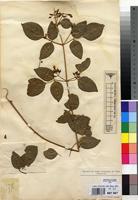
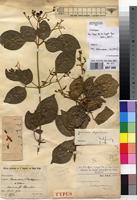
Jasminum butaguense
2 Images see all
Name
Identification
Jasminum butaguense De Wild. [family OLEACEAE ] Verified by Not on sheet, Jasminum abyssinicum Hochst. ex DC. [family OLEACEAE ] (stored under name); Verified by Not on sheet,
Related name
- Jasminum butaguense
- Jasminum abyssinicum
Flora
Entry for Jasminum abyssinicum Hochst. ex DC. [family OLEACEAE]
Herbarium
Royal Botanic Gardens, Kew (K)
Collection
Flora Zambesiaca
Resource Type
Reference Sources
Entry From
FZ, Vol 7, Part 1, page 300, (1983) Author: F. K. Kupicha
Names
Jasminum wyliei N.E. Br. [family OLEACEAE], in Kew Bull. 1909: 419 (1909). Type from S. Africa (Natal).
Jasminum ruwenzoriense De Wild. [family OLEACEAE], in Rev. Zool. Afr.9, Suppl. Bot.: 87 (1921). Type from Zaire.
Jasminum butaguense De Wild. [family OLEACEAE], tom. cit.: 84 (1921). Type from Zaire.
Jasminum rutshuruense De Wild. [family OLEACEAE], tom. cit.: 85 (1921). Type from Zaire.
Jasminum mearnsii De Wild. [family OLEACEAE], Pl. Bequaert. 1: 531 (1922). Type from Kenya.
Jasminum wittei Staner [family OLEACEAE], in De Wild. & Staner, Contrib. Fl. Katanga, Suppl. ± 80 (1932). Type from Zaire.
Jasminum abyssinicum Hochst. ex DC. [family OLEACEAE], Prodr. 8: 311 (1844). — Baker in F.T.A. 4 11 (1902). — Gilg & Schellenb. in Engl., Bot. Jahrb. 51: 84 (1913). — Turrill in F.T.E.A., Oleaceae: 18 (1952). — Verdoorn in Bothalia 6: 563, t. 6 (1956); in Fl. Southern Afr.26: 107(1963). — F. White, F.F.N.R.: 336 (1962). — Liben in Fl. d’Afr.Centr., Oleaceae: 11 (1973). — Fanshawe, Check–list Woody Pl. Zamb.: 24(1973). — R.B. Drumm. in Kirkia 10: 267 (1975). TAB. 70 .A. Type from Ethiopia.
Information
Climber with long flexuous twining stems attaining 5 m. or more; nodes of main branches well spaced. Young shoots and petioles smooth and glabrous or minutely puberulous, bark of older branches becoming rough. Leaves trifoliolate, glabrous exceptforthe acarodomatia. Petiole 1·1–7 (3·7) cm. long; petiolules of lateral leaflets 1–3 (5) mm. long. Leaflets ovate, elliptic or suborbicular, the apex acute, acuminate or rounded, often apiculate, the base acute or rounded; terminal leaflet 4–5·7 (10) x 2·5–4·5 (5·3) cm., lateral leaflets 2–4·3 (8·5) x 1·2–2·9 (4·2) cm. Acarodomatia present, usually occurring in axils of lateral nerves almost up to leaflet apex. Flowers terminal and lateral, solitary or in few– to many–flowered loose cymes, scented; pedicels 2–8 mm. long; inflorescence axes usually puberulous. Calyx glabrous; tube 2–3 mm. long, with 5 (6) teeth which are sometimes shallowly triangular but often merely points on the calyx tube rim. Corolla white, sometimes tinged pink on the outside; tube 14–26 mm. long; lobes (4) 5 (6), 5–10 x 4–8 mm., elliptic or ovate–elliptic, with auricled base and rounded or cuspidate apex. Stamens inserted at or near the middle of the corolla tube; filaments very short or up to 3 mm. long; anthers (3) 4–5 (6) mm. long, never reaching to mouth of corolla tube. Style either very short or exserted from tube. Fruit 1–2–lobed, lobes globose, c. 7 mm. long when dry.
Habitat
In evergreen montane forest and mushitu.
Distribution
Zambia E Nyika, fr. 30.xii.1962, Fanshawe 7356 (K).Zambia W Mwinilunga Distr., Mwanamitowa R., fl. 9.viii.1930, Milne–Redhead 863 (K; PRE).Mozambique MS Manica, Zuira Mts., Tsetsera, road to Chimoio (Vila Pery), c. 1800 m., fl. 3.iv.1966, Torre & Correia 15654 (LISC).Malawi N Nkhata Bay Distr., S. Viphya near Chikangawa, c. 2000 m.,fl. 11.ix.1970, Milller 1593 (K; MAL; SRGH).Zimbabwe E Chirinda Forest, fl. 30.iv.1950, Hark 225/50 (SRGH).Zambia N Mafinga Mt., fl. 26.viii.1958, Lawton 462 (K).
Distribution (external)
S. Africa (Natal and Transvaal)
Zaire
Rwanda
Burundi
Uganda
Tanzania
Kenya
Ethiopia
Notes
Specimens of .J. abyssinicum from the F.Z. area and S. Africa appear to be almost completely glabrous, but those from more tropical regions often have indumentum on stems and calyx and occasionally also on leaves. It has perhaps not been recognised previously that floral characters are useful for separating J. abyssinicum from its relative J. fluminense: the former has broad corolla lobes, usually 5 in number, the latter narrower lobes, 6 or over. This difference is almost diagnostic, but a few specimens ofJ. fluminense outside the F.Z. area, notably some members ofsubsp. nairobiensis Turrill, have been seen which have only 5 corolla lobes.