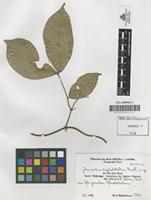
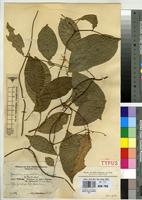
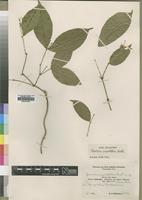
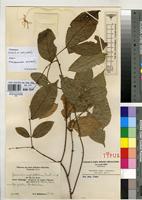
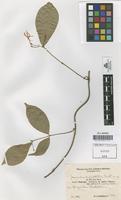
A climbing shrub; ultimate branches slender, with a few scattered hairs or almost glabrous, the older ones glabrous. Leaves simple, opposite; blades simple obovate-oblong to rather narrowly elliptic; somewhat abruptly acuminate, rounded at the extreme base, 4–12.5 cm. long, 2.2–5.6 cm. broad (said to be generally 9 cm. long and 4.5–5.5 cm. broad), midrib slightly impressed on upper and, with the main lateral veins 6–8 on each side of the midrib, prominent on the lower surface, markedly reticulate on the lower surface, glabrous except for the midrib which is puberulous on the upper surface and the pubescent acarodomatia which are conspicuous in the axils of the main veins on the lower surface; petiole 3–4.7 mm. long, apparently flattened and densely hairy on the upper side, not distinctly articulated in the material seen (the original description says it is). Inflorescence terminal to short lateral branches, 3-flowered (said to range from 1–4-flowered); pedicels slender, 1.2–1.4 cm. long, glabrous or slightly pubescent. Calyx glabrous or slightly pubescent; lobes subulate, 4–5 mm. long. Corolla white, fragrant; tube 2.3–2.6 cm. long.
Range
DISTR. T6 endemic in Tanganyika
Altitude range
900–1000 m.
Distribution
TANGANYIKA Ulanga District Mahange (Mahenge), Jan. 1932, Schlieben 1646!
Notes
In the original description it is said that the petiole is “distincte articulato.” This character has not been confirmed in the one sheet examined (an isotype). The isotype specimen appears to be closely similar to J. welwitschii Baker (Angola, province of Pungo Andongo, Welwitsch 927, K, holo.!) but has less hairy young branches and shorter calyx lobes.