JSTOR Global Plants Home
  • Home
  • Browse
  • About
  • Access
  • Account
    • Saved Items
    • Profile
  • Log in

Global Plants

Skip to Main Content
  • JSTOR Global Plants Home
  • Global Plants

    • Browse
    • About
    • Access
    • Account
      • Saved Items
      • Profile
Log in
  • Browse
  • About
  • Access
  • Account
    • Saved Items
    • Profile
Advanced Search

Compilation
Jacquinia arborea

2 Images see all

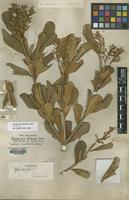
Isotype of Jacquinia arborea Vahl [family THEOPHRASTACEAE]
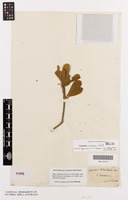
Type of Jacquinia berteroi Mez var. venosa [family THEOPHRASTACEAE]
Previous
Next

Name

Identification
Isotype of Jacquinia arborea Vahl [family THEOPHRASTACEAE ] (stored under name);
Related name
  • Jacquinia arborea
Common name
  • Braceletwood, Flora of North America Vol. 8

Flora

Entry for Jacquinia arborea Vahl [family THEOPHRASTACEAE]
Herbarium
Flora of North America (FNA)
Collection
Flora of North America
Resource Type
Reference Sources
Entry From
Flora of North America, Vol 8,
Names
Jacquinia arborea Vahl [family THEOPHRASTACEAE], Eclog. Amer., 1: 26. 1797 ,
Jacquinia armillaris Jacquin var. arborea (Vahl) Grisebach [family THEOPHRASTACEAE]
Treatment Author(s)
R. David Whetstone
Richard P. Wunderlin
Information
Shrubs or trees to 5 m; twigs grayish brown, lepidote when young, glabrescent. Stems gray, nearly smooth. Leaves usually distinctly pseudoverticillate; petiole to 7 mm, glabrous or sparsely puberulous; blade 3–8(–12) × 1.5–4(–5) cm, coriaceous, margins slightly revolute, apex rounded or retuse, mucronate or mucro absent. Racemes 7–25(–40)-flowered, to 6(–12) cm, commonly exceeding leaves. Pedicels 7–13 mm; bracts lanceolate, 1–1.5 mm. Flowers: sepals 2.2–3.2 mm, margins entire or slightly erose; petals 7–9 mm, lobes ca. as long as or slightly shorter than tube; stamens shorter than staminodes; staminodes oblong to ovate, 1.8–3 × 2–3 mm, apex rounded or retuse. Berries orange-red or red, 7–11 mm diam., pericarp smooth. Seeds light brown, 3–5 mm.
Phenology
Flowering winter–spring
Altitude range
0–10 m
Distribution
MexicoWest Indies (Jamaica, Lesser Antilles, Puerto Rico)Central America (Honduras).USA Fla.
Discussion
Cultivated and escaped in Florida, Jacquinia arborea is occasional in disurbed coastal communities of Broward and Miami-Dade counties and the Monroe County keys.
Native/Introduced
introduced

Related Materials

  • Terms and Conditions
  • Privacy Policy
  • Cookie Policy
  • Cookie Settings
  • Accessibility
  • Help
  • Contact Us
  • Facebook
  • Twitter
ITHAKA

JSTOR is part of ITHAKA, a not-for-profit organization helping the academic community use digital technologies to preserve the scholarly record and to advance research and teaching in sustainable ways.

©2000-2026 ITHAKA. All Rights Reserved. JSTOR®, the JSTOR logo, JPASS®, Aluka®, and ITHAKA® are registered trademarks of ITHAKA.

╳