JSTOR Global Plants Home
  • Home
  • Browse
  • About
  • Access
  • Account
    • Saved Items
    • Profile
  • Log in

Global Plants

Skip to Main Content
  • JSTOR Global Plants Home
  • Global Plants

    • Browse
    • About
    • Access
    • Account
      • Saved Items
      • Profile
Log in
  • Browse
  • About
  • Access
  • Account
    • Saved Items
    • Profile
Advanced Search

Compilation
Iris germanica

9 Images see all

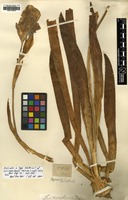
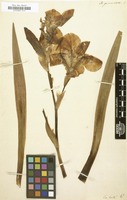
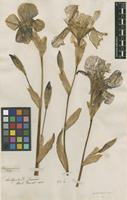
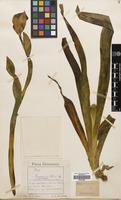
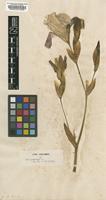
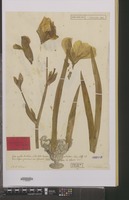
Type of Iris nepalensis Wall. ex Lindl. [family IRIDACEAE]
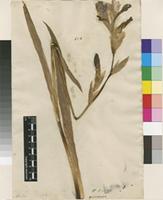
Filed as Iris germanica L. [family IRIDACEAE]
Type? of Iris polychroa Gand. [family IRIDACEAE]
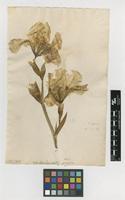
Filed as Iris germanica [family IRIDACEAE]
Filed as Iris germanica L. [family IRIDACEAE]
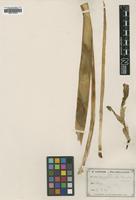
Lectotype of Iris germanica L. [family IRIDACEAE]
Syntype of Iris germanica L. [family IRIDACEAE]
Previous
Next

Name

Identification
Iris germanica L. [family IRIDACEAE ] (stored under name);
Related name
  • Iris polychroa
  • Iris germanica
Common name
  • German iris, Flora of North America Vol. 26
  • flags, Flora of North America Vol. 26

Flora

Entry for Iris germanica Linnaeus [family IRIDACEAE]
Herbarium
Flora of North America (FNA)
Collection
Flora of North America
Resource Type
Reference Sources
Entry From
Flora of North America, Vol 26,
Names
Iris germanica Linnaeus [family IRIDACEAE], Sp. Pl., 1: 38. 1753
Treatment Author(s)
Norlan C. Henderson
Information
Rhizomes homogeneous, usually many-branched, light brown, 1.2–2 cm diam., smooth, nodes marked by rings around rhizome, branches may arise in the fan or as many as 15–20 nodes produced prior to active leaves. Stems green, 2–3-branched, solid, 6–12 dm × 1–1.5 cm, glaucous. Leaves equitant, blade sometimes purplish at base, ensiform, to 4.5 dm × 3.5 cm, glaucous. Inflorescences with terminal unit 2–3-flowered, branch units 1–2-flowered; spathes green, sometimes with purple base, 2–5 cm, herbaceous with narrow, scarious margins and tip. Flowers: perianth shades of blue-violet, yellow, brown, or white with various patterns of pigment distribution; floral tube 1–2.5 cm; sepals spreading, drooping, or somewhat reflexed, blue-violet, yellow, brown, or white with patterned overlay of darker blue-violet, with white or yellow beard along midrib of claw and lower part of limb, obovate limb tapering gradually to claw, 6–7.5 × 4–5.5 cm; petals alternating with sepals, erect, obovate, 5–7 × 4–5.5 cm, with short, 1.5–2 cm, channeled claw; ovary roundly trigonal, 1.5–2.5 cm, slightly wider than floral tube. Capsules borne on ends of stems and branches, roundly 3-lobed, 3–5 × 2.5 cm, apex with short remnant of floral tube. Seeds in 2 rows per locule, red-brown, oval, 3–4 mm, wrinkled. 2n = 24.
Phenology
apr-may (spring), jun (summer)
Distribution
cs Europe.
Discussion
Iris germanica is considered to have been a natural hybrid between I. pallida and I. variegata Linnaeus, both of which also have the chromosome number 2n = 24. Whenever an interbreeding population of a fertile natural hybrid occurs, the plants can be expected to exhibit characters varying from one parental extreme to the other, and this is certainly true in the case of I. germanica. Iris pallida has striking silvery spathes subtending the flowers, whereas I. variegata has completely green or purplish, herbaceous spathes. Usually I. germanica has the spathes green or purplish at the base with scarious margins. Since I. pallida is up to 1 m tall and I. variegata is only up to 4 dm tall, I. germanica would be expected to be intermediate in height (this is true), but the forms have subsequently been selected for greater height and thus have become established as the “tall bearded irises.”
The perianths of Iris pallida are primarily blue, but one form had the blue pigment limited to stipples or stitches on the margins of both sepals and petals, and this recessive pattern was carried over into I. germanica. The perianths of I. variegata are yellow, with the veins of the sepals marked with a dark blue-violet that gives, along with the yellow background, a purple or brown effect. In some forms, the pigment of these veins spreads over most of the surface of the sepals, leaving only a small band of background color along the margins. In I. germanica, if this pattern introduced from I. variegata is added to a light blue-violet background, the petals remain light blue and the sepals become a very dark violet with light blue margins; this form has been called I. neglecta Hornemann. If the pattern is added to a white flower, the result has been called I. amoena de Candolle. A form in which the dark blue veins were replaced by white has been named I. leucographa Kerner. Another form in which this white pigment had spread to produce a large white area on the sepals with a narrow yellow border has been called I. flavescens Delile. All of these forms were known early in the breeding of the garden cultivars of I. germanica and added greatly to their popularity.
J. C. Wister (1927) said that Iris pallida and I. variegata were the only species involved in the production of I. germanica until about 1889, when Sir Michael Foster of England had several large-flowered irises sent to him from the eastern part of the Mediterranean: I. cypriana Foster & Baker, I. trojana A. Kerner ex Stapf, and I. mesopotamica Dykes. These he crossed with the best of the I. germanica forms that he had. He didn’t know it at the time, but these Mediterranean species were tetraploids, and with them he began to produce larger plants and more different patterns, which changed the entire direction of iris breeding. Since that time, many other species from Europe and Asia have been brought into the breeding: I. subbiflora Brotero, I. humilis M. Bieberstein, I. reichenbachii Heuffel, I. imbricata Lindley, I. attica Boissier & Heldreich, I. aphylla Linnaeus, I. albicans Lange, and many others. The plants resulting from hybridization with those other species can not be considered as I. germanica, but must have another name: I. ×conglomerata N. C. Henderson has been proposed.
Native/Introduced
introduced;

Related Materials

  • Terms and Conditions
  • Privacy Policy
  • Cookie Policy
  • Cookie Settings
  • Accessibility
  • Help
  • Contact Us
  • Facebook
  • Twitter
ITHAKA

JSTOR is part of ITHAKA, a not-for-profit organization helping the academic community use digital technologies to preserve the scholarly record and to advance research and teaching in sustainable ways.

©2000-2026 ITHAKA. All Rights Reserved. JSTOR®, the JSTOR logo, JPASS®, Aluka®, and ITHAKA® are registered trademarks of ITHAKA.

╳