JSTOR Global Plants Home
  • Home
  • Browse
  • About
  • Access
  • Account
    • Saved Items
    • Profile
  • Log in

Global Plants

Skip to Main Content
  • JSTOR Global Plants Home
  • Global Plants

    • Browse
    • About
    • Access
    • Account
      • Saved Items
      • Profile
Log in
  • Browse
  • About
  • Access
  • Account
    • Saved Items
    • Profile
Advanced Search

Compilation
Ipomoea wightii

15 Images see all

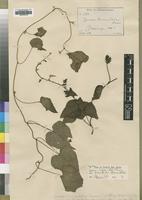
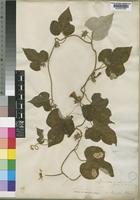
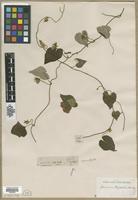
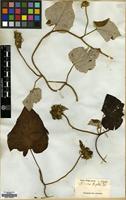
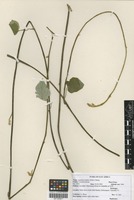
Type of Ipomoea wightii (Dammer) Verdc. var. kilimandschari [family CONVOLVULACEAE]
[family ]
[family ]
[family ]
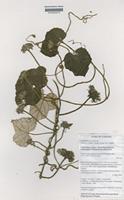
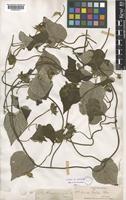
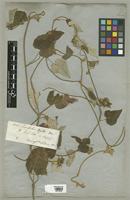
Ipomoea wightii Choisy [family CONVOLVULACEAE]
Filed as Ipomoea wightii (Wall.) Choisy [family CONVOLVULACEAE]
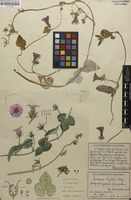
Holotype of Ipomoea wightii (Wall.) Choisy var. kilimandschari (Dammer) Verdc. [family CONVOLVULACEAE]
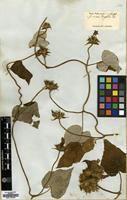
Filed as Convolvulus wightii Wall. [family CONVOLVULACEAE]
[family ]
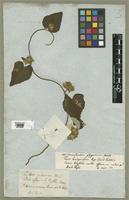
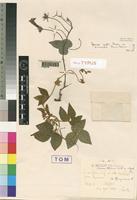
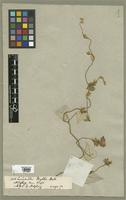
Type? of Convolvulus wightii Wall. [family CONVOLVULACEAE]
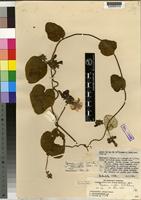
Isotype of Ipomoea wightii (Wall.) Choisy var. obtusisepala [family CONVOLVULACEAE]
Type? of Convolvulus wightii Wall. [family CONVOLVULACEAE]
Filed as Ipomoea wightii (Wall.) Choisy variety wightii [family CONVOLVULACEAE]
[family ]
Previous
Next

Name

Identification
Ipomoea kilimandschari Dammer [family CONVOLVULACEAE ] (stored under name); Ipomoea wightii (Dammer) Verdc. [family CONVOLVULACEAE ] Verified by Verdcourt,B.,
Related name
  • `
  • Ipomoea wightii
  • Ipomoea kilimandschari
  • Convolvulus wightii
  • Ipomoea whyteana
  • Ipomoea arachnoidea

Flora

Entry for Ipomoea wightii [family CONVOLVULACEAE]
Herbarium
South African National Biodiversity Institute, Compton Herbarium, Cape Town (SAM)
Collection
Flora of Southern Africa
Resource Type
Reference Sources
Entry From
Flora of South Africa, (2003) Author: Dr J.P. Roux
Names
Ipomoea wightii [family CONVOLVULACEAE]
Common names
Convolvulus wightii Wall.: 55, t. 171 (1831).
Information
Variable herbaceous perennial. Stems twin­ing or prostrate, pilose with yellowish or brownish hairs, up to 3 m long. Leaves ovate-cordate in outline, 30-130 x 25-120 mm, entire to 3-lobed to ± middle, apex acute to acuminate, basal lobes broadly rounded, sinus deep and narrow, green and strigose above, densely floc-cose-cobwebby tomentose beneath, veins on lower surface conspicuous with yellowish hairs, margin entire to distinctly repand; petiole pilose, up to 90 mm. Inflorescence a dense, head-like pedunculate cyme; peduncle hairy, 30-130 mm long; bracteoles lanceolate, hirsute, 10-12 mm long; pedicels ± wanting. Sepals equal, linear-lanceolate, 8-15 mm long, with 3 kinds of indumentum, white-cottony tomentum, adpressed or spreading yellow bristles and ses­sile or stalked marginal glands (one or more of these kinds may be absent). Corolla funnel-shaped, purple, mauve or magenta, 20-40 mm long and limb as much wide; midpetaline areas well defined, glabrous or sparsely hairy. Capsule subglobose, 8-10 mm long, slightly to densely bristly or with faint white tomentum. Seeds ovoid, dark brown, ± 3 mm long, very shortly pubescent or glabrous. Flowering time throughout the year, mostly January to May.
Habitat
The above description refers to the var. wightii. The var. kilimandschari (Dammer) Verde, and the var. obtusisepala Verde, occur in tropical East Africa. /. wightii is closely related to /. fici-folia (no. 21) and /. dichroa (no. 19), but can be recognised by its dark-edged, glandular bracts and sepals, and also by the fine reticulate pattern of veins on the whitish lower leaf surface.
Use
20. Ipomoea wightii (Wall.) Choisy in Memoires de la Societe de Physique et d'Histoire Naturelle de Geneve 6: 470 (1834); Choisy: 364 (1845); Baker & Rendle: 157 (1905-06); A.Meeuse: 737 (1957a); Verde: 110, fig. 22 (1963a); Gone.: 81 (1987); Gone.: 87 (1992); Lejoly & Lisowski: 49 (1992); Retief & P.P.J.Herman: 386 (1997). Type: India, cultivated at Calcutta from seed from Nilghiri Hills, Wight in Wallich 1406 (K, hole; G).
Range
Occurs in tropical Asia and Madagascar, also from Kenya southwards to the Northern Province, Mpumalanga, KwaZulu-Natal and Eastern Cape. Grows in forest, bushland, grass­land and on river banks, often on sandy soil. Map 50.

Related Materials

  • Terms and Conditions
  • Privacy Policy
  • Cookie Policy
  • Cookie Settings
  • Accessibility
  • Help
  • Contact Us
  • Facebook
  • Twitter
ITHAKA

JSTOR is part of ITHAKA, a not-for-profit organization helping the academic community use digital technologies to preserve the scholarly record and to advance research and teaching in sustainable ways.

©2000-2026 ITHAKA. All Rights Reserved. JSTOR®, the JSTOR logo, JPASS®, Aluka®, and ITHAKA® are registered trademarks of ITHAKA.

╳