JSTOR Global Plants Home
  • Home
  • Browse
  • About
  • Access
  • Account
    • Saved Items
    • Profile
  • Log in

Global Plants

Skip to Main Content
  • JSTOR Global Plants Home
  • Global Plants

    • Browse
    • About
    • Access
    • Account
      • Saved Items
      • Profile
Log in
  • Browse
  • About
  • Access
  • Account
    • Saved Items
    • Profile
Advanced Search

Compilation
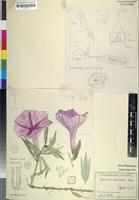
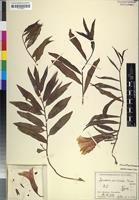
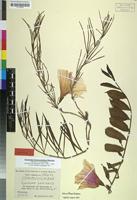
Ipomoea semisecta

3 Images see all

Type of Ipomoea semisecta Merxm. [family CONVOLVULACEAE]
Filed as Ipomoea welwitschii Vatke ex Hallier f. [family CONVOLVULACEAE]
Previous
Next

Name

Identification
Ipomoea semisecta Merxm. [family CONVOLVULACEAE ] Verified by Not on sheet, Ipomoea welwitschii Vatke ex Hallier f. [family CONVOLVULACEAE ] (stored under name); Verified by Not on sheet,
Related name
  • Ipomoea semisecta
  • Ipomoea welwitschii

Flora

Entry for Ipomoea welwitschii Hall.f. [family CONVOLVULACEAE]
Herbarium
Royal Botanic Gardens, Kew (K)
Collection
Flora of Tropical East Africa
Resource Type
Reference Sources
Entry From
Flora of Tropical East Africa, page 1, (1963) Author: B. VERDCOURT (East African Herbarium)
Names
Ipomoea welwitschii Hall.f. [family CONVOLVULACEAE], in E.J. 18 : 146 (1893); Bak. & Rendle in F.T.A. 4 (2) : 174 (1905); T.T.C.L. : 172 (1949); Meeuse in Bothalia 6 : 756 (1958); Verdc. in K.B. 15 : 9 (1961). Type : South West Africa, Damaraland, Okahandja, Höpfner 39 (JE, lecto.)
Ipomoea hystrix Hall.f. [family CONVOLVULACEAE], in E.J. 18 : 146 (1893). Type : Tanganyika, Tabora District, Gonda, Boehm 56 (B, holo. †)
Ipomoea aspericaulis Bak. [family CONVOLVULACEAE], in K.B. 1894 : 70 (1894). Type : Angola, Huila, Welwitsch 6120 (K, holo.!)
Ipomoea welwitschii Britten var. latifolia [family CONVOLVULACEAE], in J.B. 32 : 85 (1894); Bak. & Rendle in F.T.A. 4 (2) : 174 (1905). Type : Angola, Huila, Welwitsch 6120b (BM, holo.!)
Ipomoea semisecta Merxm. [family CONVOLVULACEAE], in Trans. Rhod. Sci. Assoc. 43 : 41 (1951). Type : Southern Rhodesia, Marandellas, Dehn 193a (M, holo., BR, iso.!)
Ipomoea multinervia Verdc. [family CONVOLVULACEAE], in K.B. 13 : 212 (1958). Type : Northern Rhodesia, Nsama to Mporokoso, Bullock 1372 (K, holo.!)
Information
Perennial herb with a woody rootstock or globose tuber as big as a cricket ball; stems stiff, trailing, simple or branched, glabrous or minutely puberulous, 8–45 cm. long. Leaves often erect, glabrous or asperulous; blade linear-lanceolate to oblong, 4.5–12.5(–24) cm. long, 0.3–1.8 cm. wide or rarely more, acute at the apex, cuneate at the base, occasionally incised or trisected; petiole very short. Peduncle axillary, short, 1–3-flowered. Sepals lanceolate, 1–1.4 cm. long, 3.5 mm. wide, acuminate or subacute, glabrous or minutely puberulous. Corolla rose-pink or white with pink or mauve centre, funnel-shaped, 4.8–6 cm. long, ± minutely asperulous above. The plant sometimes flowers profusely when almost leafless.
Range
DISTR. T1, 4, 7, 8
Altitude range
910–1600 m.
Distribution
TANGANYIKA Mpanda District Mlala Hills, Kapapa, 27 Oct. 1959, Richards 11575 ! ;TANGANYIKA Mbeya District Mbosi, 23 Nov. 1935, Horsbrugh Porter !TANGANYIKA Songea District 5 km. E. of Gumbiro, 25 Jan. 1956, Milne-Redhead & Taylor 8528 !
Distribution (external)
; Rhodesia
Nyasaland
Angola
Bechuanaland
South West Africa
the Sudan Republic
Notes
The type of I. welwitschii, which has been examined by Dr. Meeuse, is a wide-leaved specimen. Britten’s varietal name is therefore an absolute synonym of var. welwitschii. Milne-Redhead & Taylor 9054 (Tanganyika, Songea District, near Kitai) has exceptionally long leaves 16.5–24 × 0.8–0.9 cm. I. multinervia Verdc. is only a form with peculiar condensed venation and is deceptively distinctive. Harley 9487 (Tanganyika, Mpanda District, 104 km. S. of Kigoma) is probably an erect form of I. welwitschii which needs further study. It also shows some resemblance to I. vernalis R. E. Fr. and late season stages are needed for eomparison.

Related Materials

  • Terms and Conditions
  • Privacy Policy
  • Cookie Policy
  • Cookie Settings
  • Accessibility
  • Help
  • Contact Us
  • Facebook
  • Twitter
ITHAKA

JSTOR is part of ITHAKA, a not-for-profit organization helping the academic community use digital technologies to preserve the scholarly record and to advance research and teaching in sustainable ways.

©2000-2026 ITHAKA. All Rights Reserved. JSTOR®, the JSTOR logo, JPASS®, Aluka®, and ITHAKA® are registered trademarks of ITHAKA.

╳