

Compilation
Ipomoea kwebensis
1 Images see all
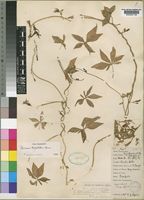
Name
Identification
Ipomoea kwebensis N.E.Br. [family CONVOLVULACEAE ] Ipomoea hochstetteri House [family CONVOLVULACEAE ] (stored under name); Verified by Maria Leonor Gonçalves,
Related name
- Ipomoea kwebensis
- Ipomoea hochstetteri
Flora
Entry for Ipomoea hochstetteri House [family CONVOLVULACEAE]
Herbarium
Royal Botanic Gardens, Kew (K)
Collection
Flora of Tropical East Africa
Resource Type
Reference Sources
Entry From
Flora of Tropical East Africa, page 1, (1963) Author: B. VERDCOURT (East African Herbarium)
Names
Ipomoea hochstetteri House [family CONVOLVULACEAE], in Ann. New York Acad. Sci. 18 : 223 (1908) (sphalm “ hochsteri ”) & in F.R. 8 : 231 (1910); Meeuse in Fl. Pl. Afr. 30, t. 1189 (1955) & in Bothalia 6 : 762 (1958). Type : Ethiopia, without locality, Schimper 321 (G, lecto.!, K, isolecto.!)
Ipomoea quinquefolia Hall.f. [family CONVOLVULACEAE], in E.J. 18 : 147 (1893); Bak. & Rendle in F.T.A. 4 (2) : 177 (1905), non L. nec Griseb. Type : as I. hochstetteri
Ipomoea quinquefolia Hall.f. var. purpurea [family CONVOLVULACEAE], in Bull. Herb. Boiss. 6 : 546 (1898). Types : South West Africa, Amboland, Rautenen 177, 179, 192, 193 (Z, syn.)
Ipomoea quinquefolia Hall.f. var. albiflora [family CONVOLVULACEAE], in Bull. Herb. Boiss. 6 : 546 (1898). Type : as I. hochstetteri
Ipomoea kwebensis N.E. Br. [family CONVOLVULACEAE], in K.B. 1909 : 123 (1909). Types : as I. quinquefolia var. purpurea
Information
Annual; stems glabrous, twining or prostrate, several metres long, with long internodes. Leaf-blade orbicular in outline, palmately divided to the base into 5 lobes, up to 13 cm. long and 12 cm. wide; lobes elliptic, acute at both ends, with the two outer lobes usually deeply or completely redivided, or rarely two lobes on one side divided, 2.5–7 cm. long and 0.7–2.8 cm. wide; petiole smooth or slightly muriculate, up to 9 cm. long; pseudo-stipules present. Peduncle 0.8–9.5 cm. long, thick, smooth or slightly muriculate, 1–several-flowered. Sepals ovate, 5–6.5 mm. long, 3.5–4 mm. wide, acute, mucronulate, with outer ones verruculose, often reflexed in fruit. Corolla white or mauve, funnel-shaped, 1.9–2.4 cm. long, the limb lobed and crinkly. Capsule globose, glabrous, 8 mm. in diameter. Seeds depressed-ovoid,4.5 mm. long, grooved on outer face, brown, black or vermilion, densely silvery-grey tomentose and usually with 5 mm. long cottony hairs on the margins.
Range
DISTR. U1, 2; K1, 4, 6; T2, 5, 7
Altitude range
1050–1650 m.
Distribution
KENYA Nairobi District Njiro, 19 km. E. of Nairobi, 20 June 1951, Bogdan 3078 ! ;KENYA Masai District Athi Plains, Mbagathi, Aug. 1934, Napier 3384 in C.M. 6650! & Game Reserve near Mbagathi Station, June 1934, Napier 3384 in C.M. 6241!TANGANYIKA Masai District Olduvai, Aug. 1957, Hyde 47 ! ;TANGANYIKA Singida District Iramba Plateau, Wembere area, May 1959, Hammond 251 ! ;TANGANYIKA Mbeya District Rujewa, 12 Sept. 1957, Anderson 1171 !UGANDA Karamoja District Kangole, 22 May 1940, A. S. Thomas 3442! & July 1957, Wilson 374 ! & Naduget, July 1954, Wilson 129b !
Distribution (external)
; Ethiopia
Mozambique
northern Transvaal
Natal
South West Africa
also India (fide Meeuse)
Notes
There is a distinctive form of this species, not uncommon between Nairobi and Magadi, which has bright vermilion seeds. I have not encountered it from any other locality so it may be a genuine local race. It is probably best to refer to this as “ red-seeded form ” rather than to give it a Latin name. Bally 5114 is an example.