JSTOR Global Plants Home
  • Home
  • Browse
  • About
  • Access
  • Account
    • Saved Items
    • Profile
  • Log in

Global Plants

Skip to Main Content
  • JSTOR Global Plants Home
  • Global Plants

    • Browse
    • About
    • Access
    • Account
      • Saved Items
      • Profile
Log in
  • Browse
  • About
  • Access
  • Account
    • Saved Items
    • Profile
Advanced Search

Compilation
Inula subscaposa

3 Images see all

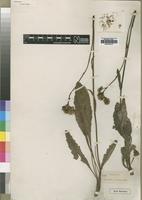
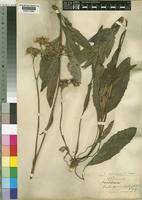
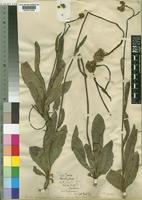
Type of Inula subscaposa S.Moore [family ASTERACEAE]
Inula subscaposa S.Moore [family COMPOSITAE]
Previous
Next

Name

Identification
Inula subscaposa S.Moore [family ASTERACEAE ] (stored under name);
Related name
  • Inula unrecorded
  • Inula subscaposa
  • Inula paniculata
  • Vernonia unrecorded

Flora

Entry for INULA subscaposa S. Moore [family COMPOSITAE]
Herbarium
Royal Botanic Gardens, Kew (K)
Collection
Flora of Tropical East Africa
Resource Type
Reference Sources
Entry From
Flora of Tropical East Africa, page 315, (2002) Author: H.J. BEENTJE
Names
INULA subscaposa S. Moore [family COMPOSITAE], in J.L.S. 35: 341 (1902); C.D. Adams in F.W.T.A. ed. 2, 2: 259 (1963). Syntypes: Malawi, Mt Zomba, Buchanan 148 (BM, E, K!, syn.) & Buchanan 1477 (BM, K!, syn.)
Information
Herb, with basal rosette and a single flowering stem 0.3–1 m high; stem unbranched except for inflorescence, sparsely pilose with tubercle-based hairs. Basal leaves suberect, petiolate or nearly so, the petiole up to 13 cm long, blade narrowly elliptic or narrowly obovate, 6–30 cm long, 2.5–6 cm wide, base attenuate, margins sinuate and broad-dentate with callose tips, apex obtuse or acute, sparsely pilose beneath and with impressed glands, similar above but more scabridulous; cauline leaves absent or very few, the ones close to the base similar to the basal leaves but sessile with semi-amplexicaul base, the distal ones much smaller and very narrow. Capitula 8–16 mm long, heterogamous, several in fairly lax corymbs; stalks of individual capitula 1–10 mm long; phyllaries pale green, narrowly triangular, 4–9 mm long, acute, pubescent. Ray florets yellow, in a single row, tube filiform, 1.5–2.5 mm long, limb 5–8.5 mm long, 1.5–2 mm wide, 2–3-toothed, style 5–5.7 mm long; disc florets yellow, tube narrowly infundibuliform from a widened base, 4–4.5 mm long, lobes 0.7–0.9 mm long and slightly pilose; anthers brown, 1.8–2.6 mm long and eventually almost completely exserted, style 5–5.4 mm long. Achenes cylindric, 1.7–2 mm long, sparsely pilose; pappus whitish, 4–5 mm long. 
Range
DISTR. T 4, 7, 8
Altitude range
950–1850 m
Distribution
TANZANIA Ufipa District Kotola Hills, 28 km W of Matai, Oct. 1992, Gereau et al. 4889!;TANZANIA Iringa District Ngwazi swamp, Dec. 1986, Lovett 1194!;TANZANIA Songea District 12 km E of Songea, Dec. 1955, Milne-Redhead & Taylor 7764!
Distribution (external)
; Malawi
Notes
This species has been put into the synonymy of I. paniculata by Wild and Lisowski, but both syntypes possess ray florets, which I. paniculata lacks.

Related Materials

  • Terms and Conditions
  • Privacy Policy
  • Cookie Policy
  • Cookie Settings
  • Accessibility
  • Help
  • Contact Us
  • Facebook
  • Twitter
ITHAKA

JSTOR is part of ITHAKA, a not-for-profit organization helping the academic community use digital technologies to preserve the scholarly record and to advance research and teaching in sustainable ways.

©2000-2026 ITHAKA. All Rights Reserved. JSTOR®, the JSTOR logo, JPASS®, Aluka®, and ITHAKA® are registered trademarks of ITHAKA.

╳