JSTOR Global Plants Home
  • Home
  • Browse
  • About
  • Access
  • Account
    • Saved Items
    • Profile
  • Log in

Global Plants

Skip to Main Content
  • JSTOR Global Plants Home
  • Global Plants

    • Browse
    • About
    • Access
    • Account
      • Saved Items
      • Profile
Log in
  • Browse
  • About
  • Access
  • Account
    • Saved Items
    • Profile
Advanced Search

Compilation
Inula graminifolia

5 Images see all

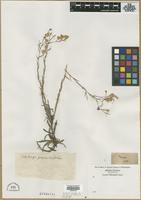
Filed as Inula sp. [family ASTERACEAE]
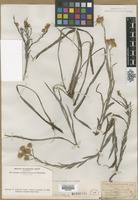
Filed as Inula graminifolia Michx. [family ASTERACEAE]
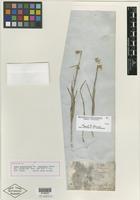
Holotype of Inula graminifolia var. tenuifolia Torr. [family ASTERACEAE]
Filed as Inula graminifolia Michx. [family ASTERACEAE]
Previous
Next

Name

Identification
Inula graminifolia Not on sheet [family ASTERACEAE ] (stored under name); Verified by Not on sheet,
Related name
  • Inula graminifolia
Common name
  • Grass-leaved goldenaster, Flora of North America Vol. 20

Flora

Entry for Pityopsis graminifolia (Michaux) Nuttall [family COMPOSITAE]
Herbarium
Flora of North America (FNA)
Collection
Flora of North America
Resource Type
Reference Sources
Entry From
Flora of North America, Vol 20,
Names
Pityopsis graminifolia (Michaux) Nuttall [family COMPOSITAE], Trans. Amer. Philos. Soc., n. s., 7: 318. 1840
Inula graminifolia Michaux [family COMPOSITAE], Fl. Bor.-Amer., 2: 122. 1803
Chrysopsis graminifolia (Michaux) Elliott [family COMPOSITAE]
Heterotheca graminifolia (Michaux) Shinners [family COMPOSITAE]
Treatment Author(s)
John C. Semple
Information
Perennials, 20–80 cm; rhizomes 3–20 cm. Stems 1–5+, erect, green to brown beneath hairs, simple, silvery-sericeous (hairs irregularly anastomosing-cohering). Leaves: basal sessile, blades linear to lanceolate, grasslike, longer or shorter than cauline, 80–250(–400) × 2–20 mm, faces densely silvery-sericeous (hairs irregularly anastomosing-cohering); cauline 20–60, sometimes crowded, spreading to ascending, linear or lanceolate to ovate, usually reduced distally, apices acute, faces silvery-sericeous; distalmost sometimes greatly reduced. Heads (2–)10–100+, in corymbiform to sometimes paniculiform arrays. Peduncles 1–10 cm, sericeous; bracts and bracteoles 3–20, appressed, often grading into phyllaries. Involucres turbino-campanulate, 5–13 mm (usually shorter than pappi). Phyllaries in 4–6 series, margins fimbriate, piloso-ciliate, faces sparsely to moderately pilose (hairs often twisted), often more densely so distally, sometimes stipitate-glandular. Ray florets 9–13; laminae 4–14 mm. Disc florets 15–50; corollas 4–9 mm, limb bases glabrate to sparsely pilose or rarely limbs moderately long-pilose; lobes 0.5–0.8 mm, glabrous to sparsely pilose. Cypselae fusiform, 2.5–4.5 mm, strigose; pappi: outer scales 0.4–0.9 mm, inner 25–45 bristles 5–9 mm.
Distribution
cse United Statesse MexicoBahamasCentral America (Belize).Central America (Guatemala).Central America (Honduras).
Discussion
The varieties can be difficult to distinguish in this highly variable species. The infraspecific classification presented by J. C. Semple and F. D. Bowers (1985) is followed here. Involucre height increases somewhat with age, making assignment of post flowering specimens of var. tenuifolia (diploid), var. latifolia (tetraploid), and var. tracyi (hexaploid) more difficult. Data on the distribution of diploids, tetraploids, and hexaploids (Semple and Bowers 1987; subsequent reports) indicate that only diploids occur west of the Mississippi River, while only tetraploids are known in the more northern parts of the range (n Alabama, Tennessee, North Carolina, Virginia). All three ploidy levels occur in Florida, where the three varieties are most distinct. Ploidy level correlates with involucre height in the limited sample of cytovouchers. Additional study is needed to sort out more fully biogeographic patterns of variation in the tenuifolia-latifolia-tracyi complex of Pityopsis graminifolia. An alternative treatment would be to combine all three in a single variety including a polyploid series, under the name var. tenuifolia.

Related Materials

  • Terms and Conditions
  • Privacy Policy
  • Cookie Policy
  • Cookie Settings
  • Accessibility
  • Help
  • Contact Us
  • Facebook
  • Twitter
ITHAKA

JSTOR is part of ITHAKA, a not-for-profit organization helping the academic community use digital technologies to preserve the scholarly record and to advance research and teaching in sustainable ways.

©2000-2026 ITHAKA. All Rights Reserved. JSTOR®, the JSTOR logo, JPASS®, Aluka®, and ITHAKA® are registered trademarks of ITHAKA.

╳