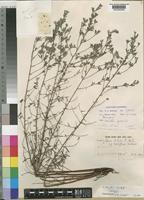
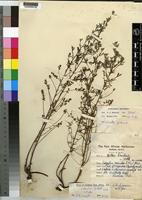
Isotype of Indigofera smutsiiGillett [family LEGUMINOSAE ] (stored under name); Verified by Not on sheet,
Related name
Indigofera hilaris
Indigofera smutsii
Flora
Entry for INDIGOFERA smutsii Gillett [family LEGUMINOSAE-PAPILIONOIDEAE]
Herbarium
Royal Botanic Gardens, Kew (K)
Collection
Flora of Tropical East Africa
Resource Type
Reference Sources
Entry From
Flora of Tropical East Africa, page 1, (1971) Author: J. B. GILLETT, R. M. POLHILL & B. VERDCOURT
Names
INDIGOFERA smutsiiGillett [family LEGUMINOSAE-PAPILIONOIDEAE], in K.B. 24: 478 (1970). Type: Zambia, Kasama District, Mungwi, Robinson 3845 (K, holo. !)
Information
Resembles I. hilaris, but the stems are more stiffly erect and up to 60 cm. tall, the leaflets 3 or rarely 5 instead of 3–7, the flowers smaller with stamens 3–5 mm. long and the flowers and fruits spreading rather than erect.
Range
DISTR. T7 NE. Zambia
Altitude range
1200–1300 m.
Distribution
TANGANYIKA Chunya District about 256 km. from Itigi on road to Chunya, 6 Nov. 1960, Richards 13516 ! & Lupa Forest Reserve, 152 km. N. of Mbeya on Itigi road, 5 Sept. 1962, Boaler 667 !
Notes
VARIATION. Both specimens from Tanganyika have a copious indumentum of multicellular hairs and stamens 4–5 mm. long. The type lacks multicellular hairs and has stamens 3 mm. long. Intermediates are found in the Mbala [Abercorn] District of Zambia.