JSTOR Global Plants Home
  • Home
  • Browse
  • About
  • Access
  • Account
    • Saved Items
    • Profile
  • Log in

Global Plants

Skip to Main Content
  • JSTOR Global Plants Home
  • Global Plants

    • Browse
    • About
    • Access
    • Account
      • Saved Items
      • Profile
Log in
  • Browse
  • About
  • Access
  • Account
    • Saved Items
    • Profile
Advanced Search

Compilation
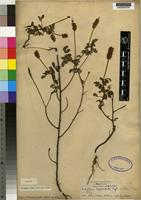
Indigofera longibarbata

9 Images see all

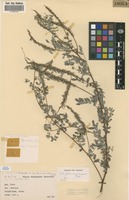
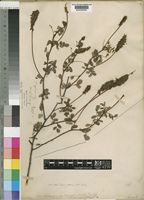
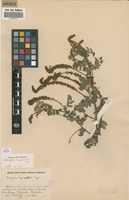
Filed as Indigofera longibarbata Engl. [family FABACEAE]
Indigofera longibarbata Engl. [family LEGUMINOSAE-PAPILIONOIDEAE]
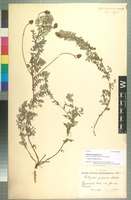
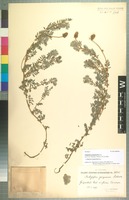
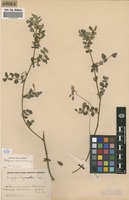
Syntype of Indigofera griquana Schltr. [family FABACEAE]
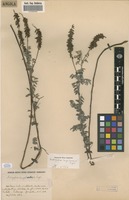
Filed as Indigofera longibarbata Engl. [family FABACEAE]
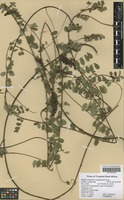
Isotype of Indigofera longibarbata Engl. [family LEGUMINOSAE]
Previous
Next

Name

Identification
Isotype of Indigofera longibarbata Engl. [family LEGUMINOSAE ] (stored under name); Verified by Not on sheet,
Related name
  • Indigofera griquana
  • Indigofera longibarbata
  • Indigofera hirsuta

Flora

Entry for INDIGOFERA longibarbata Engl. [family LEGUMINOSAE-PAPILIONOIDEAE]
Herbarium
Royal Botanic Gardens, Kew (K)
Collection
Flora of Tropical East Africa
Resource Type
Reference Sources
Entry From
Flora of Tropical East Africa, page 1, (1971) Author: J. B. GILLETT, R. M. POLHILL & B. VERDCOURT
Names
INDIGOFERA longibarbata Engl. [family LEGUMINOSAE-PAPILIONOIDEAE], Hochgebirgsfl. Trop. Afr.: 257 (1892); Cronquist in F.C.B. 5: 141 (1954); Gillett in F.W.T.A., ed. 2, 1: 541 (1958) & in K.B., Add. Ser. 1: 109 (1958); Torre in C.F.A. 3: 126 (1962). Type: N. Ethiopia, Debra Tabor, 1863, Schimper 1389 (B, holo. †, K, iso.!)
INDIGOFERA hirsuta Bak. var. polystachya [family LEGUMINOSAE-PAPILIONOIDEAE], in F.T.A. 2: 89 (1871); F.P.N.A. 1: 303 (1948). Types: Angola, Cuanza Norte, Pungo Andongo, Lombe–Quibinda, Welwitsch 2056 (LISU, SYN., K, isoSYN.!) & Huila, Ivantala, Welwitsch 2065 (LISU, SYN.)
Information
Slightly woody annual up to 1.3 m. tall; stems reddish, slightly ridged, stiffly pilose. Stipules linear, up to 8 mm. long; rhachis brown pilose, up to 5 cm. long, including a petiole of 2–6 mm., prolonged by 4–7 mm. beyond the lateral leaflets; stipellae not visible; petiolules ± 1.5 mm. long; leaflets 9–13, oblong-elliptic, apiculate, up to 20 mm. long and 10 mm. wide, softly white pilose on both surfaces. Racemes stiffly dark brown pilose, very densely many-flowered, up to 25 cm. long, including the peduncle which is usually longer than the floriferous part; bracts linear-lanceolate, up to 8 mm. long; pedicels under 1 mm. long, strongly reflexed in fruit. Calyx stiffly brown-black pilose, ± 5 mm. long, divided almost to the base into setaceous lobes. Corolla white pubescent outside. Stamens ± 5 mm. long. Pods up to 8 mm. long, ± 1.8 mm. wide and 2 mm. thick, stiffly black pilose, ± 3-seeded; endocarp dark, not spotted.
Range
DISTR. U2; K3–5; T2, 4, 6–8 eastern South Africa
Altitude range
1300–2550 m.
Distribution
KENYA Trans-Nzoia District Kitale, 12 July 1952, Bogdan 3496 !KENYA Machakos District Chyulu Hills, N. end, 21 Apr. 1938, Bally in C.M. 8197!KENYA S. Kavirondo District Kisii area, Sept. 1933, Napier 2851 !TANGANYIKA Moshi District Useri, May 1927, Haarer 677 !TANGANYIKA Buha District Kasulu, Heru Chini, 12 Mar. 1931, Rounce 21!TANGANYIKA Mbeya District Usafwa, 23 Mar. 1932, R. M. Davies 130 !UGANDA Toro District Ibonde Pass, 1 Oct. 1932, A. S. Thomas 771 !UGANDA Ankole District Butale, 27 Apr. 1946, A. S. Thomas 4470!UGANDA Kigezi District Kachwekano farm, June 1951, Purseglove 3658 !
Distribution (external)
; Nigeria
Cameroun
Congo
Ethiopia
Mozambique
Malawi
Zambia
Angola

Related Materials

  • Terms and Conditions
  • Privacy Policy
  • Cookie Policy
  • Cookie Settings
  • Accessibility
  • Help
  • Contact Us
  • Facebook
  • Twitter
ITHAKA

JSTOR is part of ITHAKA, a not-for-profit organization helping the academic community use digital technologies to preserve the scholarly record and to advance research and teaching in sustainable ways.

©2000-2026 ITHAKA. All Rights Reserved. JSTOR®, the JSTOR logo, JPASS®, Aluka®, and ITHAKA® are registered trademarks of ITHAKA.

╳