JSTOR Global Plants Home
  • Home
  • Browse
  • About
  • Access
  • Account
    • Saved Items
    • Profile
  • Log in

Global Plants

Skip to Main Content
  • JSTOR Global Plants Home
  • Global Plants

    • Browse
    • About
    • Access
    • Account
      • Saved Items
      • Profile
Log in
  • Browse
  • About
  • Access
  • Account
    • Saved Items
    • Profile
Advanced Search

Compilation
Indigofera basiflora

1 Images see all

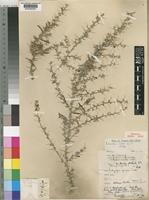
Holotype of Indigofera basiflora J.B.Gillett [family LEGUMINOSAE-PAPILIONOIDEAE]
Previous
Next

Name

Identification
Indigofera basiflora J.B.Gillett [family LEGUMINOSAE-PAPILIONOIDEAE ] (stored under name); Verified by Gillett, J.B., Indigofera spinosa Forssk. [family LEGUMINOSAE-PAPILIONOIDEAE ]
Related name
  • Indigofera spinosa
  • Indigofera basiflora

Flora

Entry for INDIGOFERA basiflora Gillett [family LEGUMINOSAE-PAPILIONOIDEAE]
Herbarium
Royal Botanic Gardens, Kew (K)
Collection
Flora of Tropical East Africa
Resource Type
Reference Sources
Entry From
Flora of Tropical East Africa, page 1, (1971) Author: J. B. GILLETT, R. M. POLHILL & B. VERDCOURT
Names
INDIGOFERA basiflora Gillett [family LEGUMINOSAE-PAPILIONOIDEAE], in K.B., Add. Ser. 1: 51 (1958). Type: Tanganyika, Arusha District, Ol Donyo Sambu, St. Clair-Thompson 270 (K, holo.!)
Information
A shrublet up to 70 cm. tall, differing from I. spinosa in the characters shown in the key, in the inflorescence-spines not exceeding 15 mm. in length, in the less silvery branches and the somewhat stouter pods (2.2 mm. wide and 2.0 mm. thick). Leaves 3-foliolate or rarely 1-foliolate. Seeds orange-yellow, oblong or ellipsoid, ± 2 by 1.3 mm. Fig. 40/14, 15, p. 254.
Range
DISTR. T1–3 not known elsewhere
Altitude range
450–1900 m.
Distribution
TANGANYIKA Maswa District SW. of Naabi Hill, 3 Apr. 1958, Paulo 418!TANGANYIKA Moshi District Engare Nairobi, 13 Nov. 1930, Sanders 5 !TANGANYIKA Pare/Lushoto District Hedaru–Mkomazi, 13 June 1915, Peter 49293 !
Notes
This unpalatable species, which has been confused with I. spinosa, seems to be increasing, probably as a result of intensified grazing. None of the collectors, who before 1915 traversed the area where it is now common, seems to have collected it.

Related Materials

  • Terms and Conditions
  • Privacy Policy
  • Cookie Policy
  • Cookie Settings
  • Accessibility
  • Help
  • Contact Us
  • Facebook
  • Twitter
ITHAKA

JSTOR is part of ITHAKA, a not-for-profit organization helping the academic community use digital technologies to preserve the scholarly record and to advance research and teaching in sustainable ways.

©2000-2026 ITHAKA. All Rights Reserved. JSTOR®, the JSTOR logo, JPASS®, Aluka®, and ITHAKA® are registered trademarks of ITHAKA.

╳