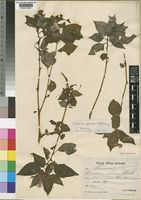
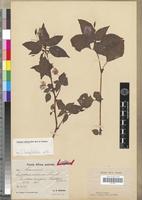
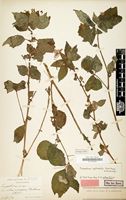
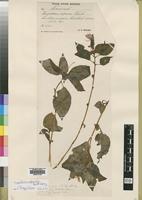
Low scrambling or upright (perennial?) herb; stems succulent, pinkish or green, often rooting at the nodes, glabrous or sparsely pilose (mainly when young). Leaves spirally arranged, petiolate; lamina 2–7 × 1·8–4·5 cm., ovate to ovate-lanceolate, membranous, pilose on both surfaces (mainly on the nerves) or glabrescent or rarely quite glabrous, dark green on the upper surface, bright green or greyish-green on the lower one, apex acute or subobtuse, margin crenate or crenate-denticulate to serrate, base usually broadly cuneate, rarely ± rounded; secondary nerves 5–8 pairs, prominent beneath; petiole 0·8–3·2 cm. long, canaliculate, sometimes densely but usually sparsely pilose or often glabrous. Flowers axillary, usually solitary, rarely in fascicles of 2 or 3 (but then usually only one developed at a time), pinkish-purple or pink with deep red blotches at the base of the lateral petals; bracts very small, lanceolate-triangular, acute, usually pilose; pedicels 1·5–3 (3·5) cm. long, very slender, usually pilose (sometimes densely so), rarely glabrous. Lateral sepals 4–6·5 × 0·9–1·25 mm., lanceolate-triangular, acute, ± densely pilose, with longer hairs along the margins; posterior sepal 9–11 (13) mm. long, 3–4 mm. deep, shallowly and obliquely navicular, abruptly constricted into the spur, distally subcaudate, pilose (especially along the keel-line); spur 11–15 (18) mm. long (or even somewhat longer), rather slender, tapering into a bluntish point, rarely with the end slightly thickened, always ± incurved. Anterior petal 7–11 × 8–13 mm. (when flattened), broadly ovate to transversely elliptic (when flattened), dorsally narrowly cristate, with the apex usually apiculate but sometimes slightly emarginate and with long hairs along the crest and denser towards the base, otherwise shortly hispid; lateral united petals 8–14 mm. long, deeply 2-lobed, usually shortly hispid outside; anterior lobe 8–10 mm. long, 5·25–7 mm. high, obliquely obovate, distally rounded or subtruncate and produced into a short ligulate appendage (1–2 × c. 1 mm.) at the lower margin; posterior lobe nearly equal in size, broadly oblique-obovate, with the apex rounded or obliquely truncate, entire or sometimes irregularly retuse. Ovary ± densely pilose. Capsule up to 1·5 cm. long, fusiform, pilose or glabrescent. Seeds numerous, not seen in a mature state (c. 1·4 × 0·9 mm. ?), dark brown, glabrous (the surface smooth?).