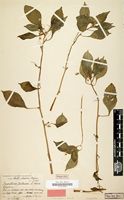
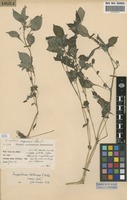
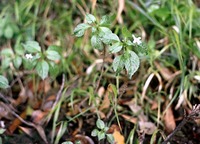
Erect or straggling perennial (always?) herb; stems 20–60 (75) cm. high, usually glabrous. Leaves spirally arranged, petiolate; lamina (3) 4–8·5 (11) × (2) 2·5–4 (5) cm., ovate-lanceolate to narrowly elliptic or elliptic-lanceolate, membranous, sparsely pilose on both surfaces or glabrous; secondary nerves 8 (10) pairs, some what prominent beneath, apex subacute or rarely obtuse, usually acuminate, margin crenulate-denticulate (the teeth usually in the sinuses), base cuneate; petiole (1) 1·5–4 (5) cm. long, rather slender, pilose or glabrous. Flowers axillary, solitary or in few-flowered clusters, usually very pale pink, white on the back with two spots at the base of the posterior sepal; bracts very small, lanceolate-triangular or subulate, acute; pedicels 2–3·5 (4·5) cm. long, very slender, usually glabrous. Lateral sepals 2–3 (4) × 0·75–1·5 (1·75) mm., lanceolate to triangular, acute, usually glabrous; posterior sepal (4) 5–6 (7) mm. long, shallowly navicular, abruptly constricted into the spur, distally subcaudate, glabrous or very sparsely pilose; spur (8) 10–18 (25) mm. long, slightly incurved, rather slender, subconical, tapering into a subacute or sometimes slightly thickened end, usually glabrous, rarely sparsely pilose. Anterior petal 5–7·5 mm. high, 4·5–8 mm. broad when flattened, with a distinct dorsal crest, apically apiculate; lateral united petals 10–17 mm. long, 2-lobed but the lobes very dissimilar in shape and size; anterior lobe variable in shape and size, 8–13 mm. long (at the base) and 6–10 mm. high, broadly transverse-elliptic, broadly obovate to subcircular, distally prolonged at the very base into a ligulate appendage 2–7 × 1–2 (3) mm.; posterior lobe reduced to a small auricle not exceeding 2 × 2 mm. (see t. 26 fig. 19). Ovary glabrous or rarely scattered-hispid. Capsule 6–13 mm. long, fusiform, glabrous or scattered-hispid. Seeds numerous.