JSTOR Global Plants Home
  • Home
  • Browse
  • About
  • Access
  • Account
    • Saved Items
    • Profile
  • Log in

Global Plants

Skip to Main Content
  • JSTOR Global Plants Home
  • Global Plants

    • Browse
    • About
    • Access
    • Account
      • Saved Items
      • Profile
Log in
  • Browse
  • About
  • Access
  • Account
    • Saved Items
    • Profile
Advanced Search

Compilation
Ilysanthes saxatilis

6 Images see all

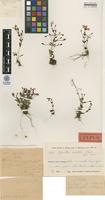
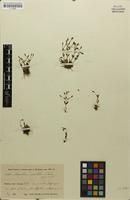
Holotype of Ilysanthes saxatilis Norl. [family SCROPHULARIACEAE]
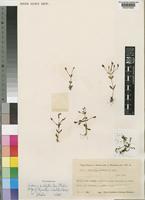
Isotype of Ilysanthes saxatilis Norl. [family SCROPHULARIACEAE]
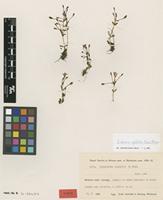
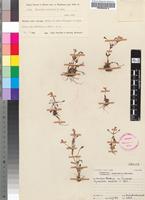
Isotype of Ilysanthes saxatilis Norl. [family LINDERNIACEAE]
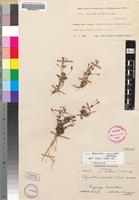
Isotype of Ilysanthes saxatilis Norl. [family SCROPHULARIACEAE]
Previous
Next

Name

Identification
Isotype of Ilysanthes saxatilis Norl. [family SCROPHULARIACEAE ] Verified by Philcox, D., Lindernia pulchella (Skan) Philcox [family SCROPHULARIACEAE ] (stored under name); Verified by Philcox, D.,
Related name
  • Lindernia pulchella
  • Ilysanthes saxatilis

Flora

Entry for Lindernia pulchella Skan Philcox [family SCROPHULARIACEAE]
Herbarium
Royal Botanic Gardens, Kew (K)
Collection
Flora Zambesiaca
Resource Type
Reference Sources
Entry From
FZ, Vol 8, Part 2, (1990) Author: D. Philcox
Names
Lindernia pulchella Skan Philcox [family SCROPHULARIACEAE], in Bol. Soc. Brot., sér. 2, 60: 268 (1987). Type: Malawi, Zomba Plateau, 1500–1800 m., Whyte s.n. (K, holotype).
Ilysanthes pulchella Skan [family SCROPHULARIACEAE], in F.T.A. 4, 2: 348 (1906). Type as above.
Ilysanthes purpurascens Hutch. [family SCROPHULARIACEAE], Botanist in S. Afr.: 461 (1946). Type: Zimbabwe, near Runde (Lundi) R., 30.vi.1930, Hutchinson & Gillett 3269 (K, holotype; BM, isotype).
Ilysanthes saxatilis Norlindh [family SCROPHULARIACEAE], in Bot. Not. 1951: 115, figs. 4d-e (1951). Type: Zimbabwe, Nyanga (Inyanga) Distr., Mt. Inyangani, c. 2400 m., fl. & fr. 14.ii.1931, Norlindh & Weimarck 4969 (LD, holotype [n.v.]; K, isotype).
Ilysanthes pulchella subsp. rhodesiana Norlindh [family SCROPHULARIACEAE], in Bot. Not. 1951:113, figs. 4 f & h (1951). Type: Zimbabwe, near Nyanga (Inyanga) village, c. 1700 m., xii.1930, Fries, Norlindh & Weimarck 3255 (LD, holotype; K, syntype (fruiting 3255b)).
Information
Erect or procumbent annual or perennial, 4–8(18) cm. tall, branched from or towards base; stems quadrangular, variously covered with short, patent to somewhat retrorse, stiff white hairs. Leaves sessile or lower shortly petiolate, 5–10(14) x 1.5–2(4) mm. opposite, elliptic-oblong, obtuse, entire to sparsely crenate or crenate-dentate, glabrous to somewhat densely, short white hispid, especially beneath. Petioles, where present, up to 4 mm. long. Flowers solitary axillary, pedicellate. Pedicels 8–20 mm. long, slender. Calyx 4–5.5 mm. long, subglabrous to minutely pubescent; lobes 0.75–1.5 mm. long, ovate to ovate-elliptic, obtuse, glabrous on margin or shortly ciliate, unequal to subequal. Corolla blue to blue-mauve or violet, pink or white, 8–10(14) mm. long; upper lip deeply bifid, lower lip trilobed, lobes rounded, wavy-margined, ciliate. Stamens two, fertile, filaments 0.5–1(1.5) mm. long, anthers 1–1.5 mm. long; staminodes two, up to 1.75 mm. long, somewhat recurved, slightly clavate, geniculate above base but appearing gibbous due to tissue forming web in angle of geniculation, tissue produced laterally forming short, slender or blunt projection 0.1–0.35 mm. long, antero-lateral ridge barely evident. Capsule 5–6.5(9) x 1.5–2 mm., cylindric-ellipsoid, acute.
Habitat
On damp rocks and wet, shallow sandy soils
Altitude range
up to 2400 m.
2400
0
inferred only top
Distribution
Zimbabwe S Masvingo Distr., fl. 1909–1912, Monro 1518 (BM).Mozambique MS Beira, Corner s.n. in 1961 or 1962 (K).Zimbabwe E Nyanga (Inyanga) Distr., Troutbeck, World’s View, 2400 m., fl. & fr. 15.i.1959, Lennon 83 (K).Zimbabwe C Harare Distr., 1525 m., fl. & fr. ii.1920, Eyles 2049 (K).Zimbabwe W Matobo Distr., fl. 4.i.1948, West 2556 (K; SRGH).Mozambique Z Alto Molócuè, c. 13 km. on road to Gile, c. 500 m., fl. & fr. 1.xii.1967, Torre & Correia 16306 (LISC).Malawi N Zomba Plateau, near Chingwe’s Hole, 1900 m., fl. & fr. 27.ii.1977, Grosvenor & Renz 982 (K; SRGH).Zimbabwe N Mutoko Distr., Mudzi Dam, 1220 m., fl. & fr. 16.ii.1962, Wild 5670 (K).Zambia C Mkushi Distr., Fiwila, 1400 m., fl. & fr. 3.i.1958, Robinson 2582 (K).
Distribution (external)
Ethiopia
East Africa
Angola
S. Africa (Transvaal)
Notes
Norlindh (Bot. Not. 1951: 113 (1951)) isolated his subsp. rhodesiana by reason of its densely hispid leaves and narrower and more acute calyx lobes. Here I dismiss these characters as they are encompassed by my general specific description, they being common throughout the range of material I have studied. He also described Ilysanthes saxatilis (ibid. p. 115) as distinct from I.pulchella by reason of the shorter and more obtuse calyx lobes and the glabrous, foveolate seeds. The character of the calyx differences occur within the range of the original material and description and in the case of both seed shape and indumentum, this appears to vary within the collections I have studied dependent on the maturity of the seeds. I have chosen to include both of these in synonymy under L. pulchella.Hutchinson (1946) described Ilysanthes purpurascens as distinct by reason of the overall indumentum of short, retrorse hairs. The holotype of this name, Hutchinson & Gillett 3269 (K), shows this indumentum to be of short, white hairs which appear as a mixture of patent or somewhat retrorse individuals occurring densely except on the upper surface of the leaves. These hairs appear to match those on the lower parts of the stem of the hototype of Ilysanthes pulchella Skan (K) both in density and direction, and in all other characters and measurements both original descriptions and specimens compare. On dissection, flowers from both are found to have two fertile stamens and two staminodes, the latter matching in having similar swellings appearing gibbous, with a web of tissue in the geniculation being produced into a long or short proboscis-like appendage. I can see no reason to keep them separate and include Hutchinson’s plant in synonymy here.

Related Materials

  • Terms and Conditions
  • Privacy Policy
  • Cookie Policy
  • Cookie Settings
  • Accessibility
  • Help
  • Contact Us
  • Facebook
  • Twitter
ITHAKA

JSTOR is part of ITHAKA, a not-for-profit organization helping the academic community use digital technologies to preserve the scholarly record and to advance research and teaching in sustainable ways.

©2000-2026 ITHAKA. All Rights Reserved. JSTOR®, the JSTOR logo, JPASS®, Aluka®, and ITHAKA® are registered trademarks of ITHAKA.

╳